The Fed reducing their balance and raising rates should have kicked off the bear market this year, were it not for some serious fiscal stimulus, most of it geared to help corporate profits. Low tax cash repatriation was the first wave of money that corporations were given. This was promptly used to buy back stock. The next wave, which will last for a while, is the lower corporate taxes, which gives corporations more capital for guess what? Stock buybacks, and the occasional PR savvy one time $1000 bonuses to all workers. There is a big difference between a $1000 bonus and a permanent wage increase, which most companies are loathe to do, and really don't have to. When you have an oligopoly, like most US multinationals do at the moment, there is no wage pressure. It is take it or leave it for the worker. They usually don't have anywhere else to go. And although they say the labor market is tight, its only because the wages haven't gone up and the labor force isn't growing. Workers have very little pricing power, unions are weak or nonexistent, and there aren't many competitors that workers can switch to.
An oligopoly not only gives you pricing power on goods, it also gives you pricing power on labor. With the relentless trend towards mergers and acquisitions, and reduced competition, companies are enjoying the benefits of increased pricing power, which obviously leads to increases profit margins.
Rent seeking is the ideal corporate business model, because there is no need to spend money on R&D, you can just raise prices and reap the benefits. And competitors don't show up because these corporations now spend more money on lobbyists and campaign financing, to ensure the moats around their oligopolies, to increase the barriers to entry via specific, pinpoint government regulation, demanded by the corporate lobbyists. The US Government has now become ensnared in an arm of the corporate "vampire squid", which provide the financing to politicians, who need the money to get elected, and thus compensate the corporations with favorable rules and regulations.
This trend towards corporate welfare will not be easy to break. It has been happening since the 1980s, under both Republicans and Democrats. Populism will only help the corporations even more, in a roundabout manner. Because populism requests handouts, and handouts mean bigger budget deficits, which eventually leads to a weaker dollar, due to the eventual requirement of low interest rates Fed intervention and QE to suck up all that debt issuance. And a weaker dollar hurts the consumer, and helps the corporations.
The current financial situation is not a stable equilibrium. Only through the sheer force of the fiscal stimulus (both tax cuts and big budget increases) has the market been able to overcome Fed tightening. This gives the market a false sense of confidence, and attitude of invincibility. The money noose is getting tighter and tighter, and the fiscal stimulus is now reflected in corporate profit estimates.
Looking at the consumer confidence numbers, they usually peak with the economic cycle, and it is looking like late 1999/early 2000, both from an economic data and financial markets perspective. The SPX and bond yields should top out later this year, probably around December, after the flood of stock buybacks get to work.
We have a little weakness the past few days based on the rapid rise in rates, but that usually doesn't last. The stock market can only fall hard on its own weight, not from external factors. Give it a couple more months and it will be bull hunting season.
There is no need to short in the hole and sell after a pullback. There will be plenty of rallies to sell into later this year. For very aggressive traders, a deeper pullback towards 2800-2820 would be a buy opportunity to sell later into a November rally.
Monday, October 8, 2018

Friday, October 5, 2018
A Different Bond Bear Market
This is not your 2013 bond bear market. Or the 2006 bear market. You have to go back to late 1999/early 2000 bear market to get anywhere close to this kind of protracted selloff in bonds. Ironically, the turtle like pace at which the Fed has chosen for this rate hike cycle has only lengthened the bearish phase. And according to Eurodollar futures, the Fed is priced to hike at least 3 more times before they finish.
I have been skeptical about the Fed raising rates as much as the STIRs market has priced in, but they have gone beyond market expectations, and Powell is clearly not into dovish moves like Bernanke and Yellen. The US economy is holding on with steady growth, although the leading indicators point to a softer economy in 2019. In 2000, the 10 year yield topped out in January, 4 months before the last rate hike in May. In 2006, the 10 year yield made an initial top right around the last rate hike in June 2006, and then retested that top a year later in June 2007. The only reason that bond bear market was stretched out into June 2007 was because the stock market kept grinding higher with commodities prices and made bond investors nervous about potentially more hikes down the line. The economy had already peaked out several months before June 2007.

So what will end this bond bear market?
1. SPX has to go down. The first and most important component is the stock market. There are two economies now in the US. The top 10% economy, and then the 90% economy. The top 10% own a lot of US stocks and other assets, so their economy is sensitive to the stock market. The other 90% is stuck in a deep malaise that is stagnant and mostly insensitive to the stock market. In fact, they would be better off with a weaker stock market and lower housing prices and lower inflation, because their wages aren't keeping up with increasing prices for services.
2. Be within 2 meetings of the end of a Fed hiking cycle. Since the Fed seems to be on a quarterly hiking schedule, the market has to sense that the next rate hike is the last one. That will bring in the sidelined money that feared the uncertainty of future rate hikes. Right now, it seems like Powell wants to raise at least once more, in December, for sure, and probably 2 more times next year as long as the stock market doesn't meltdown. So this is somewhat related to what the SPX does next year.
3. Chinese economy getting worse. Europe and Japan have been zombiefied so they are living corpses that occasionally show a pulse but rarely move the needle. A Chinese debt or currency crisis would be a game changer for the world economy. Even without a crisis, if China enters into the 1990s Japan phase of their economic cycle, low growth will be a drag on the global economy and increase demand for bonds.
We still don't have the SPX showing clear weakness, although initial signs of topping can be seen in market internals, as new 52 week lows expand at both the Nasdaq and NYSE. Powell still seems hell bent on hiking till something breaks. The highest probably situation is China getting worse, which then spills over to SPX weakness, leading to Powell stopping rate hikes. That could be a 2019 story. The rest of this year should be relatively calm as China is pumping in a ton of liquidity, cramming money down state owned enterprises' throats, which should at least keep Humpty Dumpty together for a few more months.
As for the current market, we are in the middle of a pullback that should be more vicious than the one we saw in early September. The complacency is higher now and the market internals are worse. SPX 2870 support has held on the first test today, but it doesn't look like it will stop there. Thinking SPX 2800-2810 is definitely possible within the next 2 weeks.
Thursday, October 4, 2018
Financials are the Canaries
Sector analysis is usually not very helpful in determining market direction, because the market often doesn't follow the economy. According to Ned Davis Research, since 1970, the best performing sectors in the 3 months leading up to a bull market top are health care, consumer discretionary, and consumer staples. The worst performing sectors in the 3 months ahead of a top are financials, utilities, and energy.
Here are the last 3 month and YTD performances for the biggest US sectors:
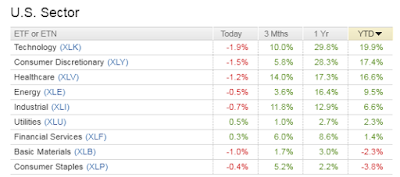
While the last 3 months are a mixed bag as far as signaling a bull market top, the YTD performance clearly shows that financials and utilities have underperformed the S&P 500, and health care and consumer discretionary have outperformed the S&P 500. What is especially notable is the weakness in the financials, because rising rates are supposed to be great for banks, increasing their net interest margin, but banks have been lagging all year, and have only started going up recently after the 10 year yield has rocketed higher for the past month. It is still barely up for the year, despite having massive stock buybacks and a 10 year yield that's gone up from 2.40% to 3.20%.
There are also the cluster of Hindenburg Omens that I mentioned last month which continues, as new lows continue to expand despite the market being close to all time highs. Add to that the pressure of higher yields and being in a blackout period for stock buybacks and you have a market that is vulnerable to a selloff. We are seeing that today and although I don't expect anything big on the downside, with decent support around the January highs and September lows of 2870, the probability of a quick plunge like you saw in February is getting higher. However, you still have positive end of year forces that will likely push stocks higher in November and December if we do get a pullback this month. We are nearing the end game for this 10 year bull market as a growing number of warning signs are flashing.
Here are the last 3 month and YTD performances for the biggest US sectors:

While the last 3 months are a mixed bag as far as signaling a bull market top, the YTD performance clearly shows that financials and utilities have underperformed the S&P 500, and health care and consumer discretionary have outperformed the S&P 500. What is especially notable is the weakness in the financials, because rising rates are supposed to be great for banks, increasing their net interest margin, but banks have been lagging all year, and have only started going up recently after the 10 year yield has rocketed higher for the past month. It is still barely up for the year, despite having massive stock buybacks and a 10 year yield that's gone up from 2.40% to 3.20%.
There are also the cluster of Hindenburg Omens that I mentioned last month which continues, as new lows continue to expand despite the market being close to all time highs. Add to that the pressure of higher yields and being in a blackout period for stock buybacks and you have a market that is vulnerable to a selloff. We are seeing that today and although I don't expect anything big on the downside, with decent support around the January highs and September lows of 2870, the probability of a quick plunge like you saw in February is getting higher. However, you still have positive end of year forces that will likely push stocks higher in November and December if we do get a pullback this month. We are nearing the end game for this 10 year bull market as a growing number of warning signs are flashing.
Thursday, September 13, 2018
Buyback Blackout Periods
We are coming up on the stock buyback blackout period which usually lasts 4 weeks every 3 months in mid March, mid June, mid September, and mid December. The SPX chart highlighting the time period for each of the last 4 years.
Sep 2014- Sep 2015
 Sep 2015-Sep 2016

Sep 2016-Sep 2017

Sep 2017-Sep 2018

As you can see during a period when the SPX has gone from 2000 to 2900 over 4 years, the stock blackout period during that time (64 weeks) is actually negative. There was a spectacular failure early this year as massive stock inflows in January provided the buying power during a time when corporations are not buying back stock. Other than that, it has been mostly a steadily negative time period.
We got US-China positive trade deal news yesterday, and along with a benign CPI number, the bulls are pushing SPX at 2900. Still remain bearish here.
Sep 2014- Sep 2015


Sep 2016-Sep 2017

Sep 2017-Sep 2018

As you can see during a period when the SPX has gone from 2000 to 2900 over 4 years, the stock blackout period during that time (64 weeks) is actually negative. There was a spectacular failure early this year as massive stock inflows in January provided the buying power during a time when corporations are not buying back stock. Other than that, it has been mostly a steadily negative time period.
We got US-China positive trade deal news yesterday, and along with a benign CPI number, the bulls are pushing SPX at 2900. Still remain bearish here.
Tuesday, September 11, 2018
Toppy Internals
The market internals are flashing red as the SPX trades between 2870 and 2890. The increase in 52 week highs AND lows as the market is still above its 50 day moving average has triggered Hindenberg Omens the last several trading days. It is one of the few technical indicators that actually show a bearish bias. Add on top that my risk parity indicator, which is showing short term bearishness as bonds are weak along with stocks since the start of September. Lastly, I want to bring back the FANG+ index that I mentioned several weeks ago. I am firm believer that the SPX can't sustainably go higher unless the QQQ is leading the way. And right now, the FANG index is lagging.


It looks like this market is setting up for a nasty fall sometime within the next 4 weeks, as we are getting closer to the stock buyback blackout period, which just happened to coincide with weakness in early February, late March, and late June. So late September/early October seems like the perfect time for another pullback as the market internals bear their weight on this toppy market.
Friday, September 7, 2018
Risk Parity Troubles
No one mentions risk parity anymore. But the risk parity nightmare is slowly creeping back as both stocks and bonds are down this week. In particular, the long end of the yield curve has taken the biggest hit. It reveals the underlying supply/demand problems that Fed QT and an ending of ECB QE and reduction in BOJ QQE are wreaking on the bond market. If the ECB pulls the plug on QE, there are no willing buyers of European government debt that yield deeply negative interest rates. Same goes for the BOJ, although they are stuck with quantitative easing due to the huge amounts of JGBs outstanding, and they are just trying to walk back from doing anymore damage to the liquidity in the JGB market, which is already a near zombie market.
The central banks, who have driven the bull market in bonds, are not willing to push yields even lower here unless something bad happens in the economy. The hurdle for central bank intervention has gotten quite a bit higher over the last year. And it will continue to get higher as Draghi has just one year left in his term, and odds are high that he will be replaced with an anti QE governor, probably someone German. So this is bad news not just for bonds but for stocks as well. The magic carpet ride of higher stocks and higher bonds that we've witnessed from 2009 to 2016 is over. Of course, if stocks take a big plunge, bonds will go a lot higher. But you no longer have that free lunch of being able to just buy bonds to hedge your stock portfolio and expect it to make money under almost any circumstances. That makes risk parity strategies riskier, and it is one of the reasons the market dropped so hard in February, as yields were going higher, something we rarely saw in the last 10 years.
The nonfarm payrolls number didn't come in that hot, although the average hourly earnings number was better than expected. Yet both stocks and bonds dropped on that number. The big fear in the market is that the dollar will continue to rally based on strong US economic data and cause emerging market contagion. I doubt that is a long term concern, because I don't think the dollar will keep rallying, but in the short term, with seasonal headwinds, there is a window of about a month where we could see some capitulation among weak longs. The divergence between the US and Europe/emerging markets is too wide for it to continue much longer.
With the weakness in bonds, it makes me a bit more comfortable to hold a short in stocks. I was originally planning on covering at 2870, but will see if we can get one more leg lower in the coming days.
Thursday, September 6, 2018
Small Speculators in Treasuries
There was a lot of Twitter talk about bonds when Jeff Gundlach mentioned the big speculator short position in Treasuries on August 17, saying it could cause quite a squeeze. The 10 year was at 2.87% that day. It is now at 2.90%, and there has yet to be that big short squeeze. Apparently, the lemmings decided to drink Gundlach's Kool-Aid and covered their Treasuries shorts over the next 2 weeks, as shown by the reduced short positions among small speculators in the COT futures data.


The COT data for the 5 yr Note, 10 yr Note, and T bond futures shows a trend of short covering over the last few weeks, making small speculators the least short 5yr and 10 yr Treasuries since Sept 2017, least short Treasury bonds since January 2018. September 2017 happened to be the top for Treasuries last year, and January 2018 was right before the big drop in Treasuries earlier this year.
It is not the large speculators which are the contrarian indicator in the COT data, it is the small speculators. And although they are a smaller percentage of open interest, they are the weakest hands in the futures market, with the worst track record, and therefore the best contrarian indicator in the futures space.
The small speculators are a bit harder to track in the equity futures space, because of the emini and large S&P and Nasdaq futures contracts, but there is a small long in combined S&P futures positions and a small short in combined Nasdaq futures positions, so no extremes as of August 28.
Market looks range bound here, consolidating the breakout from the double top at SPX 2870. Despite what the bullish sentiment poll numbers say, the anecdotal evidence doesn't seem very bullish, and if anything, traders seem somewhat cautious here, perhaps because everyone knows that September is a seasonally weak month. But the overseas markets trade heavy and that should eventually lead to a capitulation sometime this fall, which will take the S&P down with it. Timing it will be a bit harder, but it probably happens when corporations can't buy back stock.
Tuesday, September 4, 2018
Buyback Window Closing Soon
Stock buybacks are the main demand driver for equities this year. Retail has been net sellers of equities as the fund flows are deeply negative, and most institutions are basically closet indexers now, so there is not much variability in flows there. Hedge funds seem defensively positioned, from the articles that I have read over the past few weeks. So really it is corporate stock buybacks that are the main buyers of equities this year, and probably what has been driving stocks higher since early August, when the buyback window reopened after Q2 earnings.
So its not so much retail equity flows that one needs to watch, it is stock buyback flows. And while they will still support this market over the next 3 weeks, by the last week of September, the majority of corporations will enter a buyback blackout period, lasting about 4-6 weeks, depending on when the company reports. So the market could be supported at these levels for another 2-3 weeks, before it becomes vulnerable to selling pressure.
Also, it happens to coincide with the most bearish part of the year, the September-October time period. A lot of that is psychological, and it could be something to do with changing moods as the days get shorter, and the temperature starts dropping. In any case, the market is not far away from likely to face a move down to at least SPX 2800, and perhaps in a severe scenario, the July lows of 2700. I don't see it being able to get back to the 2530-2580 area just because of the persistent strength it has shown in breaking to new all time highs, which must be respected. In addition, the amount of the announced stock buybacks for 2018 and the amount actually bought is at a very large gap, so corporations will have to buyback more aggressively towards the end of the year if they want to fulfill their promises.
It doesn't feel great to be short here, but will try to make lemonade out of a lemon.
Expecting bonds to be under some selling pressure as there is usually a lot of corporate bond issuance after the summer lull starting in early September. Longer term, I am bullish on bonds, but in the short term, leaning bearish due to supply factors and also the coming ECB and BOJ meetings which will likely be more hawkish than most expect.
Wednesday, August 29, 2018
Zero Sum Without QE
In the long run, asset prices are determined by the amount of liquidity flowing in the system. With Fed quantitative tightening and a reduction in ECB and BOJ QE, the sum of central bank balance sheets are not expanding anymore. That makes global asset markets a zero sum game, as money from one sector takes money away from another section.
In 2018, it has been money flowing out of fixed income and emerging markets and going towards US stocks. Unlike what you saw from 2009 to 2017, when it was a positive sum game, as the central bank balance sheet expansion pushed global asset prices higher for real estate, bonds, stocks, and commodities. Now, its really just real estate and US stocks going higher, with the Fed no longer doing QE and with the other central banks reducing the quantity of asset purchases.
So if US stocks are to keep going higher, it is going to be at the expense of one of the other asset classes, or regions. There is no longer the rising tide lifting all boats. Sure, in the short term, you can have everything going higher together, stocks, bonds, commodities, etc. But without an expanding pool of money chasing financial assets, it will lead to sharper selloffs out of the blue like the drop we saw in February. Based on the high level of the US stock indices and the growing optimism that I am seeing now that SPX has made all time highs and broken the previous high at 2872, SPX is vulnerable to a sharp selloff down to 2700 in the next 2 months. With the cheapness of SPX puts here, I am tempted to buy October puts in the coming weeks to play for a sharp correction.
Monday, August 27, 2018
Honey Badger SPX
Back from my little blog break, as I watched the SPX finally break through to new all time highs on Friday, and as I am writing, making the breakout more emphatic with a don't ask, don't tell 11 point SPX gapper in the works. Welcome to hell for the equity bears.


I tried to get cute with another short attempt last Monday around 2860, and have gotten squeezed since. It was a small short, so its not that big of a deal, but anyone who trades knows that any loss is irritating, especially when I kind of broke a rule of not shorting S&P unless I had a bearish view in the longer time frames, and I didn't. I was bearish in the short term, but as I mentioned in the last blog post, Pullback Reveals a Lot, I had changed my stance from intermediate term bear to bull. Despite this, I still wanted to take another crack at the SPX short, and I have gotten punished for breaking one of my rules.
During slow markets, especially when many are on vacation and volumes and volatility are low, it is best to do nothing. Especially when I don't have high conviction, and the short I put on last week was not a high conviction trade. Its another one of thousands of mistakes I have made, just glad that it wasn't a big one because I didn't put on much size. I am still nursing the short, hoping for a more graceful exit point. But the recent dollar weakness and the heavy long dollar spec positioning doesn't look favorable for equity bears. Also, bonds are acting strong which is another positive for stocks. I still believe bonds will pullback and move towards the 3.00% 10 year area in September.
The honey badger SPX doesn't care if you think it is too high, it doesn't give up, it just keeps grinding away, making new highs, irritating more traders. I don't see it stopping anytime soon, and we probably will have to deal with the SPX not making the final top until well into 2019.
You have to trade based on your market analysis, not based on what you want the market to do. It will be a grind for those with a bearish lean for the next few months. But there is no way I will chase on the long side with this kind of overvaluation and excesses built up.
Friday, August 17, 2018
Pullback Reveals a Lot
There is a lot of information that can be gathered from the reaction of market participants to a pullback. Just from looking at the reaction on CNBC and on Twitter, you would think we were in correction territory, with carnage across the board. But the SPX is 1% below all time highs! This is unbelievable. Turkey really did scare a lot of investors, even if they won't admit it. The high put/call ratios also confirm what I am seeing and hearing on financial media.
I thought this market would be topping out around this time period and entering a downtrend heading into the fall, but based on the near panic levels of put buying and excessive bearish mood relative to the small decline, I am rethinking my projections. The probabilities now favor a breakout to all time highs and towards SPX 3000, which likely coincides with a US/China trade deal and a rebound in the hated emerging markets.
China is aggressively priming the pump again, and that should be good enough for a reprieve from the selling for the next few months. The long dollar trade seems extremely crowded now, and it will be difficult to get more dollar strength with the ECB and BOJ intent on normalizing policy in the coming months.
Counterintuitively, with trade war worries still hovering over this market, there is a big potential positive catalyst. Even though a trade deal won't solve the long term problems of overvaluation, late cycle dynamics, and monetary tightening, it will change sentiment and encourage risk taking behavior, which should be good for a few percent rally in the SPX.
As for the rest of this month, I still see a range trade with the SPX ranging from 2790 to 2850. We are closer to the top of the range, so its probably better to be short than long at current levels (2843). But I have lost my confidence on the short side after seeing the panicky market reaction to such a small pullback.
August is usually a bullish month for Treasuries, and that should keep bonds bid for the rest of this month, perhaps taking it to 10 yr 2.80% later this month, but that should change in September, if my medium term view on equities is correct. Expecting 10 year to get back to 3.00% in September.
Wednesday, August 15, 2018
Easily Scared Market
That was fast, how quickly investors have turned on this market and gone from bullish and complacent to worried and scared. It took less than a 2% pullback in SPX to cause this to happen. I am not basing this on anecdotes, but seeing the put/call ratios soar over the past few days, higher than the levels seen at the July lows below 2700. Of course, the overseas markets are taking a bigger hit, as always, but the SPX is the center of the financial universe, and it is still more than 100 points higher than the July low, and the sentiment is similar to those times.
I would like to see a bear market and high volatility as much as the next trader, but the market doesn't care about what I want or what traders want. After the big tax cuts, the US corporations are too flush with cash and too willing to buy back stock for there to be a big drop that sticks. Sure, you can have algo driven flash crashes but not a bear market. And without a significant fundamental change in US economic conditions, you will not have a sustained correction in the stock market.
I covered my short on Tuesday, and was very tempted to reshort yesterday at higher levels, because I didn't think this bearish sentiment would go away quickly. These kind of sentiment shifts tend to last at least 5 trading days, since the mood shifted on Friday, that gives this market at least another 3 trading days to go lower. There is decent support around SPX 2790, the highs in June and the low earlier this month. That could be an area to take a small speculative long, looking for a move back to 2850. My base case is for a small choppy range from 2790 to 2850 for the rest of August.
Monday, August 13, 2018
Turkeys Scared of Turkey
 Turkey represents 1.4% of global GDP. I won't pretend to be a 5-minute expert on Turkey, but anytime you get one of these emerging market scares, which is somewhat expected, they are usually an overreaction. Turkey has been on the radar for quite some time, the president seems like a knucklehead, so this sudden currency crisis doesn't surprise me.
Currencies just don't suddenly depreciate like the Turkish lira for nothing. I am sure just like Argentina, the government is printing money like mad and there has been a lagged response by the market. Unless you have the reserve currency (US), or have a healthy current account surplus (China until 2015), you cannot print money like mad and not expect significant currency depreciation.
I am sure the contagion effects on European banks with Turkey exposure was brought up, but they are not THAT vulnerable or reckless to the point where Turkey would bring them down. Turkey borrowed a lot of money in foreign currencies, and that was warehoused to bond funds/pension funds via the banks. The funds can take the pain. It is a drop in the bucket. Turkey will just have to default and get the Argentina treatment in the future. The market will move on to the next issue.
Still short SPX, but was tempted to cover on Friday. Even though I am short, I don't believe there is that much downside. At the same time, I don't believe there is that much upside either. The overnight lows around 2820 is probably the level to get out of the short. There seemed to be the typical Friday risk off mentality on bad news price action. You can sense that investors are turning bearish quite quickly on pullbacks, mainly due to ongoing trade war worries. Only when the trade war is resolved will you have the investors all in and have the good news topping phase.
Despite the Turkey crisis and the large short base, I am bearish on Treasuries for the next few weeks. The strengthening dollar and steady stock market gives room for foreign central banks to follow the Fed and tighten monetary policy. And it seems like Powell is in "raise until hell or high water" mode. He has drunk the kool aid on the US economic boom thesis and will probably want to raise 2 more times before signaling that he wants to slow down rate hikes.
Thursday, August 9, 2018
Shorts Not Looking Good
Its not always tangible, but when you've seen a play a hundred times, you sense what the next scene will be. I am still short, but I no longer expect a move back to 2700, the volatility is too low near all time highs, the complacency is not as high as I expected it to be when we got back up to these levels. Even without a settlement of the trade war between US and China, the market is ignoring the tariffs and just going higher. The put call ratios are not low enough for the rise in the SPX, so it definitely feels like hedge funds and retail are not fully on board.
I will not add to the short position, keeping it a reasonable size for the level of my conviction, which is decreasing every day. With the threat of Democrats taking over the House in the midterm elections in 3 months, I don't expect a surge higher before then, so I will be patient.
The leading indicators point to growth decreasing in the beginning of 2019, so we will probably make a top right before then, in December, once the trade war with China is over and the midterm elections are behind us. Until then, there is still a wall of worry to climb.
Monday, August 6, 2018
USDCNY Battle
China used to not have to worry about its currency becoming too weak, as it had a hugely positive current account surplus and no worries about big capital outflows. That started to change in 2015, and now it is a completely different story. The PBOC has been able to be reckless with their monetary policy and pump up M2 to astronomical levels without worrying too much about inflation because of that huge current account surplus and strict capital controls. Well, the capital controls have gotten even more strict under Xi, but that net inflow of dollars isn't there anymore. That's why China's holdings of Treasuries has been going down over the last few years, and thus the tighter capital controls.
Last 10 years:

Last 6 quarters:

The last 2 quarters has seen a net outflow of dollars from China, and that is what is preventing the PBOC from having even easier monetary policy, because of the yuan weakness. In China, the supply of dollars is tight but the supply of yuan is plentiful. That is why they have capital controls. The only long term solution to relieve that pressure is to either have a tighter monetary policy or a weaker yuan. They seem hell bent on keeping the USDCNY under 7, which will limit the amount of monetary stimulus they can provide. Unless of course, they decide to sell more Treasuries, which will only make their FX buffer smaller for supporting their currency.
I have seen a lot of articles about China intentionally letting the yuan weaken to support exporters because of the US tariffs. No, they don't need to do anything and the yuan would have weakened naturally from 6.30 to 6.80 anyway, just because of their current economic weakness and the dollar outflows.
Now you are seeing China try to support the yuan by making it harder for speculators to bet against it, but these are desperate measures that don't work in the long run. They will need to sell dollars if they really want to support it, which is something they don't want to do because it sends a bad market signal, like 2015.
This is worse than 2015 for China, and the market is acting like it isn't as bad as 2015. Sure, the SPX has benefited from the big corporate tax cuts, and should be higher than it was in 2015, when it went down to 1840. But the global economic situation, particularly China, is worse. Right now, US market momentum from stock buybacks keeps the thing going, but if you remember in 2007, that was also a year when buybacks surged higher, and that was the top of a 4 year bull market.
Wow, this SPX is like a zombie, it rises from the dead and keeps coming back. Back on Thursday, we had a gap down, supposedly as trade war worries crept in, but that has all disappeared in a matter of 2 days, and we are back to the post US/EU deal euphoria levels from Thursday, July 26. It is definitely tempting to add to the SPX short here, but the strength in Treasuries is holding me back. If the SPX stays in a 2830-2850 range this week, I will probably add to the short.
Subscribe to:
Posts (Atom)


 Posts


