Thursday, May 5, 2022

A Post Bubble Face Ripper

Pumping Powell pulled off an AAPL special:  under promise, over deliver.  This time, he raised expectations for rate hikes so high, that even just promising to do 50 bps at a time in the next 2 meetings was received as dovish.  In reality, he's sticking to his original plan back when he was talking hawkish in early April.  Its just the Eurodollars/Fed funds rate market that drank the Jim Bullard kool-aid and started pricing in a chance of a 75 bps move, when it wasn't going to happen.  

The market is acting according to script, scaring out investors and getting them nervous ahead of a big FOMC meeting, and then breathing a sigh of relief when Powell didn't talk more hawkish than he did a few weeks ago, resulting in a face ripper.  Big picture, the situation hasn't changed.  Fed is still on automatic pilot for the next couple of meetings, for rate hikes, so you can book 50 bps hike in June and probably 50 bps in July.  If the market starts to fall apart going into the July meeting, Powell could just do 25 bps in July to try to foment another short squeeze and rescue the market.  

In either case, the Fed funds rate will get up to 175-200 bps by end of July.  That would probably be enough for Powell to slow down and only do 25 bps hikes if the stock market is not weak.  That's way different than what the Eurodollars market is pricing in, which is penciling in 50 bps in June, 50 bps in July, 40 bps in Sept, 28 bps in Nov, and 23 bps in Dec.  That's a total of 191 bps of additional rate hikes in 2022.  That's not going to happen.  The market will break so hard if the Fed tried to follow the market pricing that Powell will pivot before he could pull it off, guaranteed. 

People don't learn from history.  How soon do we forget about Mr. Transitory.  Powell has no backbone, and he loves to find excuses to be dovish, or less hawkish.  How soon we forget about the dovish pivot in January 2019, after the S&P 500 went down 20%, and he kept the dovish pivot even as SPX was ripping to new all time highs in 2019.  

This time, It took 8% CPI to get him to finally stop QE and start talking about 25 bp hikes.  Only market pricing in 50 bps hikes for several meetings did he finally get the message and the balls to at least try to catch up to the Eurodollars market.  The Fed has never been a leader in starting the hawkish wave.  It waits for the market to price in rate hikes and then follows suit, usually being way too late.  

I know people love to rip on Jim Bullard, especially because his hawkish tone has sparked some selloffs in the past few months, but he's been right more than Powell.  Powell is a politician wearing a central banker costume.  He does what the politicians and the financial markets want him to do, in that order.  He could care less about price stability.  He's looking for positional stability, as in staying as Fed chairman for as long as possible. Once again, he will be praised for pumping the markets higher at the FOMC meeting.  If it was the opposite reaction, he would have been loudly jeered and criticized.  That's the nature of the central bank game.  It incentivizes the Fed chairman to be dovish.  Don't forget that. 

2022 reminds me of 2000, but worse.  Inflation is much higher and the budget deficits required to keep this pig afloat is now the highest that its ever been.  Once you start handing out money to solve short term economic problems, it becomes an addiction.  The Rona stimulus checks were enormously popular.  If you do a search on youtube, you'll see so many videos regarding stimulus checks and when they will arrive, whether there will be more, etc.  Also, with an aging demographic, Social Security and Medicare spending will keep going much higher, and those are golden gooses that politicians can't touch.  All that money that the elderly receive either through Social Security or through healthcare subsidies from Medicare are inflationary.  Money for doing nothing.  Money for being old and retired. 

Even in an inflationary environment, the government knows only one way to solve the problem, either hand out money or reduce taxes.  Already student debt is being forgiven, $10,000, and that's just the beginning.  Gas taxes will probably be eliminated or drastically reduced if oil prices keep going higher, which is very likely given the supply/demand situation.  The Republican party has basically become the Trump party, so like Trump, they will try to pump up the economy with short term band aid solutions like tax cuts and more stimmy.  Since Republicans are much more aggressive about tax cuts than Democrats, yet only slightly less aggressive on government spending, they would likely cause bigger budget deficits than big spending Democrats, and thus more stimulative for the economy.  Of course, since Republicans are much more politicially savvy than Democrats, they won't provide any of that stimmy under a Democrat president, and instead wait for Trump to retake the throne in 2024 to pour on the stimulus and tax cuts.  

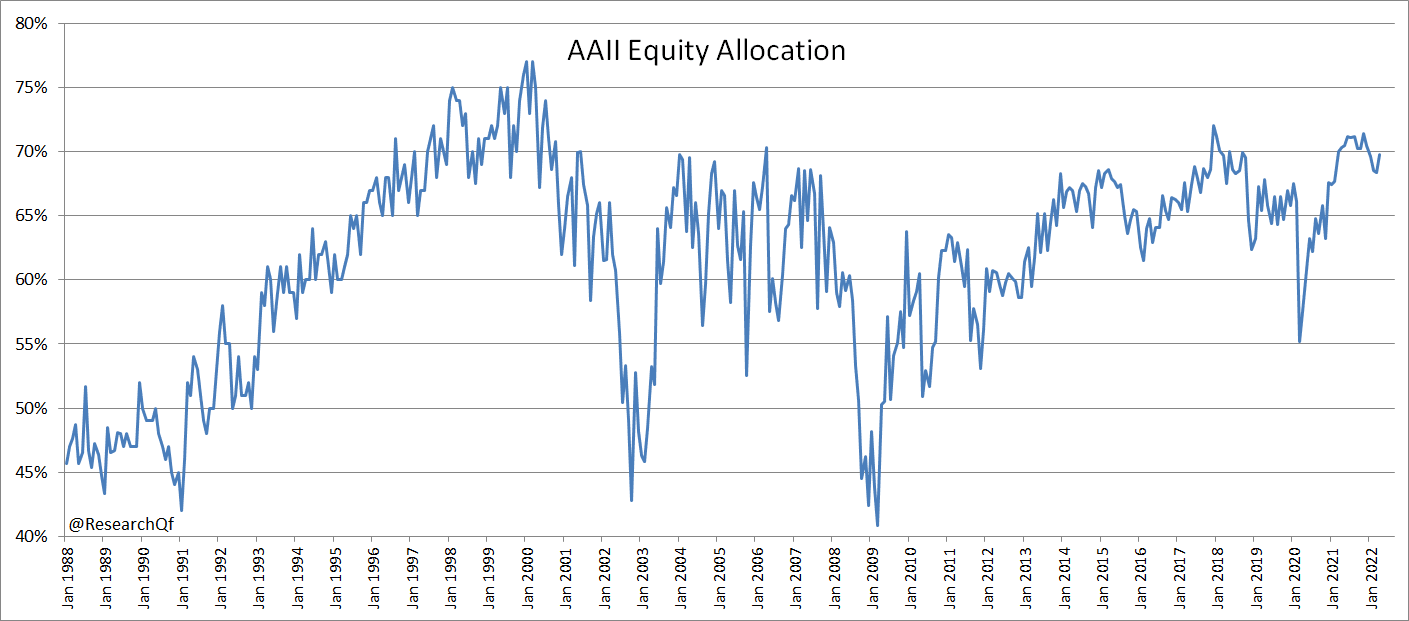
Don't lose sight of the big picture.  The SPX and in particular, the NDX has topped out.  The price action is terrible.  I know a lot of people talk about the bearish AAII and II sentiment surveys, but those are only good contrarian signals in a bull market.  In a bear market, not so much.  Sure lots of people talk a bearish game, but are they still heavily invested in stocks?  Yes.  

I am sure most will agree that 2020 and 2021 was a giant speculative bubble (tons of SPAC IPOs, rampant speculation in meme stocks, ridiculous moves in tech stocks, bitcoin, etc.).  So in a post bubble environment that we've entered, the closest analog is Nasdaq 2000, especially considering how much retail investors got excited about stocks.  Nikkei in the late 1980s, 1990, Shanghai in the mid 2000s, 2007, are also good analogs of a bubble market.  

TINA has been engrained in the brains of millennials throughout the last 13 years.  Almost like tech stock speculation was engrained in the brains of baby boomers in the late 90s to 2000.  The usual aftermath of these speculative boom periods is an extended bear market.  Here are a few examples:

Nikkei 1990

Shanghai Composite 2007, Nasdaq 2000

Nasdaq 2021-2022

Past bubbles tell you that the first year of the post bubble downtrend is the steepest and most painful.  Right now, we are closing in on almost 6 months after the Nasdaq peak in November 2021.  So if past is prologue, you have at least another 6 months of a steep downtrend where countertrend rallies will be brief and be great shorting opportunities.  The Nasdaq will be the place to put on short bets, as its much weaker than SPX this year, and has much more froth and the worst overvaluations. 

Tuesday, May 3, 2022

The Worm has Turned

 2022 is turning out to be like 2000.  The second half of 2000 that is.  Here are the charts for 2000 and the past 12 months.

SPX daily (2000)

SPX daily (May 2021 to May 2022)

The worm has turned.  The bears are back.  They've been getting destroyed year after year since 2008.  Only brief glimmers of success taken back with a vengeance with each V bottom ripping the heart out of the shorts and annoying those holding mostly cash.  Its a different story now.  

This game is about making adjustments.  Like a 7 game series in the playoffs. After seeing what happens in game 1, you have to determine if you just had bad luck or if you actually had a bad strategy and the circumstances have changed.  There is a fine line between sticking with your strategy that has been working over the years but recently hasn't, and changing your strategy on the belief that the market regime has changed.  If it hasn't, you pay the price by missing out on a big move, or even worse, being faked out and being on the wrong side of one.  

The evidence is mounting that the market regime has changed.  Here are pieces of evidence:

1. Huge rally off the March 2020 bottom taking the SPX from 2192 to 4818 in less than 24 months.  

2. Highest ever price to book, price to revenue ratio for the S&P 500 in 2021.  

3. Massive equity inflows and retail participation in speculative garbage/meme stocks from November 2020 until January 2022, most since 2000.  Lots of weak hands and public is highly exposed to stocks. 

4. High inflation worrying politicians which leads to a hawkish Fed pivot.  Results in a weak bond market, 10 year yields up to 3.00%, and Fed funds rate still at 25-50 bps, and Powell seems hell bent on getting Fed funds at least up to 1.75-2.00% before he slows down.  

5. Lots of bearish sentiment in the sentiment surveys, but survey on equity allocation still very high (equity fund inflows have only recently turned into outflows).  Fully invested bears?


6. Nasdaq tech stock underperformance, financials very weak even with rates projected to go much higher.  

7. SPX is no longer giving bulls much time to sell the highs, rallies are sold quickly and the bottoms are messy, lots of U bottoms that lead to only brief rallies vs. V bottoms that lead to relentless rallies from 2009 to 2021. 

There are probably more things out there like specific fundamentals for big cap tech which showing slowing earnings momentum despite big time overvaluation, bearish leading indicators, etc.  

Yesterday, I could finally see some fear in the market as we broke the 4100 support level and made new lows for the year.  Its not a great way to make a bottom, but a lot of pre-FOMC hedging / risk reduction happened over the past several days and it looks similar to the pre March FOMC setup that resulted in a big rally from 4140 to 4620 in 3 weeks.  Not expecting anything close to that since we're beyond the point of recognition and its the sellers, not the buyers who are more eager these days.  And seasonally, not a good time for investors from May to October.  

Very few investors are used to these type of markets, it hasn't happened in over 13 years.  The natural instinct of many fund managers is to wait for a big rally to sell, because they ALWAYS happen, right?  I tend to agree, but I don't think we'll be getting anything that lasts more than a month from these levels, so I would not be surprised if we go up to 4400-4500 area and then go right back down to 4100.  Its a seller's market.  Something that investors are not used to.  Investors talk bearish, but are they still fully invested?  It seems retail investors are, while hedge funds have rightfully turned cautious this year, and for once in a blue moon, are actually outperforming the SPX.  

Still low equity exposure, with most of it in energy.  Staying away from taking significant SPX positions, unless its on a short setup.  Going long SPX is treacherous in this market and to be avoided except for catching brief rallies after big dips. 

Friday, April 29, 2022

No Recession But a Weak Stock Market

The stock market is trading like the economy is about to enter a big growth slowdown, and possibly even a recession.  I am hearing lots of talk about the Fed breaking something and having a hard landing.  This reeks of myopic market focused thinking, with total disregard for the real economy, and the absurd fiscal policy that's still pumping huge amounts of money into the economy in the background.  

It was fashionable to talk about the massive Covid fiscal stimulus and QE double bazooka in 2021 as the markets kept going higher.  Now its fashionable to talk about a hard landing as the Fed does 50 bp hikes and QT in the coming months.  While monetary policy is definitely going to be much tighter, there is still $1.7 trillion of excess liquidity looking for a home that is stuck collecting 25-50 bps in the Fed repo facility designed to sop up all the QE created excess liquidity.  There is no shortage of liquidity in these markets.  QT will keep bond yields higher than if there was no balance sheet reduction, but I'm betting that Yellen will be financing a big portion of the deficit with T-bills, not coupon bonds.  That will have a less negative effect on Treasuries than if coupon bond issuance was expanded. 

I still believe we're entering a bear market, but not because the Fed will break something and cause a recession, its just because investors got way too exuberant and overweight equities over the last 18 months.  It will be a lot more like 2000 to 2002 than 2007 to 2009.  I don't even think that the US economy will get as weak as it did during the post dotcom bubble economy of 2001 and 2002.  Back then, there were even budget surpluses, and the budget deficits were a tiny percentage of GDP, around 1-2%.  Now its at 6.4% of 2022 GDP, and that after 13% of GDP in 2021.  We are in a totally different planet when it comes to the fiscal pumping of the economy.  That will keep inflation higher than normal and disappoint those looking for a crash landing and a recession.  


Now the economy in Europe and Asia are a different story, but those stock markets are already reflecting a much weaker economy, more so than US stocks are.  There is no valuation froth in Europe and Asia, so its not priced for perfection like US stocks were before this recent swoon.  So even though I expect the US economy to outperform expectations vs Europe/Asia, the US stock market likely underperforms because of the big overweight investors have in the US.  

There will be some wealth effect related weakness in the economy this year, and that will counteract some of the positive growth effects from the government spending, but overall, growth probably goes back to the mediocre 2012-2019 level, which is enough to keep the commodities bull market going and keep the stock market from a total crash scenario, as some are forecasting.  

The price action this week seems to confirm the gut feel that market is bottoming and found another bottom at similar levels made in March at 4170-4180 SPX.  This should take the market higher over the next 3 weeks as the big earnings reports are now behind us, and FOMC meeting of 50 bps and QT announcement will likely be sell the rumor, buy the fact in my view.  Not sure how far we bounce up to in the coming weeks, anywhere from 4500 to 4600.  By early June, I expect the market to have either already topped out or be very close to a local top, so a short opportunity will be there.  That will be the time to put on short positions to ride lower during the summer.  

Don't lose track of the big picture:  lots of fiscal pump and small reversal of monetary pump.  That is the mirror image of what was happening from 2010 to 2017, before the Trump tax cuts and Covid pork stimmy fest.  We know what happens when there is a lack of fiscal stimulus and a lot of monetary stimulus:  a strong bond and equity bull market, but a low growth economy.  How about when we get a lot of fiscal stimulus and a lack of monetary stimulus, like what we will see over the next several months?  Probably a weak bond market and stock market, but a surprisingly strong economy.  Basically a great backdrop for commodities. 

Wednesday, April 27, 2022

Its a Bear

The bull is dead.  Its over.  Its a bear market.  We haven't seen a bear market since 2008.  Investors are not ready for it.  I wasn't ready for it to happen so quickly.  After 14 years, memories of 2008, and 2000, have faded.  After losing money trying to buy the dip a few times since the start of the year, its getting more and more apparent that we aren't turning back.  No more multi-month continuous rallies that go to new all time highs.  No more V bottoms that don't give you much time to buy the lows.  Now you will see messy bottoms that only lead to short term rallies that are a few weeks, not months.  

The topping phase and the transition from bull to bear has been shorter than I expected.  I see no way this market goes back to SPX 4700 this year, and probably the next rally off this oversold market, will likely only take it up to 4500-4550, at the maximum.  The stock market is smarter than back in 2007, and 2000.  The markets now realize how important monetary policy is to stocks, unlike back in 2000 or 2007.  Its almost gotten to the point where basic macroeconomic fundamentals don't really matter to investors, its just monetary policy. 

In order to fuel a stock market that is fundamentally overvalued, new equity inflows have to come in and/or corporate stock buybacks.  After the heavy equity inflows since the November 2020 election, you have a heavily invested community that has just started turning tail, and it would not surprise me if these equity outflows turn into bond inflows, which has turned negative.  Ever since 2008, these kind of heavy outflows have proven to be near intermediate term peaks in the 10 year yield. 

Equity Fund Flows (Jan. 2020 to Apr. 2022)

Bond Fund Flows (Dec. 2021 to Apr. 2022)

At this point, you have a huge investor base, broadened considerably post 2020 with the retail frenzy into speculative names, all underwater and bleeding, with a hawkish Fed and reduced liquidity going into an economy that is slowing.  A bad mix would be an understatement. 

For this bear market:

The match:  Fed liquidity from +$120B and ZIRP to -$95B and 2.00+% Fed funds rate.

The fuel:  High valuations.  

The only thing that the bulls have going for them is the negative sentiment, but sentiment doesn't change a trend.  If investors aren't willing to get bullish, negative sentiment will stay negative, or just get less negative.  And given how much the financial markets these days are obsessed with the Fed, I don't see how you get that big bullish turn in sentiment that would drive stock prices higher unless you get Powell throwing in the towel on tightening.  I don't see that happening until at least another 125-150 bps of hikes being done.  That takes you to possibly at the earliest, the September FOMC meeting where they signal a pause or less hawkish rhetoric.  

So from that standpoint, I don't see a bullish catalyst that lasts until you get the Fed throwing in the towel on their inflation "fight", and go back to what they are comfortable doing, pumping more liquidity into the system and backstopping the stock market.  But the problem is that I don't see inflation, at least commodity/food inflation coming down.  I believe we're in the middle of a strong secular bull market in commodities due to the lack of investment over the years in new oil/gas production and nuclear energy, as well as the rush to invest in low ROI energy sources such as solar and wind.  That's causing a shortage of energy, that either needs to be resolved through demand destruction through higher prices or additional production, which will take a few years to come online, because these things don't turn on a dime. 

For the first time in 13 years, it will be safer and much more profitable to short rallies than to buy dips.  I don't say that lightly, because the buy the dip strategy has been a huge winner over the years.  

It looks like the bond market has finally reached a point where buyers are willing to step in and take a stand, which is at 3.00% 10 year yields.  There is still time to enter bonds at good levels, so I don't see a need to rush in here.  I don't see much upside or downside for bonds as I expect it to be slowly forming a bottom in the next 2 months, before you get that trend change which will spawn a new bull market for bonds.  But I don't expect it to be as strong as the bond bull markets from 2008-2009, and 2011-2012, 2014-2016, and 2019-2020.  Those bull markets were fed by a steady downtrend in commodity prices, Chinese offshoring led deflation, and less expansionary fiscal policy.  

Now we've entered a strong bull market regime for commodities, and the low hanging fruit of Chinese export led deflation is gone.  Plus, you're seeing in the US, and even some in Europe, more of a willingness to hand out stimmy checks and deficit spend their way to short term prosperity.  That's inflationary, so bonds will not have the same type of crazy moves lower in yields as you've seen in the past 13 years.  With that said, I don't expect a secular bear market in bonds, but more of a range bound market for several years that probably trades between 1 to 3% 10 year yields depending on what the Fed is doing at that particular moment in time.  

Into the weakness this week, I have stayed away from the temptation to buy SPX and have focused on buying some of the strongest stocks in the strongest sector, energy.  I expect energy to be the best hiding place for stocks over the next 2-3 months.  And after that, I don't think it will be safe to hold anything, as I expect stock investors to become more and more indiscriminate and urgent in their selling, as it becomes obvious that we're in a bear market.  

I am still long a small SPX long position, its small enough where I can weather the storm and not worry, but I will be selling it on any trip back towards the 4400-4500 resistance zone.  With a much feared FOMC meeting next week, and with big tech earnings out of the way after this week, given this oversold nature of the market, I expect a strong rebound for stocks in May, maybe the last golden exit opportunity for bagholders like me to dump their stocks and either buy bonds or put on a short position. 

Wednesday, April 20, 2022

A Mess of a Market

The SPX doesn't know where it wants to go.  It looks weak, but its still in a rally window after the fear based W bottom in February/March.  Unfortunately, I overestimated the strength (maybe timing is just off and it rockets higher this week?), and bought the first major dip off the thrust higher in early April.  In a more constructive market, where the Fed governors aren't trying to outdo themselves by trying to be the most hawkish banker, you would see another burst higher after that big bottom in March.  But its been chopping downwards, although a big thrust higher the past 2 days.  

Looking at the options data and commitment of traders futures positioning, the readings are neutral and provide very little edge.  Despite the weakness over the past 2 1/2 weeks, there was not a lot of heavy put buying, which is usually a negative.  Investors speak bearishly, but they aren't acting out on their opinions, as equity inflows are still historically high for the past 3 months.  

Instead of focusing on the macro markets, I should have been focusing on specific sectors which are in strong bull phases with lots of room to run higher on a fundamental basis, in particular the energy sector.  The SPX and NDX are a choppy mess right now and in a phase transition, so probably the best strategy there is just to wait for a bullish extreme, hopefully on "good news", in order to put on a short position.  You can be your own worst enemy just focusing on your main market when the market is directionless.  

I sold a lot of my underwater SPX long yesterday into the rally, although still holding some just in case we keep going higher.  The price action isn't that great so I have reduced.  Will be focusing on buying energy stocks, which seems to be the only place where I can see a big rally for the year.  Don't see much of an edge in the overall market, and my preference will be to sell remaining longs and go short the SPX or NDX  after hopefully a relief rally in May after the FOMC meeting.  

Bonds continue to trade horribly, and the 10 year yield nearly touched 3% in overnight trading before BOJ came to the rescue and caused a little short squeeze.  Longer term, these are good levels to buy bonds, but short term, its not a great time to buy the dip with just 2 weeks left till the FOMC meeting in May, where you will be getting the double barrel tightening of 50 bps and QT.  Its not an event that bonds are likely to rally into, so its probably better to wait till right before the meeting to buy.

This market trades like there is a huge amount of overhead supply, those heavily long US stocks who are looking to reduce their exposure on a rally towards SPX 4600-4700.  The crowd has made an 180 degree turn, rightfully so, from bullish to bearish, and realize that with the Fed reducing their balance sheet + hiking aggressively, with the federal government about to enter gridlock after the midterms, its asking for trouble, as the economy slows and you get both fiscal and monetary tightening. 

Wednesday, April 13, 2022

Time Arbitrage

There is a lot of noise in short term price moves.  Moves that are hard to predict because in the short term, a big institution or group of institutions suddenly deciding to increase or decrease their equity exposure will move the market for the next hour or two, or if they are looking to move very large size, for a day or two.  That could be in the direction of the intermediate term move, or against that direction.  The longer you go out in time, the less one or two big institutions can influence the direction of the market.  Its much easier to forecast what the overall crowd will do, rather than one or two of the big participants.  

Some may say that the longer out in time you go, the more exposure you get to news headlines and unpredictable events.  That's true, but most of the time, these news events don't affect the market for more than a few minutes or hours.  It is not common to get a market event that affects the market for more than a few days/weeks.  Covid type of market game changers are rare.  Even September 11 2001 doesn't come close.  In 2008, which could be considered a slow motion event, wasn't a black swan type of unpredictable market mover.  It was building steadily over the previous years.  The Russia/Ukraine war this year, which definitely caused the selloff to last longer than it would have otherwise in February/March, is already an afterthought compared to what is always on the minds of most investors: the Fed. 

Daytrading is profitable as long as retail investors are heavily involved in the market.  If retail is not active, daytrading gets a lot harder.  Daytrading against institutional order flow is possible, but much harder than against retail order flow.  Institutions are more disciplined, more knowledgeable, less predictable, and make fewer mistakes than retail traders.  The only place you will find retail traders making up a significant amount of the volume is in small cap stocks that are in play.  That is the only place where consistently large edges exist.  That is where beginner traders who are looking for an edge should specialize.  The big drawback from focusing on the small cap stocks is having to find shares to short, lack of deep liquidity (not being able to put on large size for more than the day that its active), and long periods of fallow periods with few opportunities when stocks are in a downtrend and/or retail speculation is subdued.  

But in order to play with the big boys and be able to scale up, one needs to trade markets where institutions dominate, and retail flows are mostly irrelevant.  These are usually macro markets that are covered by futures, such as stock indexes, fixed income, commodities, and currencies, and also large cap stocks.  That is where another type of edge appears which is not talked about much.  The edge from having longer time frames than institutions that trade frequently, in particular, hedge funds.  Hedge funds in particular are judged on a month to month basis, and extended drawdowns are avoided whenever possible.  Hedge funds always worry about drawdowns because it looks bad on their record and its frowned upon by their investors.  So they often get stopped out of long term positions that are in a long term downtrend.  These stop outs are not fundamentally driven decisions, based on investment merit, but based on risk management and fear of big drawdowns.  When you have investors that are making trading decisions based on risk management rather than fundamentals, there is an opportunity.

Let's call it time arbitrage.  This arbitrage comes from being able to enter positions that are currently out of favor and in extended downtrends, with some liquidations and stop losses exacerbating the trend.  These opportunities occur when something is fundamentally undervalued, but currently out of favor on Wall Street.  This arbitrage can also happen in the other direction, where a market is in a bubble and extremely popular, and fundamentally overvalued.  But usually its more difficult and more dangerous to try to short an overvalued market in a bubble than going long in a undervalued market that is in a bear market.  

In the current market, the only market which I see this time arbitrage opportunity is in bonds.  I see no long term time arbitrage opportunity in stock indexes or in commodities.  For currencies, there is definitely a long term opportunity in the yen, as its selloff is related to Fed policy, so highly correlated to bonds.  And buying Treasuries is a better expression of the Fed turning dovish on a weakening economy than going long yen.  

Yes, the best long term "time arbitrage" opportunity is in bonds, not because I think inflation will go down a lot more than market expectations.  Its because I believe the Fed won't be willing to hike as much as the market is pricing in, based on the global economy weakening, even though I expect inflation to remain sticky, due to continued commodities and housing inflation.  We saw in 2007 and 2008, in the face of rising inflation, mainly due to commodities, while the economy was noticeably weaker, the Fed was aggressively easing, and didn't care about inflation in that environment.  Now I don't expect a financial crisis or a great recession, but I do see a US/EU recession coming in 2023, like many are predicting.  That is another aspect of this opportunity which makes it interesting.  Its the fact that so many investors are now expecting much weaker growth or a recession by 2023, but most are not positioned for it, except for crowding into defensive sectors in equities.  But the best way to play economic weakness is not in defensive stocks, but in bonds.  They are for the most part eschewing fixed income, due to 1) continuous downtrend 2) Fed hawkish rhetoric 3) inflation fears.  

The investment flows out of fixed income and towards stocks have been sizeable since the beginning of 2021.  Investors were already historically overweight equities vs bonds going into 2021, with the flows since then, its become even a bigger overweight in equities.  This makes the weak equities scenario much more harmful for the overall economy, as the most dynamic part of the US economy is US equities.  Growth is low, without massive fiscal stimulus, so the wealth effect from equities is a much bigger factor than many are willing to admit.  So a few more hikes will cause stock market to go down even more, and thus, a weaker US economy via the reduced wealth effect channel.  That's not even factored into the leading indicators which are already rolling over hard. 

But the Fed is hawkish now, when the current Fed funds rate is 0.25-0.50%.  This isn't a tough time to be hawkish.  But the more important issue is this:  Will they remain hawkish after 3 rate hikes (50 in May, 50 in June, 25 in July), with the Fed funds rate at 1.5-1.75% and the stock market in a strong downtrend as the economy is clearly weakening (likely August/September scenario)?  That's not something many investors are considering at the moment, even though its probably the most likely scenario in 4-5 months time.  And no, I don't expect the bond market to be weak until August/September.  Unlike 2018, when the bond selloff was extended as the Fed slowly hiked 25 bps every other meeting, this time, they are looking to do 50 bps per meeting, so 4 times faster, plus a much faster QT than in 2018.  And leading indicators are more ominous now than in 2018, mainly because the economy didn't get so hot and inventory didn't get so bloated as they have now.  

I haven't entered any long term bond positions, but its the best market for those looking to play the long game, and can withstand short to intermediate term drawdowns (unlike hedge funds), with fundamentals that are unfavorable now, but will soon turn favorable. That's an opportunity for those willing to make a long term investment in an asset with a very bad looking chart that is in a slow motion liquidation cycle.  

Its brutal price action for the SPX.  It usually feels this way at the end of a downswing, unless of course you are in the middle of a protracted downtrend, which I don't believe is the case.  I could be wrong, but this looks like a deep dip in a 2-3 month countertrend up cycle that started in mid March.  I agree with the majority that the longer term picture looks weak, but disagree about the short term, mainly due to light fund positioning.  Still long, looking to hold for a couple of weeks.

Friday, April 8, 2022

Peak Fed Fears

This is about as hawkish as the Fed will get.  They are tripping over themselves to act like they weren't the same tools who kept pumping in $120B/month of QE and doing nothing but jawboning about transitory inflation to justify their inaction and stock market pumping for all of 2021.  The public loved it, as stocks skyrocketed, at least until their meme stocks kept going down while the inflation kept going up.  Then the public suddenly wanted their low inflation again, and the politicians got the message.  

No, the Fed won't be regaining their credibility on inflation with their sudden tough talk.  Actions speak louder than words.  And let's face it, they are only talking tough while the market is still calm.  When you get those nasty 10%+ corrections, like you saw earlier in the year, then the Fed suddenly get timid again, as seen by their 25 bps bb gun shot in March.  A whimper of a first barrel.  Its easy to sound tough on inflation and threaten 50 bps hikes while stocks are going up, its a lot tougher to do it while the stock market is entrenched in a nasty downtrend and pressure is on them to do less, not more. 

To put it another way, the Fed has no guts.  They just want the glory.  As I mentioned before, they want gutless glory.  Powell is the farthest thing from Volcker.  He wants to be revered like a Volcker, but couldn't even carry his jockstrap.  Powell is the slickest, most political Fed chairman ever.  He will suck up to the Republicans when it serves his interest, and then flip back towards sucking up to the Democrats if that's what's necessary, even if he doesn't believe any of the crap that he spews out.  Powell folded like a cheap lawn chair in early 2019, under pressure from Trump, Mnuchin, and most of all the stock market.  And with his nomination up in the air in 2021, he did the gutless easy thing:  continuous pumping through QE and blatant lies on inflation as being transitory to goose the stock market, using the Rona as convenient cover, even as inflation and the economy were red hot.  

Powell hasn't changed.  He's still the same guy who folded in early 2019.  He's still the same guy who tried to win the nomination by spewing transitory inflation BS until he got renominated.  He will cave in under the pressure of a falling stock market + weakening economy and stop the tightening later this year.  Its not a matter of if, but when.  Will it be September? October? November?  My bet is on one of those 3 months.

So with that baseline assumption of a gutless Fed clearly stated, the Fed has slowly backed themselves into a corner.  They have to back up their tough rhetoric even if stocks go down, just to keep what little inflation fighting credibility they have left, after they lost a lot of it last year.  So with the Powell/Brainard hawkish talk over the past 2 weeks, they are signaling 50 bps in May and 50 bps in June, and if the stock market isn't falling apart by late July, probably another 50 bps in the July meeting.  If the stock market and or the economy is weakening, they either do 25 bps or pause and completely cave in. 

One of the reasons that investors are so skeptical of the Fed's sudden hawkishness is because they've always folded under the pressure of a weakening stock market.  See 2016.  See late 2018.  So to get their hawkish message across, they basically have to bring down the hammer and be over the top.  Otherwise, investors won't get the message.  Well, stock investors are finally starting to get the message, much later than the bond investors.  And from what I am hearing, even bond investors are still trying to pick the bottom, saying the high for yields is just around the corner.  But the price action and looming deluge of supply with a net $215B/month change from Fed buying to Fed selling Treasuries + MBS is a HUGE thing to overcome. 

The only way Treasuries will be able to have a sustained rally under the barrage of supply is if the economy or the stock market actually starts to noticeably roll over.  For the real economy, its still a few months away, as the fumes from the 2020/2021 stimulus are still there, with a decent amount of leftover buying power still available.  For the stock market, with hedge funds having low net exposure, and from the COT positioning data and dark pool activity (DIX index from @SqueezeMetrics), fast money speculators are lightly positioned in stocks at the moment.  There has been higher than normal dark pool short selling activity, meaning passive flows have been steadily buying since January, so about 3 solid months of continuous buying.  But with weak fundamentals (QT+rate hikes, weakening economy in 2nd half), speculators and hedge funds just getting back to neutral levels of stock exposure would be enough to bring back the window of vulnerability to this market.  About 1-2 more months of calm and rising markets should be enough to get exposure back to neutral levels. 

Just a note on the crowd: they are not as dumb as widely perceived.  They got the big picture right by being bullish for most of 2021, rightly noting that the monetary and fiscal largesse were big tailwinds and the economy would get red hot.  And they are right on the big picture now, noting that aggressive Fed tightening will likely lead to a hard landing and a possible recession, and be bad for stocks.  But trying to time when the stock indices will go down for several weeks to months is one of the toughest things to do.  Its much easier to time when the stock indices will go up.  Basic math tells you that since bull markets are much longer than bear markets, and stock indices usually drift upward, its going to be much easier to time a profitable long entry than a short entry.  

I expect further weakness in the bond market until the May FOMC meeting, where the Fed has to back up their talk and do 50, otherwise they might as well take their ball and go home.  Usually a weak bond market is bad for stocks, due to risk parity effects, but there was such a huge purge of speculative positioning in stocks from January to March, its going to take a while for the fast money/hedge fund crowd to get back to even neutral levels, which usually happens as long as the economy holds up over the next 2 months, which is the most likely scenario.  Coincidence and short leading indicators are still strong, while long leading indicators are getting weaker and weaker.  

I did buy SPX on Tuesday and Wednesday, looking to play for a short term bounce.  I will look to sell if it bounces back close to 4600. 

Wednesday, March 30, 2022

Its Right to be Bearish

There is an old saying that bottoms are an event, while tops are a process.  Fear is a much stronger emotion than greed (the new kids call it FOMO).  The action so far in 2022 is showcasing that, as the downtrend has been choppy, and this rally off the bottom for the last 2 weeks is catching a lot of investors off guard, holding too much cash.  They are right to be nervous, but its never a straight line when transitioning from a bull market to a bear market.  Tops are much choppier and take longer to play out than bottoms.  Tops are flatter, with prices hitting the upper end of the range multiple times before finally going down for good into a bear market.  During this topping process, investors actually get less bullish even though prices are trading in a range for several months.  For example, investors are much more bearish now than last November, when the S&P 500 was trading at 4600. 

There is a misconception about investor sentiment and psychology.  Most contrarians view a lack of bullishness as a positive and a sign that there is room for investors to get more bullish.  That assumes that the crowd as a whole are dumb and don't have a clue about fundamentals, and blindly get more bullish as prices go higher.  But investors as a whole aren't idiots, and are definitely smarter than they were even 10 or 20 years ago.  In the past, macroeconomic fundamentals were considered the most important variable for the stock market, when it was actually monetary policy.  The market now knows that the most important variable for the stock market is Fed policy.  Then comes fiscal policy, which is a distant second.  

Investors actually are sensing that this is not a good time to be in stocks.  This is based on the simple assumption that a hawkish Fed looking to do a bunch of rate hikes in a hurry after a huge move higher in stocks in 2021 is not a good thing.  And that's the correct view, even though it doesn't look so correct when stocks are screaming higher like they have for the last 2 weeks. 

 It was great time for stocks for all of 2021, as the Fed was way behind the curve, doing massive QE while CPI was printing 7% month after month in the biggest fiscal pork stimulus bonanza in US history.  Powell screwed up big time, although he'll never admit it,  mainly because he put his own political situation ahead of the facts, which he brushed off as transitory.  Now the Fed is so far behind the curve and the economic cycle that they don't have enough time to tighten sufficiently before the economy completely rolls over.  You will likely get lower inflation prints in the 2nd half of the year (ex food & energy) due to the weaker economy and less fiscal stimulus, not because of the Fed's tightening.  The Fed should already be at their so-called neutral rate of 2.5%.  

The Fed is so late that they are early.  That's right, they are so late to tighten that they won't be able to hike as much as they want before the crap hits the fan.  And no, the Fed will not be hiking when the stock market is going down a lot and the economy is quickly slowing.  Right now, the economy is past the peak but still in the gentle downslope part of the economic cycle.  When the leftover stimulus is mostly exhausted and higher rates and QT begin to curb speculative activity, the downside of economic cycle will gain momentum and at that point, the Fed will freeze, and then make a dovish pivot.  Similar to what they did in early 2016 and in early 2019.  This time, they will stop hiking rates not because inflation is under control, but because they don't want to take the blame for tightening the economy into a recession.  

You see, the Fed's main goals are not to maximize employment and have price stability.  They want to:  1. Protect themselves, to not receive any blame, so always doing what is politically popular (right now fighting inflation is politically popular)  2.  Keep goosing asset prices higher as long as there is no political pushback from high inflation caused by loose monetary policy.  

The Fed could care less about high inflation if it wasn't so unpopular amongst the public.  But since people actually don't like it when their purchasing power goes down due to excessive monetary stimulus, the Fed has to react to that.  If people didn't care much about inflation, the Fed wouldn't care either.  They are academics, but political academics.  There is no such thing as Fed independence.  That's a joke.  The Fed is like the 4th branch of the government.  

Sold the rest of my SPX longs, too early again, looking to have dry powder to buy into a pullback.  It looks like another one of those classic run for the hills rally towards previous highs.  Its been just over 2 weeks since the bottom before the FOMC meeting, but it feels like its been so much longer considering how much ground the SPX has made up.  Its only down 4% from all time highs.  There will be great opportunities on the short side, but you have to be patient and can't rush to get short.  It takes time for the herd to get their fill of stocks, and considering how low the net equity exposure is, it will take at least another month or two before it will be safe to short.  

Same goes for going long on Treasuries.  It feels like its still a bit too early to get long bonds because I still hear many people skeptical that the Fed can do so many rate hikes that are priced in.  Only when that skepticism turns into true fear that the Fed is serious about hiking 50 bps clips at each meeting, will you be able to finally get the weak hands out of the bond market.  Then it will be a safer spot to get long.  Until then, its a waiting game. 

Thursday, March 24, 2022

Gutless "Hawk" Powell and Honey Badger Stock Market

The reaction to the news tells you a lot about a market.  The stock market is no longer the bear's punching bag.  Its punching back at the short sellers, who have aggressively sold bad news since the start of the year.  

On Monday, Powell reinforced his all talk, little action credentials.  The only thing that's changed from Wednesday to Monday is the SPX, which was about 200 points higher on Monday than last Wednesday.  If Powell seemed so concerned about inflation and was comfortable with hiking 50 bps, why didn't he do it last week?  He's been talking hawkish all year, but the reality is that the Fed funds rate is still 25 bps.  Its a joke. Gutless.  He's brave and will talk a tough game, but when it comes time for hawkish action, he does the bare minimum.  That's why so many are so skeptical about those Fed dot plots, which is just another way the Fed tries to act self-important, even though their forward guidance is useless.  Just 6 months ago, the Fed was predicting continuous QE and the first rate hike in 2023.  Completely wrong. 

Powell is excruciantingly slow in hiking even as he talks tough, like he's the next coming of Paul Volcker.  He made an obvious policy error, and inflation is out of control, but people still think he's doing a "good" job, because stocks are much higher over the last 2 years.  I wonder if the people who hold no stocks and are getting squeezed with higher inflation think he's done a good job.  

Anyway, on Monday, we did get a knee jerk move lower on the hawkish rhetoric from Powell, throwing around potential 50 bps hikes like Putin throws around nuclear bomb threats.  And yet the next day, the SPX squeezed higher above 4500 and even after yesterday's pullback, its still higher than pre Powell hawk talk levels on Monday.  And that's despite the bond market trading extremely weak and crude oil surging higher.  

Across that negative backdrop of weak bonds and surging oil prices, stocks are like the honey badger, they just don't care. Its been 10 days since the bottom last Monday, and the SPX has rallied almost 400 points from last week's low to this week's high.  The stock market is clearly showing that the big boys are underinvested and putting on equity exposure quickly, so as not to be left behind just in case there is a no looking back rally, which keeps grinding higher.  

There is nothing that motivates buying more than career risk, and getting destroyed by the S&P 500 while holding cash, as the market surges higher.  Even if the fundamentals don't justify buying at these levels, that doesn't matter.  Hedge funds are short term players, they can't think about the long term if they underperform so badly that they can't get to the long term if they face big redemptions.  

So considering the plentiful signs of an intermediate term bottom in stocks, continued weakness in bonds, and unreal strength in commodities, what is the plan?  Right now, the best play is to be long stocks, even if in the 2nd half of the year, I expect another waterfall decline.  The hedge funds are very underinvested, and with the strong rally in the face of bad news and bond market weakness, I can see the SPX going up to at least 4600, and perhaps even 4700 in April.  I did sell most of my longs on Friday, so I am one of those underinvested investors.  I will be looking to buy any weakness in the coming days, although I am not sure it will be coming.  

The speculation is starting to heat up as AMC and GME and other meme stock favorites are running hard, but I wouldn't consider that a contrarian signal yet.  We've had so much doom and gloom for so long, its going to take several weeks of grinding up action to get the majority back on board.  This looks like one of those extended countertrend rallies in a topping phase that tricks investors into piling back into stocks despite the deteriorating fundamentals.  Like the May to July 2000 rally, like the August to October 2007 rally (Look at a historical SPX chart to see what I mean).  

It seems to be more like 2007, mainly because investors seem more cautious and are aware of the downside risks, much more than they were in 2000.  So giving this rally a couple more months to play out, and by May or June, it should be a good spot to either get long bonds or short stocks.  UST 10 yr around 2.60% would be a very good long term level to get long, as there is a lot of resistance at that level.  Also, leading indicators are also rolling over and I doubt the Fed can get off too many more rate hikes before they start getting scared again as growth slows and they get scared of their own shadow as the 2-10 yield curve probably inverts.  But until then, stocks look like the place to be. 

Wednesday, March 16, 2022

Overextrapolating

Humans have a tendency to think about the present and extrapolate it into the future.  In the investment world, this tendency is reinforced by month to month performance tracking of hedge funds, mutual funds, etc.  No one wants to lose money in the short term, which leads to herd behavior and short term thinking.  When the herd is running away from stocks in a rush, driving prices lower, fund managers can't pretend like they are managing their own money and just hold their positions and wait for the storm to pass.  They have to worry about short term performance, about losing too much money because that could lead to redemptions.  So they have to sell some of their holdings, just to slow the bleeding, even when they don't want to. 

The war in Ukraine is a perfect example of an exogenous event which has made investors revise their global view and overextrapolate.  Not only about the economic side of things, but also the geopolitical side.  Economically, now most expect the war to cause inflation to rise and growth to slow, especially in Europe, due to the side effect of Russian sanctions.  Geopolitically, suddenly people think there is a pre World War II setup where you have the Allies and Axis powers, getting ready for war, this time with US/EU/Democracies on one side and Russia/China/Non-democracies on the other side.  

I disagree with that view.  But I feel like I am in the minority, with most people now expecting more wars and conflicts between the 2 sides.  There is a lot of inertia when it comes to geopolitics.  Especially when the current situation is close to the equilibrium.  The overwhelming advantage that the US/EU/Democracies have from an economic and military aspect makes it a lopsided contest, and Russia and China know this.  Sure, they are nuclear powers but before nuclear weapons are used, financial/economic warfare through sanctions and restrictions will be leaned upon, and those heavily favor the side with the bigger total economy and the one with the global reserve currency.  It only took a couple of weeks and the Russia economy is already in free fall because of the sanctions.  Holding the financial levers in a global war is a huge advantage.  

After financial/economic war, then comes a hot war using conventional weapons.  That also gives a big edge to the Democracies due to the US investments in the military. Technologically, from a militaristic standpoint, the US is the best. You can say what you want about incompetence in the US government, which is valid, but the US military through massive spending and investment over the past few decades has put them clearly at the top.  Its not a force that Russia and China want to antagonize into a world war.  There is a clear deterrent effect of the US military buildup which prevents a hot war between superpowers from getting started.  

I see some of the 15 minute geopolitics experts who are opining that because Putin gambled and invaded Ukraine with bad information, that Xi will do the same thing with China.  They are 2 very different countries.  Historically, Russia has started a lot of military conflicts.  China has not.  China has usually been on the receiving end of other countries' aggression.  Unlike Russia, which has some imperialistic ambitions, China seems more concerned about its economic position, and ensuring that it has a steady supply of natural resources to keep growing to become a first world country. 

So what about all the talk about China invading Taiwan?  China invading Taiwan is different than Russia invading Ukraine in the sense that there is no way the EU/US will put on heavy handed sanctions on China like they did to Russia.  It would be suicidal, because of the amount of Chinese exports that they depend on for their economies.  And the difference between China invading Taiwan and Russia invading Ukraine is that Ukraine is right on the border with EU countries that are also NATO members.  That immediately rings alarm bells for the EU and its allies.  Taiwan has no such borders.  And most countries don't even recognize Taiwan diplomatically as a country, like they do with China.  And with Xi set to be reappointed as Chairman for life this coming fall, I don't expect any risky moves like a Taiwan invasion before then.  So if it does happen, it probably happens in 2023 or later.  

We are getting some headlines about Russia and Ukraine making progress in peace talks.  Its the rational outcome for both parties.  Only through a peace agreement will Russia be able to get the West to lift sanctions, winning the war and occupying Ukraine is losing economically and politically.  Putin is not crazy, like many think, he just has bad information from incompetent sycophants who tell him what he wants to hear.  If he knew what would have happened before the invasion, he probably wouldn't have invaded.  So clearly taking an off ramp before his economy goes even further down the toilet is the rational choice.   

As for Ukraine, if they don't reach an agreement with Russia, they'll have to probably withstand another couple of months of artillery bombardments with the West making token donations of weapons and aid until Zelensky and his government get taken out by Russia, dead or alive.  Any deal that isn't totally egregious is better than doing nothing and eventually losing the war.  Ukraine cannot win the war militaristically.  They are totally outgunned, outmanned.  Sure the Russians also are taking significant losses, but their military can bleed for quite a while before they run out of manpower and firepower.  Ukraine cannot win a war of attrition, they just don't have the capacity.  

Of course, if neither side is willing to compromise to get a deal, then wars continues, but the pressure on both sides is building with each passing day to make a deal.  The alternative is worse for both sides.  

We have an FOMC meeting today, I see that many are expecting 25 bps and a hawkish statement and press conference.  So the bar is a lot lower than the last meeting, when many were still not so sure about Powell's stance.  They know now that he's taken a hawkish turn, so the expectations are more aligned with reality.  I actually think the FOMC meeting isn't that important right now, its not really a variable, its a constant and that is 25 bps for each of the next 3 meetings, taking the Fed funds rate to 0.75-1.00% range.  After that, it becomes a variable again.  I don't put much weight on what Powell says because he seems locked in for the next 3 meetings, and the balance sheet runoff is probably going to start either in June or July.  

The market cares about the war much more than this FOMC meeting.  Hedge funds have not been derisking like this (near spring 2020, early 2016 levels of net equity exposure) just because they think the FOMC will be hiking rates for the next few meetings.  Its from the unknown and economic doomsday scenario that they picture with a long dragged out war where Russian sanctions eventually result in much higher energy and food prices, and thus lower overall global growth.  

Still holding long, see some stiff resistance at SPX 4400, and strong support around SPX 4150-4200 area which has held the last few times down.  Bond market weakness is a definite negative, but I'm not sure how much of that is selling ahead of the uncertainty of the FOMC meeting, and how much is from a view that inflation will remain higher for longer due to the side effects of war.  If it is more the latter, that's not a good sign, because I expect commodity prices to be quite high for longer even after the war is over.  That's the biggest fly in the ointment for the stock market bull case.  But despite that, I still see a market that's oversold enough and de-risked enough to rally for 1 to 2 months from these levels.  A bear market rally of sorts, a counter trend rally that surprises a lot of investors. 

Of course, if you get peace and Russia leaves Ukraine, that event itself would get the animal spirits flowing for at least a few weeks, if not months.  I still view this as the middle of the topping phase, I don't expect a protracted downtrend until more rate hikes are behind us and investors are more complacent.  Right now, so many are cautious out there because of the war that when the war ends, a lot of money will be put into stocks, and its going to take more than a week or two, considering how much the funds seem to have sold down. 

Wednesday, March 9, 2022

Commodities Going Parabolic

During the past 3 weeks, since the beginning of the fears of a Russian invasion on Ukraine to actual war now, you have seen a shift in the mood from possible supply shortages if there is a war to pricing in a supply shortage for the next several months in crude oil, natural gas, metals, and grains.  The supply shortage coming from Ukraine unable to harvest and export grains is natural, and will be there until the war is over and Russian troops leave.  That is why the move higher in wheat looks much more sustainable than the move higher in energy.

The supply shortage coming from Russia due to embargoes and sanctions is artificial, and can be circumvented through exporting to non-sanctioning countries such as China and India, when possible (crude oil), although for natural gas exports, there isn't the infrastructure to export it to China or Asia through pipelines or as LNG.  

There is an assumption that Russia won't be able to export most of their normal 5-6 M barrels/day of oil due to Western sanctions.  But Russia still has the capability to export it, although at a steep discount to non-embargo countries.  Since crude oil is fungible, in that case, there is no supply disruption, as China/India will be substituting non-Russia crude imports with cheaper Russia crude imports.  The US can make warnings all they want about China buying Russia commodity exports, but they can't do anything about it, and it actually helps the White House, because China importing Russian crude helps to keep crude oil prices from getting completely out of control.  

 As for European natural gas supply coming from Russia, it looks clear that Europe can't take the pain of not importing Russian nat gas, no matter how bad it looks politically.  Because it will be even worse when natural gas prices go so high that it requires demand destruction from high prices, which is a politically painful way to match supply with demand.  That's why Germany has refused to put an embargo Russian natural gas. 

There is now a consensus belief that there will be an extended global crude oil shortage, and a European natural gas shortage.  But that's assuming an extended, drawn out war between Russia and Ukraine, and no deal between Ukraine and Russia.  Those are questionable assumptions because Russia has taken control of most of the south, and is steadily advancing towards Kiev, and with their artillery firepower and Putin being committed to taking over Kiev barring a peace deal where his demands are met.

If Putin takes over Kiev, the war is effectively over.  If he makes a deal with Zelensky, the war is over.  The likelihood of one of those things happening within the next 30 days is much greater than 50%, IMO.  The war coverage is clearly biased for the Ukraine side, just from people wanting to root for good vs evil.  But the reality is that US/EU are not interested in going to war with Russia over Ukraine, and without their direct military help, Ukraine is massively overpowered and will be overwhelmed by Russian forces.  Its a matter of when, not if.  

Zelensky is starting to waver on his firm stance of refusing to compromise on certain issues when negotiating with Putin.  He may be seeing the writing on the wall, and is between a rock and a hard place.  If he acts rationally, he would accept the deal from Putin and remain in power, give up trying to get into NATO/EU, although with the dark cloud of Putin hanging over Ukraine, but not directly taking over.  Taking the deal from Putin is not a get out jail free card, it's basically just kicking the Russian can, but he's buying time and avoiding regime change.  If he decides to keep fighting, eventually he'll lose to Putin, get taken out dead or alive, leading to more destruction and a humanitarian disaster from artillery fire in the coming weeks and months. 

Stating the obvious, the Fed and ECB are not what's keeping this market down.  Investors are reducing equity exposure because of the uncertainties of futures sanctions and second order effects of effectively shutting off a big part of Russian trade out of the global economy and explosive moves higher in commodities, fearing that tips the economy towards a possible recession.  

If we get a resolution to this war, the market will go much higher than current levels, given how much hedge funds have taken down net equity exposure, and how much fear there is in the market.  This level of fear is not sustainable for long.  Its not an equilibrium situation, because eventually those that wanted/had to sell have already sold.  

Still long, and nursing losses, but I just don't see a big economic impact from high commodity prices that many believe.  Spending on fuel and wheat is just not a big part of consumer spending in the US/EU.  And the extra money that they do spend just gets recycled to commodity exporters who will have more money to buy financial assets. 

Friday, March 4, 2022

Nuclear Risk

The VIX is pricing in nuclear war risk, as the realized vol is badly lagging behind implied vol over the past 4 trading days.  Overnight VIX levels are trading at 33.8.  A VIX of 32 implies daily 2% moves.  Since last Friday, the SPX has moved the following:  -0.24%, -1.55%, +1.86%, -0.53%.  If you are counting the current level of the futures, the SPX is down a little over 1% this week.  

The divergence between realized and implied vol eventually converges to its historical level, which is around 3-5 VIX points.  Right now, over the past 4 days, that IV to RV premium is hovering around 15.  These kind of bloated implied vols are usually present around big events, like a 2020 Presidential election.  This time, the event is something that is everyone's biggest fear:  nuclear war.   

The market got a big scare when a Ukranian nuclear plant got hit and a fire broke out.  Eventually the fire was put out, but you still have the leftover nuclear jitters and of course weekend war risk, which is now being priced in as the futures sink pre-market.  

During the past 4 trading sessions, the divergence between the Eurostoxx and SPX has been dramatic.  Europe is making lower lows, and has broken the Thursday 2/23 Russian invasion panic low, while the SPX is still trading above 4300, well above last Thursday's levels.  A lot of risk is being priced into European equities, and much less is being priced in for the US.  It seems like the US stock market is considered a relative safe haven for risk-on flows, less affected by the repercussions of the war than Europe.  

We are still chopping around in the 4300 to 4400 range over the last few days, almost like a mirror image of the chop that we saw between 4280 and 4430 in late January.  This time, the fear is more palpable, although the realized vol is less.  If the market stabilizes and stays within this 4300-4400 range, the VIX will naturally drift lower as the IV-RV relationship converges to its historical relationship.  

On Wednesday, Powell all but put 25 bps rate hike in stone for March, but seems to be considering the aftereffects of Ukraine, which probably takes out 1 or 2 rate hikes he would have probably pushed through if there were no geopolitical risks out there.  Marginally lower rates and less aggressive Fed talk should keep the Fed from blowing up this market in the intermediate term.  But if the market rebounds too much, then I can definitely see Powell going back to hawk Powell mode. 

I am seeing a steady flow of elevated ETF put volume relative to calls throughout this week, as investors get more hedged.  We have a big options expiration in 2 weeks, so there will be a lot of put deltas that will either evaporate to 0 if the market goes up or stays still.  Barring nuclear armageddon, dealer hedging flows (delta, vanna, charm) are a net positive for the next 2 weeks, and should provide steady SPX buying, and the flows will be even heavier if the VIX starts to go down. 

Lots of things are in favor of the bulls at the moment, even as it looks scary right now.  Well hedged market, bullish options flows (barring nuclear war), reduced fast money net equity exposure, and lots of fear.  

Given how much fear there is in the market, I expect an extended rally from these levels over the coming months, as investors slowly increase their equity exposure as they put the war behind them and focus on less "scary" things such as inflation and Fed rate hikes. 

Wednesday, March 2, 2022

Is Putin Mad?

Its easy to get caught up in the Russia/Ukraine news and market implications, but every 15 minute geopolitical expert has pined their views over and over, so I'll give you mine a bit later in this post. 

I was listening to a Quoth the Raven podcast yesterday, with guest Ben Hunt.  He was talking about the Ukraine war, and how prices/valuations are determined by stories, and one of the stories that the market often repeats is when it faces an obstacle, and volatility increases and prices go down. But eventually, the market overcomes the obstacle, and during that process, stock prices go up.  

That made me think about the obstacles for the market in 2022.  First, it was the Fed turning hawkish, starting with the Fed minutes from the December meeting released in early January, which started this downturn.  And it continued as the market kept pricing in more rate hikes and stock jockey central bankers like Bullard giving his 2 cents and talking more rate hikes, multiple hikes.  Bullard even got specific, saying he would like the Fed funds rate to be at 100 bps by July 1.  

In the middle of all this, the market was thrown another obstacle, the Russian invasion of Ukraine, which many suspected for several weeks before it eventually happened, despite denials from Putin the whole time.  People were mocking Biden for scaring the market by saying that Russia was getting ready to invade, and it wasn't happening right away.   

As the negotiations between Putin and the EU/US kept failing, and the US intelligence kept repeating news about more and more Russian troops at the Ukraine border, the market was sensing a war could happen any day.  And with any bad news, it usually comes out overnight, and the futures tend to have a kneejerk selloff, and it did last Thursday.  And it did it again on the Russia central bank asset freeze/SWIFT ban, stoking up counterparty risk fears, and talk about another Lehman 2008 / Covid March 2020 moment on Sunday overnight/Monday morning.  And yesterday and today, another one with crude oil surging higher as Russia can't seem to sell its oil, even though oil falls outside of the scope of the sanctions.  

At this point, it seems like a total mess, but if you look at the SPX chart, while the news seems much worse now than it did in late January, we're basically back at those late January price levels of SPX 4280-4400.  But now, sentiment is much more bearish, there's been more time for fast money fund managers to reduce their equity exposure, and you have the market much more prepared for further downside.  The news flows seems much more horrible, but here's probably the most important difference:  bond yields are much lower, especially the last 2 days as the market is now pricing in a less hawkish Fed and ECB with all the geopolitical uncertainties.  Lower bond yields are a positive, a less hawkish Fed and ECB are a positive, even if it only lasts a few months. 

So you have less hawkish central banks even with oil surging way above $100.  Bond yields are much lower.  And investors are much more bearish.  Yesterday, I was listening to CNBC Halftime Report, and 2 of the guests were both looking for the market to chop around these levels, even looking for a retest of last week's lows, but they expect that the market will eventually go higher after a few weeks, after the Fed raises rates.  Its seems they are not fully invested.  Well if they are going to wait for the bad news to stop, or for the market to stop caring before increasing their risk exposure, then they'll have to pay higher prices for the certainty.  

Eventually, there will be a resolution to the war, Russia can't fight forever.  They can't even produce most of the military equipment and weapons without importing high tech parts from the EU.  They'll eventually run out of conventional firepower.  So they go nuclear after that?  Putin going nuclear basically assures the end of his regime, and he knows that.  There is already so much global backlash at Putin due to the Ukraine invasion, imagine how much worse it will get if he uses nukes.  The whole Western world will be looking to eliminate Putin from power, dead or alive.   

Really that's the only uncertainty left for this market, whether Putin goes nuclear or not.  And that's a black swan event, but there is no incentive for him to do that unless he wants to go out with a bang.  But based on how scared he is of Covid and how far he literally distances himself from those around him, I don't think he's looking for a death wish.  Even as delusional as he is, he knows that going nuclear will be the riskiest move he's ever made, with a substantial probability that it ends his regime.

Many are saying Putin is a mad man, unpredictable, and apt to do crazy things.  He's not mad, he's just out of touch with current events.  His inner circle are a bunch of yes men who don't give him an accurate view of what's happening.  He invaded Ukraine because he thought it would be easy, the world wouldn't really care, and would let him take it without consequences, like the other small wars that he fought before.  And even with sanctions, he won't change his view, unless he feels his reign is in jeopardy.  He was so secure that he would stay in power, that he didn't even consider the risk that a Ukraine invasion could possibly backfire and potentially lead to his downfall.  

I don't know how much he's going to invest in the Ukraine war, but at this pace, he won't be able to go on for long.  Eventually they'll run out of conventional weapons and military equipment.  Unless China steps in to provide it to him.  Don't think Xi will want to do that, considering how much the world is against the war.  Plus, China is a net importer of energy and commodities, so this war is hurting them economically.  Unlike other dictators like Xi and Kim, Putin doesn't have the same logistical capabilities to get his population completely under control.  If the war drags on and the Russian economy falls into a depression, there could possibly be uprisings or a coup. 

I have a full SPX long position and just waiting out the turbulence.  Bond market strength is a positive, and its a much bigger factor than crude oil prices rising.  Financial markets are a rich man's game.  Higher oil prices negatively affect poor people, not rich people.  Bond prices affect rich people, not poor people.  Higher oil prices are a stock market negative if and only if it makes the Fed more hawkish.  Based on the moves in the bond market, it appears that the market is sniffing out a less hawkish tightening cycle due to the Ukraine war.  That's the most bullish development I see over the past 3 days.  Much more important than any Russia SWIFT ban or Russia default concerns. 

Friday, February 25, 2022

War Panic and Liquidations

The war headlines are relentless.  That's all the market cares about right now.  That was one scary looking drop in the overnight futures on the Russian invasion.  WTI oil broke $100/barrel and was up over $8 on the day before dropping hard on news of more SPR releases and slap on the wrist sanctions on Russia.  The key to this market is oil.  If you get crude oil to stay under $100 and keep inflation from getting totally out of control, you can sustain a rally for 2-3 months.  If oil maintains its strength, the rally will have a shorter lifespan and will peter out after a few weeks.  

The market hates uncertainty, and now that its clear that US and Europe don't want to hurt themselves economically with any serious Russia sanctions, almost a best case scenario is opening up where war keeps the central banks from being too hawkish, but at the same time, weak sanctions allowing Russian oil and gas to flow freely throughout the world.  Its actually even a better case scenario than an agreement with Putin, because now that he has Ukraine, he's likely to consolidate his position, and wait awhile before his next move.  

The price action on Thursday was beyond my imagination, a one day turnaround that's uncommon.  It shows how much panic the overnight futures were pricing in, there were no real eager sellers once the US regular trading started.  Usually I don't put too much weight into one day of trading, but after so much selling and a big time break of the January SPX 4220 low, that quick of a reversal in the face of bad news and fear everywhere gives us a high probability bottom signal.  Put volume was through the roof yesterday.  Very heavy volume and it definitely felt like a deep cleanse to break that 4220 support and stop out the weak hands.  I have enough longs for now, and I have no plans to sell anytime soon.  My base case is that we've bottomed and washed out the weak hands, and there will be a sustained rally for the next 4-6 weeks. 

Tuesday, February 22, 2022

War Doom and Gloom

Its palpable now.  You can sense the fear, the gloom in the air.  Right as the SPX is testing the 4250-4300 zone, a hard support area from last fall and in late January.  The Fed is temporarily out of the picture.  Its Russia/Ukraine news, all day, every day.  Full blast.  You would think Russia and Ukraine were some kind of financial and economic hub if you saw the price action in global index futures over the past few days.  

When you are long and you see the futures plunging overnight, its natural to question your sanity for being long, when everyone out there is talking about the negatives in the market, the bearishness is the most extreme I've seen since spring of 2020.  This easily tops the 2020 election uncertainty, which feels like happy days compared to the war doom and gloom that you see out there.  My Twitter stream is filled with Russia/Ukraine 5 minute macro expert takes, about how Putin will take over all of Ukraine, etc.  You can only laugh at it if you want to maintain your sanity in this craziness.  Especially when you are long.  

Its a lonely place, expecting higher prices this week after seeing the news flow.  Its easy to feel like an idiot when all the scaremongers are out in droves spreading the bearish gospel, and seeing the market go down.  But intuitively, I get more confident in my position when I see this, when I know that fundamentally, war doesn't have negative economic effects, rather, they are expansionary, and because of the pansy Fed and ECB, who don't have the balls to raise rates aggressively while a war is going on with the SPX trading weak.  Sure, if the SPX was making new all time highs, they would ignore Russia, but when its trading weak, they won't ignore it.  They even metioned Ukraine in the Fed minutes, and that was referring to the situation 4 weeks ago.  So with things getting this hot in Ukraine, its a guarantee that 50 bps is off the table for the March meeting, and that's a win for the stock market, which was scared about a hawkish Fed more than anything before the Russia headlines took over  Of course, none of the bears screaming their war takes will ever mention that.  

I plan on adding more long exposure today, as the EU seems to finally be putting on sanctions on Russia, getting closer to the end of what will eventually be done.  Its not the war itself that causes stock market weakness, it is the lead up to the war that cause its.  This retest of the January lows feels scary to be buying, but with fundamentals actually better now than before things got heated in Ukraine (less hawkish central banks, now) its makes it a higher probability that the retest will be successful.