Monday, April 28, 2025
The Game Taught Me the Game
Monday, April 21, 2025
Dumping Dollars
US assets are being dumped. They are dumping US stocks. They are dumping Treasuries. The last 2 months have been a massive reversal of global capital flows which have gone from the rest of the world into the US for the past 15 years. There are a lot of foreign investors overweight US assets and they are feeling the pain. Not only are they losing money on the dollar weakening vs the local currency, they are also losing as the SPX goes lower along with long term Treasuries.
This is a huge problem for the US government and for those with big allocations to US stocks and bonds. Dollars are weakening despite the Fed remaining hawkish amidst Trump's trade war. I am no Trump fan, but Powell is definitely playing politics. How do you suddenly go from dovish and overcutting in a red hot stock market and easy financial conditions in the fall of 2024, to being hawkish and watching and waiting as the US economy weakens rapidly. Powell should be fired. He's the most political Fed chair in modern history. He only cares about maintaining power, and he's taking out his grievance against Trump who won't reappoint him with hawkish policy while the US economy weakens. Sure, Trump's tariffs are the main reason for the economic weakness. But the Fed's job is to focus on the economy, not on fiscal policy.
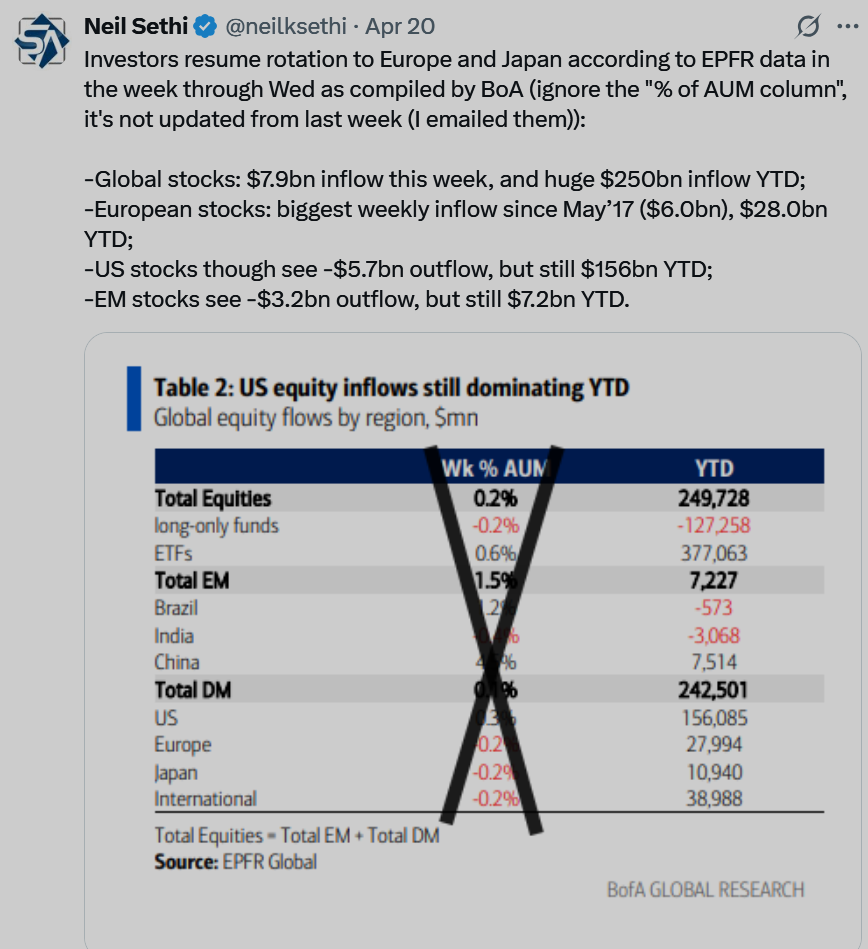
Here's a look at fund flows into US stocks:
Cross border inflows into US assets has been skyrocketing since the beginning of 2022. There is a lot of foreign hot money in US stocks.Lastly, let's take a big picture look at the call/put ratio, or the ISEE index of opening calls to opening puts ratio. This shows that we are at a historically elevated ratio for the index, still showing lots of call speculation.
The long term fund flow and positioning data are all negative for the SPX. In the short term, you can get counter-trend moves that get bulls excited again thinking the worst is over. But the long term factors such as valuations, positioning, and speculative activity are all showing that we are in the early innings of this downtrend, not the late innings.
I haven't even gotten into the fundamentals of the market, which are on shaky ground with Trump's infatuation with tariffs, and animosity towards trade with China. China has the upper hand in this trade war, as Trump's pain threshold is much lower than Xi's. Wall St. is already breathing down Trump's neck, along with his group of trade hawks in Navarro and Lutnick. Wait till Main St. gets upset when the effects of the tariffs really hit home, and prices for imported Chinese goods skyrocket and/or are just unavailable due to lack of inventories.
These tariffs will be so painful for the US economy that they won't ever gain traction, and Trump will backtrack quickly, or be forced to give up his tariff powers as Congress takes away his keys to the tariff controls with a 2/3 vote if he remains intransigent.
Covered the short last week, as I was wary of holding shorts over the long weekend. Unfortunately, I covered too early as we are getting a big gap down this morning, along with the long end of the Treasury curve selling off hard. This is a terrible market to be a long term long in US stocks. I believe we will be chopping around in a range between SPX 5150 to 5450 for the rest of the month, so we are closer to the lower end of that range at the moment. I may nibble on SPX longs if we get some further selling after the cash open. Will not chase longs higher. Eventually after the chop for the next 2 weeks or so, I expect another sharp move lower towards SPX 4800-4850 in May/June.
Monday, April 14, 2025
From Trump Premium to Trump Discount
The US stock market is in transition. From a raging bull market, to what is likely to be a raging bear market. From a market that is pricing in a Trump premium, to one that is pricing in a Trump discount.
The initial euphoria after the Trump election victory is a distant memory. Hopes for big tax cuts, deregulation, and a repeat of the 2016 to 2020 up move in the stock market was consensus. It was perhaps the most bullish I've seen investors on US stocks since early 2000. It doesn't take much to push investors towards a less optimistic view when they are that bulled up. This time, it wasn't just a small little catalyst, but a big bomb going off with the Liberation Day tariff announcement.
It was commonly viewed that tariffs were just used as a negotiating tactic to make better trade deals with foreign countries. But it underestimates the desire for Trump to have the US go back to the old days, where it was one of the manufacturing hubs of the world, with a smaller trade deficit, and when high paying factory jobs were commonplace. Of course, for those with any kind of insight into the world of manufacturing and production, the US just can't be cost competitive with China unless it jacks up the tariffs several hundred percent, and thus raising prices on almost all goods by huge amounts. That's just not going to happen. The market would break far before it even got close to that situation. And if the market breaks hard enough, next thing you know, Congress will be taking the keys from Trump and taking away his tariff powers.
This past weekend, Trump caved to Apple and the mega cap tech companies that rely heavily on Chinese outsourcing. It was Trump showing that he reached his pain threshold, and was feeling the heat. It also gives China more leverage, as it shows that Trump is a caver, and while crazy, will back down if the stock and bond markets start panicking like they did last week. Which forced Trump to both delay tariffs by 90 days, and then backtrack even further with more tariff exemptions.
Of course, Trump didn't want to sound weak, so he tried to talk back his exemption, saying it wasn't an exemption, but a reclassification to another bucket of tariffs which are at a lower rate. Howard Lutnick came out on the TV circuit to try to tamp down the enthusiasm, saying that tariff exemptions were temporary. For those that know Lutnick, he is probably the biggest brown noser in the business. What he's saying is what Trump wants to hear, and what Trump believes. The stock market doesn't want to believe in that reality, instead hoping that Trump fires Lutnick and Navarro, so the stock market can go higher. Trump is far closer to Lutnick's view than Bessent's view. While the market seems to love Scott Bessent, as he tries to placate the market every chance he gets, its not what Trump's really thinking. Trump wants tariffs, and wants to keep using the threat of tariffs to exert his Presidential powers. That's not going away.
With the gap up today, investors are assuming that Trump has showed his hand, and his mettle, and its a weak hand. He's clearly not willing to stand up to the stock and bond markets to push his trade agenda when they are having a tantrum. As much as he wants to reduce trade deficits and bring back manufacturing jobs to the US, he doesn't want to experience the pain and pressure of being responsible for a big decline in stocks, with growing anger from his corporate base.
While Trump caving means that markets are less worried about big tariffs, he's stubborn and so obsessed with being at the center of the action, that I expect another tariff tantrum just so he can be the center of attention again. He enjoys being both the arsonist and the firefighter who puts out the fires that he starts.
Last week's panic move lower, and subsequent huge rally higher on the 90 day tariff delay was a classic waterfall decline, followed by the strong reflexive bounce. You saw similar action in August 2011 and August 2015. The current situation is worse than both. Not only are investors more complacent than back then, they are also much more heavily exposed to equities, making it likely that last week's move lower was a prelude to a new bear market, rather than the starting point for a re-newed bull market.
The COT data released Friday showed a significant, but not overwhelmingly big reduction in asset manager long positions in SPX. If you zoom out on a 5 year time frame, the current asset manager net positions in SPX is still on the high side, but no long extreme. It is still way higher than most of 2022 and 2023.
![]() |
| SPX Asset Manager Net Position |
![]() |
| SPX Commercial Net Position |
Last week, you saw the stock guys on CNBC start talking about bonds. They only talk about bonds when something bad is happening in that market. Once again, we witnessed long term Treasuries fail to provide a hedge to equity market weakness. Its now the 3rd time in a row, the first in 2022, the second in late 2023, and now where Treasuries sold off hard as equities sold off hard. Instead of acting as a hedge, long term Treasuries have acted as piece that adds more downside volatility in the portfolio in times of stress. The golden days of Treasuries providing a positive yielding hedge to equities are long gone. That's bad news for financial asset investors that could use the diversifying benefits of a negative correlating asset that provides positive returns like bonds did from 1981 to 2020. That era appears to be over, as we now live in an era of fiscal dominance.
I believe that for the rest of the year, you will be transitioning to pricing in a Trump discount, a much bigger one than what happened post Liberation Day. Trump has only a few cards that he can play when trying to push around the stock market. Its either big tax cuts or big tariffs. Despite him caving on tariffs over the past few days, he won't want to give up on that card, not when it gives him so much power. And he loves being the center of the chaos, where he seemingly controls the outcome. Its a power trip for him. He's not going to give that up in order to placate investors and CEOs.
Anecdotally, I still see a lot of investors eager to try to catch the rebound, expecting a continued rally when tariffs are out of the headlines. You have seen a huge amount of retail dip buying this year, and that has continued into the waterfall decline. With the Fed unwilling to bail out Trump on his tariff mess, and with big tax cuts and deregulation a more distant and uncertain catalyst, there doesn't seem to be the fundamental backdrop for a sustained uptrend. We will see bounces and big bear market rallies, but the damage has been done. Its looking more like the fall/winter of 2000, the spring of 2022. The beginning of a bear market.
I entered a starter short position after the 90 day tariff announcement rally, and remain short. I am looking to play for a 2/3 retrace of this rebound off the panic lows, expecting more volatile chop in the coming weeks. Not looking to put on any big positions in this volatile market, especially on the long side. Playing small ball until I see a fatter pitch. I do think you will get a magnificent shorting opportunity sometime this summer. Until then, looking to just stay in the game, and trying to hit singles.
Monday, April 7, 2025
Crashing
Monday, March 31, 2025
Sturm und Drang
That elevated quickly. One week ago, almost everyone was expecting tariffs to be limited, and not as bad as initially feared. I heard too many fast money traders who were expecting a big pension fund quarterly rebalance from bonds to stocks. But these pension funds are complete idiots. They know that there are many that try to front run their rebalancing flows. So they probably spread out their rebalancing over several days, way ahead of the end of the quarter. It hardly ever seems like these quarterly rebalancing flows have much impact on the market.
Fast forward one week to now, and 200 SPX handles lower, and the mood is quite different. No talk of the quarterly rebalance at the end of the quarter, which is today. Nothing much has changed. Sure, Trump added some auto tariffs last week and threatened secondary tariffs on Russian oil this weekend because he was "pissed off" at Putin. But overall, its the same picture.
It continues to be amateur hour at the White House. Through the sturm und drang of headlines good and bad, nothing much has changed. You still have the same unaccomodative fiscal policy with a Powell that is just watching and waiting, probably hoping for Trump to make a bigger fool of himself with all the wax on, wax off on tariffs. Powell is in no mood to help Trump with loose monetary policy, not with the convenient excuse of tariffs being potentially inflationary.
Without supportive fiscal and monetary policy, the market is between a rock and a hard place. That's why you have so little confidence in this market, with a bounce that took 8 trading days to go from low 5500s to high 5700s, but only took 3 trading days (including today) to go back towards the low 5500s. It seems like it takes twice as much energy and effort to go up than to go down these days.
The positioning is still bad, just not horribly bad like it was in mid February, before hedge funds started unwinding their big net long exposure in US stocks. Hedge funds are back to more neutral positioning, but the slower moving institutions and real money are still in the concerned, but not selling yet stage. And retail is just horribly positioned, basically all in on stocks, thinking that stocks only go up. They have completely changed their thinking on stocks: from thinking they are a horrible investment, from 2008 to 2016, to now stocks are always the best investment in 2025.
If you look at the data from those that track retail investment flows, they have been heavy buyers of stocks over the past 12 months. In particular, since the Trump election victory in November. This high net long positioning is also seen in the CFTC COT futures data for SPX futures, showing small speculators at historically high levels.
The COT data last Friday showed asset managers re-entering their large net long positioning, buying back what they sold in March. Only to get rug pulled again in the last few trading days. Its not healthy to see asset managers so eager to put back on such large net longs in this kind of market. And the result of this offsides positioning is the nasty selloff you had on Friday.
Throughout the volatility, the bond market has relatively calm. You are not seeing a huge rally or a flight to quality that you saw in February when the SPX dropped 10% over 3 weeks. Instead, you are seeing mild negative correlations with stocks and bonds, as bonds rally when stocks selloff, and bonds selloff when stocks rally. Back in the old days, the 2010s, bonds would rally when stocks sold off, and would often not selloff or even rally when stocks went up. Those were the golden times for bond investors, as supply demand dynamics were very favorable for bonds, with QE, lower budget deficits, and lower inflation.
With the vicious selling on Friday, spilling over into the overnight market Sunday and into Monday morning, I have started a long SPX position, as the selling has gotten extreme in the short term. I am not super confident that 5500 will hold, but even if it does, I do expect 5400 to be strong support in the case of true panic this week. At these levels, it is worth a shot to try to catch a bounce once the uncertainty clears after the tariff announcement on April 2, and after the feared to be bad nonfarm payrolls report on April 4. Seasonally, we are in a very positive time of year, as April is usually one of the strongest months of the year, although last year didn't play out that way. I am not a big believer in seasonality, so I don't put much weight on it. Especially when you have a lot of capital gains taxes that are due April 15, with the big stock gains in 2024.
Whatever happens in the short term this week, I expect it be to be a volatile range in April, from 5400 to 5700 (bad case scenario), or from 5500 to 5800 (good case scenario).
Monday, March 24, 2025
From Bull Market to Something Else
Monday, March 17, 2025
Bubble has Popped
The bubble has popped sooner than expected. Unlike 2000, when the bubble extended for several months after rabid enthusiasm had set in, this time, it didn't even last 2 months past the Trump election win before the indices started to falter.
The market can give you the clues but you have to be willing to put money on the line if you want to cash in. You have to risk being a bit early if you want to be sure that you catch the reversal. The violent gap downs and volatile intraday price action were clues that the market was unstable at those high prices from mid December to early February. But given the resilience of the market in late January to mid February, I expected a bit more of a thrust higher above previous highs. To suck in more bulls. But alas, the market was already too saturated with bulls and there were no more suckers looking to chase all time highs. Instead, we got a very minor break of previous all time highs on February 19, and have been going down in a straight line since.The price action of the past 3 weeks clearly shows that investors are overinvested in US stocks, and underinvested in international stocks. This is the first time since 2008 when you've seen such lopsided underperformance by US stock indices versus European and Asian indices. That is a huge signal, because almost everyone has bought into the US exceptionalism theme. That has led to the biggest ever household allocation to US stocks in history.
After the carnage of the past 3 weeks, there are many now looking for a bounce off these oversold levels. We got the beginning of that on Friday, and Nasdaq has been outperforming the SPX for the past 2 days. It looks as if there is decent support at the the 5500 level, with March opex coming up soon. In the past, there used to be a strong tendency to rally into the big quarterly options expirations of March, June, September, and December. That tendency has disappeared in recent years, perhaps due to the prevalence of options speculation (especially calls) that is unprecedented in stock market history.
You add to that the negative fiscal impulse of tariffs and DOGE. Its not a pretty picture for US growth for the next several months. You can already see the negativity from a weak stock market show up in the consumer confidence numbers. The US is the most financialized economy in the world. It has the greatest concentration of wealth tied to equities vs other assets. The wealth effect is real. This is just the appetizer. The negative wealth effect of a bear market starting in 2025 would be even bigger than the one felt in the bear market starting in 2000.
What can be assured is that this week's moves will be exacerbated by the triple witching opex forces at work. They were super bearish on the downside for December. This time, I doubt that repeats due to the already big down move that's happened since February monthly opex. My crystal ball, which has been foggy over the past few weeks, would think that we get a choppy up and down price action, that ultimately goes higher into Friday morning. But my conviction on the bull side has gone down with the continuous weak price action, and yet, you get surveys like this:Sure, you can say that the big Friday rally was the reason for the sudden optimism. And in an uptrend, the optimism is usually a sign that the market will keep going higher. But we're not in an uptrend anymore. That's a really lopsided ratio of short term bulls to bears, which is contrary to the price action of the past 3 weeks.
Still holding a very small long SPX position, and looking to add on a dip this week. Not looking for a huge bounce, but a move towards 5800 is possible within the next month. On the downside, 5400 is about as low as I think this market goes before you get a multiweek move higher.
Monday, March 10, 2025
Chopping Down
Monday, March 3, 2025
Jack in the Box
Retail investors are Jack. The market is the box. Its been a Jack in the Box market. Retail got rugged hard last week. Its been a brutal 10 days for retail investors, as the momentum crowd favorites got crushed and massively underperformed a weak market. Unlike the January selloff where the selling in momentum and retail favorites was tame, this time the selloff was led by the momentum names.
This market is volatile, but directionless. Its in a hurry to get to nowhere. Its stuck in a big box. From Friday opex till last Friday, over a span of 1 week, the SPX dropped 290 points, almost 5% in a week. That is fairly intense volatility, something unusual for a market that's lingering around all time highs. It points to a market that is not normal, something where the past patterns are less common. This market is giving you much less time to sell the highs than the markets you saw in 2023 and 2024. Its been an adjustment period where I've been too patient waiting for the right spot to short, and missing the entries because they don't last for long.The last sweet spot entry was after the FOMC minutes on Wednesday, Feb. 19, when the SPX went above 6140. It stayed there for about an hour and never sniffed those levels again. Its a brutal market for those buying strength and expecting breakouts to keep going higher, like they did last year. The character of the market has changed, and its our job to adjust to the new patterns.
It seems pretty clear now that we are stuck in a range, although it can feel scary. The movements are violent from the upper end to the lower end. Roughly, we can define the current range as being between 5800 and 6150. Eventually, more and more market participants will catch on to this being a range bound market. When they show less fear and start getting bolder and nonchalant at the bottom of the range, that's when you need to get more concerned. But we're not there yet, as I heard quite a few calls for a move towards 5600 and 5700 on CNBC as the market was hurtling lower last week. We are still getting the fear at the bottom of the range, which means investors are not really believing that we're stuck in a box.
The ISEE index of calls to puts opened shows that we reached mid January levels of put buying. Investors started buying more put protection last week, and the volumes were above average. We've rung out most of the post Trump election optimism from this market. It makes it less likely that we get the rapid, deep down moves over the coming weeks. With more put protection bought, there is less need to panic sell weakness.
Monday, February 24, 2025
Entering Stall Speed
This high flying airplane of my market is showing signs of entering stall speed. Momentum is a self perpetuating phenomena where strength induces more fund inflows and more strength, until you reach a saturation point. At that saturation point, the inflows are not sufficient to maintain the high altitude, and the stocks get dumped, with weakness feeding further weakness. During this process, there are some wild down moves that match the steepness of the up moves.
Reddit WSB favorites PLTR and HIMS, along with many other momentum favorites made spectacular tops this week. It is not coincidence that this happened during an options expiration week. Some of the other large cap momentum blowoff tops include RDDT, CVNA, NET, and WMT. WMT even became a momentum favorite this year. Its valuation reached overvalued extremes that reminded me of the way it traded during 2000, in the midst of the dotcom bubble.
Tuesday, February 18, 2025
Iron Chin
Monday, February 10, 2025
Being Desperate
“Most people overestimate what they can achieve in a year and underestimate what they can achieve in ten years.” - Bill Gates, Tony Robbins,.....
The market will seek out your weaknesses, find them, and test them. One of those weaknesses is desperation. Especially for full time traders. When you have to make money, then you are trading from a weakened position. Its easier to succeed when you want to make money, but don't need to make money.
I've noticed that I've usually traded better when I've been winning than when I've been losing. Its because losses affect your mindset differently than wins. After losses, most traders, including myself, want to recover those losses quickly to get rid of the negative emotions that come from losing. The bigger the loss, the stronger the urge to recover losses quickly. This means trading from a desperate position, which is a position of weakness.
After wins, most traders are not in a hurry to get into the next trade, because they already have a feeling of satisfaction from recent wins. The bigger the wins, the stronger the feeling of satisfaction and the less urge to rush into the next trade. This is trading from a position of strength, with no desperation.
When you are not desperate, you don't take marginal or negative EV trades. You don't sacrifice the optionality that cash provides by being stuck in those mediocre to bad trades. When you have free cash, you have the option to take advantage of good opportunities that come along. Just by not being a desperate trader, you can take advantage of more good opportunities because you aren't stuck in mediocre to bad trades.
This is why I've noticed a streakiness to the results of not only my trading, but other peoples' trading. The psychological aspect of this game is extremely important. But since its so vague, and hard to quantify, it is underestimated and often ignored. When I first started in this business, I gave little thought to psychology and emotions and mind control. Its only after several years of experience and observation that you realize how psychology is such a huge part of the game.
Becoming a full time trader is hard because of the need to make money. Trying to make money in the markets is similar to trying to get a loan at the bank. When you have enough money and don't need to make money, then it becomes easier to make money. When you try to get a loan at the bank, its much easier to get a loan when you have collateral, i.e. real estate, to put up to get a loan. If you have nothing, the bank doesn't want to lend to you. If you have a lot, the bank will want to lend to you.
If you really need to make money from trading, its hard to not be desperate. When you have lots of expenses, and no income except from trading, its nearly impossible to trick your mind into thinking from a position of strength when you are in a position of weakness. Its why those that do make it as full time traders are mostly young traders, who don't have families, who have fewer expenses, and less to lose when blowing up. The nothing to lose mentality actually can reduce the desperation of having to win. And if you add risk management to that, then you have a chance to make it in the long run.
Nothing noteworthy in the COT data or the put/call ratios last week. Asset managers made small reductions in net long positions in index futures, and dealers reduced some of their net short positions. Bond yields have stabilized around 4.5%, which is good news for risk asset holders. It looks like we got the fear based bottom in both bonds and stocks in January after the hotter than expected NFP number along with the pre Trump inauguration jitters on tariffs.
Last week began with tariff news at the start of the week, and ended with tariff news at the end of the weak. These headlines ignite 1-2% moves, but they don't last. The more often you get these headlines, and the more predictable they become, the less they will move the markets. It appears a lot of selling was front run on Friday afternoon ahead of the potential announcement of reciprocal tariffs. If tariffs are the worsã…… thing that can happen to this market, then that's not really bad news. Tariffs are easily taken off, and their effects are overrated. Especially if you get all those tax cuts that Trump is looking for.
Still holding a small long position, not looking to make any big moves here, in this narrowing range. Although if I didn't have any position, would be taking a long position on any tariff fear induced dips this week.
Monday, February 3, 2025
Lowering Expectations
Once again, the market gets kneecapped by news, this time, something that was kind of expected. Everyone knew that tariffs were coming, just not sure when and how much. The reaction to the news is a bit surprising, since this wasn't completely unexpected. It shows you how much optimism was priced into the market after the Trump win, as everyone was talking about the good things coming, and not much about the potential bad things coming. We are still working that off, with these violent gap down moves, showing you how bad it is to be long stocks when there is so much enthusiasm.
Its been 1.5 months since the beginning of the real shake out, starting from the December FOMC meeting. Usually, these shake outs and pullbacks last about a month. But this one has been so choppy with big moves in both directions, that its not a typical pullback. Its more of an off/on selloff that would normally be completed in less than a month, but with the intermittent face ripper rallies, you've not been able to get a real purge of the saturated positioning that was present a couple of months ago.
With this latest piece of "bad" news, we are getting closer to the end of this choppy correction. This is not a stable condition for the market, to have these huge gap downs and then equally huge face ripper rallies right afterwards. Eventually you either blast higher and resume the uptrend, or the market keeps going lower, really flushing out the weak hands and scaring investors.
From an economic viewpoint, there should still be an initial boost from the Trump win with more investment spending and looser credit and regulatory conditions at the banks in the next few months. It makes it likely that you will have at least a bounce from these selloffs, or more likely, a typical resumption of the uptrend after a corrective period.
Tariffs are overrated and overhyped. Because they are unpopular, they are unlikely to stay on for the long term. Most of the US population doesn't like higher prices for imported goods. Most of the US population won't benefit from any trade protection coming from tariffs. And most of the US population doesn't like lower stock prices that are coming from tariffs. Since most of these imported goods can't be substituted by goods produced in the US, it just ends up being a tax on consumption and production. From past history, Trump is likely to declare victory over his tariff strategy after he gets some token concessions.
Its actually a better thing for the market to have the tariffs come out from the beginning, in order to lower expectations for the coming quarters for economic growth. The expectations were a bit too lofty going into 2025, with irrational expectations of strong growth coming from de-regulation and future tax cuts, with very little concrete evidence. Now investors are slowly coming back to reality, with the DeepSeek news and now tariffs driving away a lot of that unbridled enthusiasm, and keeping the trend on a more sustainable path.
The string of big gap downs and bad news is actually a bad thing for the bears in the short to intermediate term. There was a risk that if you didn't get any bad news, and the market kept going higher after the bottom in mid January, you could have had a nasty blowoff top made in February/March, leading to a much bigger correction. Since the SPX has been contained below 6125 on the rallies, it means that the selloffs don't have as much fuel, and won't be as long lasting. You just haven't had enough time for the weak hands to build up big long positions again, like they did in early December.
The COT data as of last Tuesday, didn't show any big changes in positioning, with asset managers adding a small amount to their net long positions. Looking at the ISEE index, you can see that the enthusiasm has been pared back to more normal levels of call buying.
The excessive optimism has been pared down and you are back to more neutral levels of sentiment among investors. You can see that in the NAAIM exposure survey.
The bond market has stabilized closer to 4.50% after selling off to 4.80% 10 year yields. This should help stocks from going down much further. The bond market doesn't seem to be fazed by tariffs, which shows that speculative positioning is much lighter and you probably have CTAs short bonds here, which adds potential short covering fuel for bonds if inflation isn't as sticky as many expect for 2025.
Still holding the small long position from last Monday, I may add to the position if there is a further selloff from the current levels in the coming days. Leaning bullish, but not a great risk/reward so keeping positions small.