Wednesday, May 10, 2023

Heaven and Earth

We are in a new Gilded Age.  A time of extreme inequality, which has spurred a populist wave in politics, which ironically has just exacerbated the inequality.  This inequality originates from corporations financing campaigns and using lobbyists, who have bought out politicians, ensuring favorable taxes and regulations.  These regulations and lack of anti-trust enforcement, has created a M&A boom, which has effectively turned most US industries into oligopolies, providing corporations with unprecedented pricing power, which they have exercised to full effect over the past 2 years.  Excess money supply from fiscal pork stimulus, along with greedflation, are the 2 main reasons you had an inflationary wave after 2020.  

Corporations had a convenient excuse to continually raise prices with all the talk about supply chain issues, and rising commodity prices.  And now that commodity prices and raw material input costs have come down, they are sticking with their margin over volume strategy, sacrificing some revenues for higher margins and higher net profits.  This margins over volume strategy requires less labor, as there is less production.  This should embolden companies to be more willing to layoff workers, not a great sign for the economy.  

Corporations can only get away with this strategy if there is limited competition.  And that's the case for most industries, as competitors have been acquired, leaving fewer players left on the field.  The fewer the competitors, the easier it is to raise prices and quietly collude to maximize profits.  This pricing power flows through to the bottom line, as can be seen by the trend in profit margins as a percent of GDP. 

Having few competitors also means you can pay workers less because there are fewer competitors for that labor.  

 
The over the top Covid stimulus of 2020 and 2021 ended up flowing mostly to the wealthy, a kind of reverse trickle down effect.  When most of the poor get money, they spend it, or if they do invest it, its often in bad investments such as meme stocks, random crypto coins, or they just leave the cash in the bank collecting 0% interest.  So whatever stimulus money the poor receive, it eventually ends up trickling up to the top.  That's what has played out over the past 3 years.  So the excess savings, while declining, is also changing in composition.  A higher percentage is now concentrated among the upper class, those who have much less propensity to spend their income and wealth than the lower and middle class.  
How does a 5.25% Fed funds rate affect this situation?  Well, you can break it down into those who have excess cash to invest in high interest savings accounts/money market/T-bills and those who need to borrow money.  It is heaven for those with excess cash, as the high interest rates provide passive, risk-free income.  On the other side of the coin, it is back to earth for those that need to borrow money to either operate businesses or to maintain their current standard of living.  Don't forget that those who want/need to borrow money have a much higher propensity to consume and spend their excess cash than the wealthy who won't change their consumption patterns based on receiving a few extra percent on their cash.  

For those benefiting from the higher interest on cash, they won't be much affected by the extra income.  But those that are hurt by the higher interest will either find it difficult to get loans or credit extensions, or just be unwilling to pay the high interest rates (for those looking to make investments/run a business).  In particular, those that rely on leveraged loans (variable rate), are feeling the pain.  

This ties back to the current environment of a working population that is flatlining, especially without all that illegal immigration of the past.  When you don't have a growing working population, you don't have a vibrant economy.  The only growth you are seeing is in the elderly population, and they are mostly consumers, who are not providing productive capacity to the economy.  The elderly are just fueling more inflation by consuming while not producing.  I sometimes hear arguments about how tight the labor market is, how wage growth is strong and thus the economy will be strong.  Let's play a hypothetical game.  Let's say you cut the working age population by 90%, and wages go up 1000%.  The labor market would be super tight and the wage growth is super, duper strong.  Is that a sign of a strong economy?  No, its just a sign of a tight labor market.  Tight labor market =/= strong economy.  Just look at Japan and their sub 3% unemployment rate.  No one would consider the Japanese economy as being very strong.  
 
What the crazy amounts of fiscal pork in 2021 and 2022 has done to Wall Street is confuse a short term crack up helicopter money fueled boom with a sustainably strong economy.  The US is not an organically strong economy.  Population growth rates, among those age 15-64, is miniscule.  What's been fueling the strength since 2020, and to a lesser extent since 2017, is an increase in budget deficits through a combination of tax cuts and increased government spending.  That's poor quality, inflationary growth that comes purely from handing out cash to the private sector from the money printer.  As you can see below, inflation (in red) is the vast majority of the contribution to nominal GDP growth since 2020. 
 

While big budget deficits are still continuing, its the fiscal impulse (change in budget deficits) that affects economic growth.  And the fiscal impulse is only marginally positive for 2023, mainly from less capital gains taxes being paid and a slowing economy.  The main driver of US economic growth, big budget deficits, won't be able to overcome the tightening credit conditions which should lead to the well advertised recession later this year.  
 
Consumer demand should continue to trend lower as the labor market weakens, inflation remains sticky due to greedflation/oligopoly pricing, and as credit tightens, reducing the cash flowing to consumers.  While it is consensus that we will be getting a recession later this year or in early 2024, investors are not optimally positioned for it.  You are seeing big overweight in equities and cash, and big underweight to fixed income.  The best performer in a recession is fixed income, even if inflation remains sticky.  The Fed has been adamant that they are higher for longer, and that they will not cut rates this year.  If that is the case, which I don't believe, that would just make the economy even weaker than if they were more willing to cut.  So in a paradoxical way, Powell's stubborness and unwillingness to cut will create conditions which are optimal for fixed income.  Yet, that's not how most investors view the current situation.  They believe that a hawkish Fed that keeps rates too high and doesn't cut early is bad for bonds, when in reality, its actually great for bonds. 

The markets these days have slowed down and many days just feel like a holiday, with not much happening.  This market has gotten complacent, but not bullish.  There is a difference.  People are not fearful, but they also realize that economic conditions are not favorable for equities.  This creates a situation where the market remains sleepy and trading in a small range until the cumulative effects of the monetary tightening and deposit flight bear their weight on the banks first, and then to the overall market.  
 
Investors who are unwilling to chase stocks higher as the economy slows is not an environment where the SPX can grind higher.  It will probably just be range bound.  I can picture a similar situation to what happened in 2015, as the volatility compressed for several months until it exploded higher in August 2015.  


The latest news these days is the debt ceiling, and how catastrophic it would be if the US defaulted on its debt.  It would just be a technical default, as they would just delay payment until the debt ceiling was raised.  And it will get raised eventually.  What's interesting this time is that the House Speaker McCarthy is in a bit of a hot seat, as he can be kicked out of his post quite easily, the deal he made to become speaker after failing multiple votes.  This will incentivize him to get a palatable deal for his party, which means he would rather default than pass a clean debt ceiling deal.  So at the margin, this should reduce government spending a bit for the next budget.  In any case, the volatility will just be temporary and will be much about nothing, just taking the focus away from the important issues to the market, which is the tight monetary conditions and the continuing deposit flight from the banks.  

Not much to do these days, added to some individual stock shorts that rallied last week.  Expecting continued low volatility for the next few weeks, with occasional dips  that get bought, similar to what you saw from April to July 2015, before you get the big waterfall decline. 

Friday, May 5, 2023

Culling the Herd in Banks

Powell just pulled forward the date of the first cut by hiking again.  Now you will have a reverse repo facility offering over 5% on cash, while banks pay next to nothing on deposits.  That magical 5% number sounds much higher than a rate with a 4 handle. 

People are bad at math.  You have people with savings accounts that pay less than 1% interest while holding credit card debt they are paying over 20% interest on.  Many don't understand how much interest income they are giving to the banks by not moving excess cash from their bank to a money market fund.  $100,000 earning zero at the bank is basically giving up $5,000/year to the bank in income.  

But things are changing.  Interest on cash is now in the news.  You have interest from a money market account on a magazine cover.  Cash earning market interest rates are popular.  Banks need sticky deposits, that don't care about the interest they get.  People didn't care when rates were at zero because they weren't losing out by keeping excess cash at the bank.  Since SIVB, people are starting to care.  That's bad news for the banks. 

In the age of social media, news travels fast.  The more that regional banks are in the headlines, the more negative exposure they get, which encourages more deposit flight.  It doesn't help when you see banks plunging on news that they are looking to sell (PACW).  Its not evil short sellers attacking these stocks.  These companies are up for sale because in a 5% Fed funds rate environment, deposits are no longer sticky, and money starts to move to where there is yield.  

With the crap long duration mortgages and low fixed rate loans on their books, if these banks have to make up for the deposit losses with wholesale funding at market rates, they can't make money.  They become walking zombies.  And for a bank, when you become a zombie, the stock price goes down a lot, which makes depositors nervous, which induces more deposits to leave, creating a vicious circle.  Sure, PACW can survive in the current state if none of the deposits leave.  That goes for all the regional banks whose stocks have been getting pounded.  People selling these regional stocks are not worried about the current state.  They are worried about the future state.  A future with much fewer low cost deposits as deposit flight continues to those seeking higher risk free yields.  People are dumb, but not that dumb.  Eventually they catch on to the banks ripping them off on their .01% yielding deposits. 

These regional banks can't survive for long unless Powell takes rates drastically lower, and quickly.  In all likelihood, a bunch more of the regional banks will have to go bust first before those big rate cuts happen.  Its survival of the fittest for the regional banks.  Those with the fewest CRE loans and long term debt on their books will survive.  Those that got greedy seeking yield in 2020-2021 on their assets by going out in duration will be the most vulnerable to getting culled in the coming months.  

This culling process is going to be disastrous for bank lending.  The demand for credit was already going down before the SIVB debacle happened.  At these elevated rates, with a slowing economy, it just doesn't make sense to make long term investments.  That's the demand side.  The supply side situation for credit is even worse.  Regional banks make up a huge portion of commercial real estate and C&I lending.  Seeing how their deposit base is getting less sticky, they will be making big cutbacks on lending to the real economy.  Credit is starting to freeze.  

Credit is the best leading indicator for the economy.  More money flowing through the economy generates growth.  Turning off that spigot eventually catches up to the economy as new loans get turned down and loans coming up for renewal are not extended.  Its not going to be a sudden event, but more of a slow squeeze, sucking oxygen out of the patient.  Once you get to a critical point of too little oxygen, its game over. 

The SPX is hanging tough, just selling off a couple of percent before the dip buyers come back in and rally the market again.  A lot of this bid over the past month has been coming from dumb beta systematics that are upping their equity exposure as the volatility goes down.  Corporate earnings still haven't reached the precipice of the cliff, so the buybacks are still heavy.  Investors are a bit nervous, but they aren't selling.  Take a look at the flows into technology funds since 2007.  It went parabolic in 2020-2021.  And they haven't sold. 

Tech stocks are still loved.  Going into a recession that will probably be deeper than most expect.  Not a great set up for Nasdaq.  It boggles the mind to think that AAPL, MSFT, and META are considered safe havens in a recession.  Those are 3 economically sensitive stocks with slow growth.  The love affair for big cap tech stocks is so deeply ingrained in investors that they act as a safety blanket when you have these bank crisis headlines. 

Its gotten to the point where I think it will be better to just short Nasdaq instead of SPX when the time is right.  Maybe it happens after the debt ceiling gets done and investors breathe a sigh of relief.  From past experience, its risky to short when you have bad news headlines dominating the tape like you have this week with the regionals.  

In all likelihood, the Fed is done with its hiking cycle, especially with the continued stress in the regional banks.  I made a wrong assumption that a Fed hiking while not making any mention about future tightening would be celebrated.  But investors just couldn't sit still on the banks and started selling the banks aggressively right before the FOMC meeting.  That was definitely unexpected, especially after the uncertainty of FRC was taken off the table as JPM took them over.  The grace period after that was less than 24 hours.  Now the market's main focus is on the banks, and that's not an environment where you will get institutions chasing stocks higher even after the Fed basically said in their round about way that they are pausing.  So I missed a good short there in SPX on the end of April rally. 

Its been 7 weeks since the SIVB panic so that's plenty of time for this rally to exhaust itself and run on fumes.  It appears we won't be getting that run to SPX 4200 on a Fed pause.  There's nothing bullish about a Fed that stays stubbornly above 5%, barring things breaking.  An FDIC guarantee on all deposits doesn't matter.  Its about yields now.

Monday, May 1, 2023

A Calm Interlude

People forget sometimes how often the stock market is boring.  After the crazy volatility in 2020, 2021, and 2022, and even the first quarter of 2023, when you get a boring month like April after the craziness in 2022, it feels abnormal.  But its actually what was going on most of the time from 2012 to 2019.  If you go back for the past 30 years, I would say more than half of those years were "boring years" (1993 to 1997, mid 2003 - mid 2007, 2012-2019), where realized volatility was much less than what you saw in 2020 to 2022.  

If you look at what years were volatile, it basically comes down to 2 types of regimes:  bubbles and bear markets.   2020 and 2021 were a combination of a panic + bubble market, and 2022 was the popping of a huge bubble, which is always the most volatile (eg. 2001, 2008).  I still believe its a bear market, so this interlude of calm shouldn't fool anyone to thinking that the worst is over.  We're just going from a panic phase from a combination of a huge bubble popping and a big decline in bond prices last year, so any kind of stabilization on both fronts will be viewed positively.  This grace period for the stock market should not be misconstrued as a resumption of the bull market.  Systematic funds reallocating to both stocks and bonds is not a long term bull market driver.  Bull markets don't have much fuel when they are at these kind of lofty valuations, with the Fed still trying to fight inflation with Fed Funds 500 bps higher than a year ago.  If it is the start of a new bull market, then I will have to go back to the drawing board to figure out what's changed in current markets that make it so different from past markets.  

The economic fundamentals are weakening, and the soft data is clearly showing this, and the hard data is close to showing this.  There are leading signs of weakness in the labor market such as lower working hours, weakness in temporary work, which leads nonfarm payroll weakness.  Also the weakness in commodities is a lead on producer prices, which leads consumer prices.  It was just a month ago that OPEC announced a supply cut and crude went from 75 to over 80, and last week it filled that gap and crude has been trading weak relative to the SPX for the past 2 weeks.  

Counterintuitively, this coming economic weakness should be just weak enough to get the Fed to stop hikes after May, but not so weak that it worries equity investors into thinking that there is going to be an imminent hard landing.  A poor man's Goldilocks, if you will. 

One thing that gives me pause about shorting right here is that the price action is just too strong given the skepticism I see among the investing public out there, and we've still not gotten any "good" news that get bears throwing in the towel and bulls getting excited.  Recession seems to be the base case now for the majority of the analysts and fund managers I see on TV.  Sure, we had some tech earnings beats but they didn't really excite the bulls or scare the bears.  

You are going to need to see investors get more confident that Powell is done with rate hikes.  Although I don't think he will sound hawkish at this coming FOMC meeting, I also don't think he will be going out of his way to forward guide the market towards a potential easing by signaling a pause.  While I doubt he says that more tightening is necessary, he will definitely leave things open ended to keep the market on its toes and not get too comfortable by pricing the end of the rate hiking cycle.  So I don't think it will be the FOMC that ignites the last leg of this bear market rally. 

What probably needs to happen for the bulls to get excited and the bears to throw in the towel are both technical and fundamental.  Technically, you will need to see the SPX break out above 4200 to stop out the fundamental bears, who are right, but close to their uncle point.  Next, you need some fundamental news to create the reasoning for that kind of move.  My best guess is a softer employment report (somewhere between 50K-130K jobs?) and a weaker than expected CPI number in May would do the job, and take the SPX above 4200.  That would make bears nervous, and bulls feeling invincible, and comfortable knowing that Powell is done with hikes.  That's the point where you want to feed the ducks while they're quacking.  With where the VIX is now, SPX puts will be very attractive to own into coming economic weakness.

Why would I still be bearish when the Fed is done hiking?  Well, its the credit contractions that you will start seeing in the coming months that will slowly suck the oxygen out of the economy.  Its not a flashy bank contagion situation that's going to take this market down.  It will be from an old fashioned credit contraction led by banks reducing lending which feeds into more job cuts and less consumption, leading to recession.  It won't happen in a flash, but it will slowly build momentum and by Q4 this year, it should be a freight train of weakness and negative feedback loops.  Not much to do now, but wait for a fat pitch which I think is coming in the next 2 weeks. 

Monday, April 24, 2023

Economy =/= Financial Markets

People are negative.  The pessimism about the economy is similar to what we saw in late December 2022, when you had a lot of investors calling for an imminent recession and a difficult first half of 2023.  That also happened to coincide with a significant pullback from SPX 4100 down to below 3800, during a volatile time period.  SPX realized vol was around 20.  This time, you hardly have any pullback in the SPX, as it is lingering near the highs, with very little volatility.  Realized vol is now around 10.  So you have half the volatility that you did compared to last time people were similarly gloomy on the economy. 

SPX Realized Vol

The knee jerk contrarians will view this as a bullish sign for the stock market, as you have investors who are bearish on the economy.  But the economy doesn't act like the stock market.  And people don't trade the economy.  They trade stocks.  If you look at investor positioning, you get a different story now than at the end of 2022.   GS Prime Broker data shows net leverage about 5% higher now than versus the end of December. 

GS Prime Broker Hedge Fund Positions


ES Futures Asset Manager Net Position

Not only is the SPX about 300 points higher, hedge fund net leverage is about 4% higher, and asset manager net long position in ES has grown by over 100K contracts from end of 2022 to April 18.  It is asset managers, not leveraged funds which are the better historical fades in the CFTC COT futures reports.  

So investors are acting like they are scared of a recession.  In any case, it seems almost everyone expects a mild recession, where earnings won't go down much. 

Let's get back to the economy.  There are times when the crowd is too pessimistic on the economy, too optimistic on the economy, and when they are about right.  So while you have almost everyone on CNBC/Bloomberg/Twitter talking about a coming recession, like they did in late December, they are positioned much more bullishly than back then.  You got a surprisingly strong start to 2023 for the economy due to Social Security COLA adjustment higher, higher tax brackets lowering percent of taxes withheld starting in 2023, and a strong stock/credit market.  Those positive catalysts are fading as the stock market has stalled out under SPX 4200, the credit market has tightened with bank lending, and Fed funds rate is about to be 75 bps higher in a few days versus late 2022.  Let's not forget about the lagged effect of rolling maturities from the lowest rates in financial history to levels 3-5% higher across the curve.  This doesn't even get to the reflexive feedback loop from the inventory de-stocking cycle which continues to chug along.  

In some ways, the crowd doesn't seem to be beared up enough relative to what the economy will look like in the 2nd half of the year.  Contrary to late 2022, when they were too bearish on the economy before credit tightened enough and before some of the lag effects took hold.  Its been so long since we've had a real recession (2020 was fake) that investors seem to have forgotten how a very weak economy causes a domino effect where weakness begets more weakness until the Fed or the government comes in with big time stimulus.  I doubt the government with come to the rescue considering the House is majority Republican, and they are not in the business of pumping up the economy ahead of November 2024 when a Democrat president is seeking re-election.  

The debt ceiling debate will be the perfect opportunity for McCarthy and the Republicans to take a stand, knowing that any short term blow back for not giving in to Biden and the financial markets will be made up for big time by an economy that will be weaker without ever increasing government spending, easing the way for a Republican victory in 2024 as the economy is in a deep recession.   

So expect no fiscal pump, leaving the Fed as the Lone Ranger who needs to come to the rescue.  And considering how much rhetoric Powell has spewed about killing inflation and higher for longer and not repeating the mistake of the 1970s, there will need to be some notable economic pain before Powell comes in with the bazooka this time.  He will eventually, but I would expect a few small cuts here and there in late 2023/early 2024 that won't be enough, which will force the Fed to go even bigger in the middle of 2024, possibly back to ZIRP.  

While the markets are quite boring these days with volatility going back to 2019 levels, the coming earnings disappointments in the 2nd half of 2023 along with more layoffs and a weakening jobs market should bring back the volatility which will make it a more favorable environment for traders.  This is a fallow period, setting up the harvest later in the year.  I've put on a small short position in some retail favorite stocks, but I am waiting for the May FOMC meeting to put on an SPX/NDX short.  The May meeting could be the final bull catalyst for the bulls who will likely celebrate the end of Fed rate hikes, which will be the worst time to go long/best time to go short.  A false break above SPX 4200 would be an exquisite shorting opportunity. 

Monday, April 17, 2023

The Fed Pause

The Fed hiking cycle appears to be coming to an end at the May FOMC meeting, with Fed governors coming out last week to reiterate market pricing of a 25 bps rate hike in May, but also saying that they see a pause afterwards.  So let's make the assumption that the last hike of this cycle is in May. 

Fed Funds Rate (1999-2023)

Here is the SPX after the last rate hike and first cut in 2000-2001.

Obviously when you do this kind of analysis, the timing of the last Fed hike and first Fed cut in each business cycle is a huge variable.  In 2000, the Fed was about on target with the last rate hike, and the first rate cut, not hiking too late, and not cutting too early/too late.  Remember, the final rate hike in May 2000 happened near the peak of a massive internet bubble, so there was going to be a lot of pain once the Fed had gotten through with its rate hikes.  Despite being at bubble levels, you still had a brief grace period for the SPX after the last rate hike, as it chopped around in a range for a few months, grinding a bit higher before going on a massive downtrend into the first rate cut, which was only good for a 1 month rally, and then further weakness afterwards.  This is typically what you would expect from an average Fed cycle.  

Here is the SPX after the last rate hike and first cut in 2006-2007. 

This time, the Fed was slow to hike rates in 2004 to 2006, going just 25 bps at a time, nurturing a huge housing bubble, which gathered a momentum of its own, keeping the economy resilient for several months after the last rate hike in June 2006.  This is probably the most unusual Fed cycle in recent history, as the economy was able to brush off the higher interest rates and an inverted yield curve for over a year, before finally succumbing to the dual pressure of high rates and a popping of a massive real estate bubble.  The lags of monetary policy were longer than usual as the reflexivity of the real estate mania took a life of its own and credit kept booming despite the higher rates, as the momentum dragged economic growth higher for longer than most business cycles.  Thus, you had a huge rally after the last rate hike, one that lasted a year.  When the economy started to weaken and you got early signs of things breaking in the summer of 2007, the Fed came in with a rate cut which was good for about a 1 month rally, but that was just a bull trap into a massive downtrend.  

Here is the SPX after the last rate hike and first cut in 2018-2019. 

In this cycle, you had a Fed that just got bullied by the stock market.  When Powell made his final rate hike in December 2018, the economy was steady, but growth was slowing.  There were no obvious signs of a recession coming, yet Powell pivoted in January 2019 because....... the stock market went down.  This is where Powell cemented his reputation as a caver, as a folder.  In this case, the stock market was already down over 10% from the highs when the Fed made its last rate hike, and was helped immensely by Powell's pivot, because you had a Fed that was promising easier money when the economy wasn't even that weak.  It was the best situation imaginable for stocks and you had a relentless rally all the way to the first rate cut, which was unnecessary but Powell did it just to keep his promise, even though the economy was strengthening again by the time he made that call.  What happens when the Fed cuts rates when the economy is not weak?  You get a rally, although it was choppy due to overblown trade war fears at the time, once people realized that was a nothingburger, it was off to the races for 6 months, blasting through all time highs and going up relentlessly for 13%.  

Once again, the Fed is faced with a decision on what to do after its final rate hike, which is most likely in May.  The Fed is laying the groundwork for a long pause at above 5% Fed funds rate.  Its one thing to pause at a restrictive level of rates when the economy is slowing and there are no signs of a recession, its whole another thing to pause when the economy is slowing but there are signs of recession in manufacturing and commercial real estate, as well as tech, with layoff announcements accumulating.  

Let's not forget that this economy has a much slower natural growth rate now versus 2000 or 2007, when the demographics was younger, as the baby boomers were in their prime working years, as well as faster population growth.  Productivity growth was also greater at that time.  Global growth was also much higher because China was booming in the 2000s.  So the baseline growth rate is much lower now, which makes a 5% FFR much more restrictive than 5% in 2007 or 2000.  Let's not forget the long period of zero or near zero rates from 2008 to 2021, which incentivized corporations and investors to pile on low interest rate debt to leverage capital for higher returns.  That's not so feasible when short term rates go from 0% to 5%.  So you can absolutely bet that investment will be drastically reduced at these level of rates, especially as the massive distortions created by $6 trillion of fiscal stimulus is no longer there pumping everything higher. 

People talk about today like it is the 1970s, just because that was the last time you had high inflation.  But today couldn't be more different than the 1970s.  Just the overall debt levels in the US and global economy are on a whole another stratosphere than back then.  Less debt = higher tolerance for high interest rates.  More debt = lower tolerance for high interest rates.  The natural growth rate of the economy was much higher.  The population much younger.  No savings glut keeping interest rates down.  There was almost no offshoring to put downward pressure on wages.  Just a totally different world now.  

The Fed hiked so late in this business cycle that its putting the most pressure on the economy when its naturally slowing from the lack of pentup demand for goods and too much inventory(the inventory de-stocking cycle) and the popping of the everything bubble.  The Fed should have been hiking a year earlier, in spring 2021, and that would have been able to slowly bring down the economy with monetary tightening.  Instead, they have back loaded rate hikes and jammed it in over a year, while the business cycle is on the downtrend.  

Compared to May 2000, June 2006, and December 2018, this is the weakest the economy has been when the Fed made its last rate hike.  And its also the most inverted yield curve, mainly because these rates are unsustainable in the long run for this high debt, slow growth economy.  And why are rates so high?  As a reaction to a one time global fiscal stimulus bonanza that caused massive inflation.  An inflation wave that many are extrapolating out into the next several years, just because that's what people do.  With the coming debt ceiling fight and the Republicans' desire not to help Biden in 2024, you can bet on McCarthy not playing ball, looking for either a budget freeze or sequestration for FY 2024.  And don't forget the student debt moratorium gets lifted at the end of August, which will be a drag on consumption later this year.  Plus all the credit tightening and lag effects of higher rates going to work to slow down loan growth and investment.  

The equity market is trading in its own reality, with huge stock buybacks providing the demand as investors increase their cash holdings. 

Those big buybacks will be difficult to maintain when earnings are dropping hard, as I expect in the 2nd half of the year.  Its going to be interesting to see how the stock market trades when the buyback bid is much weaker than it has been for the last few years. 

The coming weakness will really test Powell's mettle to see if he is willing to torpedo the economy and cause a deep recession to try to be the next Volcker.  Powell is quite nonchalant now and seems as if the things will be fine just keeping rates above 5%, but the economy is already noticeably slowing (rising jobless claims, fewer job openings, very weak ISMs, weak demand for diesel/trucking/shipping, and weakening retail sales).  I doubt Powell will be able to hold off on rate cuts as long as he wants.  The economy will be too weak for him to just sit and do nothing.  The market will force a cut, as it usually does when the economy enters a full blown recession.  My guesstimate for that to happen is 3 to 6 months from now (July-October).  Timing when the worm turns is always difficult, which is why I am leaving dry powder available just in case the bulls go overboard.  

I am mostly on the sidelines when it comes to playing the stock index.  The second half of April, after tax reporting season, is usually a bullish time of the year for the stock market, as you get buybacks coming back after the blackout period during earnings season.  I don't expect anything too bad from Q1 earnings, it will be a different story for Q2 and Q3.  For now, its not likely you'll see any big bombs being dropped this season, so you could get a relief rally.  Positioning is not that favorable for bulls, so I would only expect a small rally.  The SPX could grind a bit higher from here, although fundamentals are too weak, and its already up over 350 points from the March lows so I doubt you see any big rallies from here.  Thinking SPX 4200-4220 is as high as it can go before hitting a wall of reality, and even that might be tough to reach.  

I will start layering into short positions if the SPX gets closer to 4200.  The top of this rally should come in early May, around the time the Fed officially signals that they are on pause after their last rate hike, which will probably be front run by eager beaver longs who don't want to miss a Fed "pivot" rally.  A Fed pivot is only bullish when they are pivoting while stocks are down big, and/or the economic conditions are not so weak.  You have neither in the current situation.  It will make for a messy 2nd half of the year.

Tuesday, April 11, 2023

Long Bonds vs Short Stocks

The 2 most common ways to express a bearish view on the economy is to be long government bonds and to short stocks.  Last year, one of those worked very well, the other one was a disaster.  Investors fight the last war.  They have been clobbered trying to buy dips in Treasuries for over 2 years, as you can see from the TLT chart below.  

Despite the big drop in the SPX in 2022, the real economy was quite resilient, still riding the inflationary wave from the bazooka Covid stimulus.  That was a disaster for Treasuries, as high inflation, high nominal GDP growth, and a Fed starting a power hiking cycle was the perfect storm.  

But its a different story now.  Inflation has peaked, even though price levels are still rising.  People sometimes forget that inflation is a rate of change measurement.  Even as prices go higher, as long as they are going higher at a slower rate, then inflation goes down.  That's what's happening now.  And due to last year's blow off top in crude oil, you have some abnormally large base effects coming through for the next few months.  This will bring year over year CPI down dramatically in the coming months.  People talk about inflation being sticky, but this is what the CPI readings will be with the corresponding month on month inflation numbers.  With a month on month inflation number at 0.3%, which is near consensus, the CPI will be down to 2.75% by June. 

I am hearing very few people talk about this.  People are still more worried about sticky inflation, despite WTI trading around 80, lower than almost all of 2022.  A CPI below 3%, as jobs numbers start to shrink, tighter credit in the economy due to less bank lending,  and more cash hoarding into MMFs: near ideal conditions for bonds.  As fuel for the fire, hedge funds and CTAs are still positioned very short despite the big rally since SIVB went bust.  The speculator net position in 5 yr Treasuries is the shortest since 2018. 


Also, you had huge outflows out of bond funds last year, the most since 2010, which is atypical as the age bracket with the most money, the boomers, will be adding to their bond weighting and reducing their equity weighting over time.  You are starting to get some reversal in that trend in 2023, but still a long ways to go to undo last year's massive outflows. 


There has been a sea change in household asset allocations since the start of the ZIRP and QE era in 2008.  Households are now heavily allocated in equities (35.6%) and have very little fixed income exposure (5.8%).  

Household Allocation to Equities as Percentage of Financial Assets

Household Allocation to Bonds as Percentage of Financial Assets

Just as the yields offered by bonds is the most compelling since 2007, you are seeing most investors heavily overweight stocks and underweight bonds in their portfolio.  

From a big picture standpoint, both being long bonds or short stocks for the next 6 months look like a good risk/reward trade.  But I give the edge to being long bonds because of the underweight positioning of most investors in fixed income, and the popularity of cash, which will get deployed sooner or later.  I expect most of that cash to flow towards bonds as the economy continues to weaken in 2023.  Also, being long bonds is a less crowded trade due to still lingering inflation fears than being short equities.  When most of CNBC Fast Money are bearish, as they have been for the past few weeks, I am reluctant to get aggressively short SPX. 

On the recent action in the stock and bond market:  you are seeing the beginning of a divergence in price action with stocks and bonds, a subtle return of the negative correlation.  It appears that bad news is acting as a positive for bonds, but no longer a positive for stocks.  This makes sense because the Fed is basically done with their rate hiking cycle, and any good news will not encourage the Fed to hike beyond May.  But bad news won't encourage them to cut either right away, thus the divergent path of stocks and bonds.  

I've noticed quite a few who are puzzled by the resilience of stocks despite signs of a weakening economy and a likely hike in May (currently 70% odds from Fed funds futures).  A lot of it is due to a much lower realized volatility in the indices, making vol control funds add equity exposure.  Also you have the seasonally strong April time period which is usually good for stocks.  And you have hedge funds that are still at low net equity exposure, which keeps potential bids in the market as hedge funds are more likely to add exposure than decrease it.  And lastly, there is the Fed's pivot card which still hasn't been pulled out, but is getting closer and closer.  What I mean by pivot is the Fed saying they will be pausing, which is akin to opening the door to future cuts, because naturally at these high rates, with the economy slowing and credit tightening, its a matter of when, not if they cut.  That will be the equity rally to fade. 

Thursday, April 6, 2023

Pounding the Poor

Inequality is deflationary.  Raising interest rates exacerbates inequality.  The higher the interest rates, the more money flows from borrowers to savers.  Most savings are held by the wealthy, so they are the recipients of interest income.  The poor are the ones running up credit card debt and auto debt.  They mostly don't own houses, so they don't have mortgage debt because they have no home equity.  The poor are taking the brunt of the punishment for the inflationary money spew of 2020 and 2021.  That is on top of the drop in median income as a percentage of GDP/capita.  The bottom half are taking a smaller portion of the pie, as the corporations increase their profit margins at the expense of labor.  I see nothing to change that situation. 

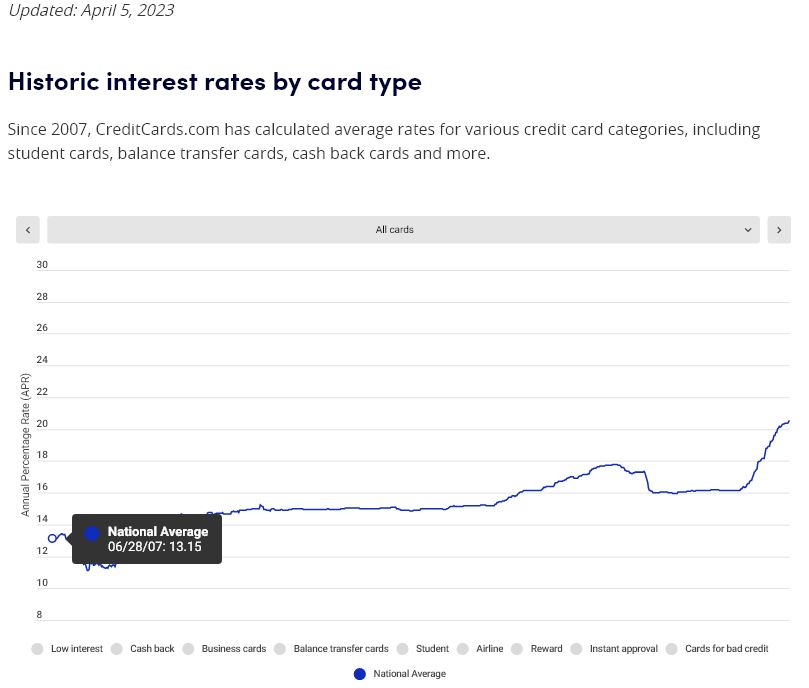
I find it interesting that credit card debt has gone from 13.15% in June 2007, when Fed funds rate was at 5.25%, and is now at 20.35% in April 2023, with Fed funds rate at 4.83%.  Over the course of 16 years, credit card issuers have fattened up their profit margins. 

The stock market isn't really a reflection of the economy, its a reflection of corporations' ability to generate cash flow.  The biggest corporate expense is from labor.  The median wage to GDP/capita ratio has been trending down for the last 40 years.  A boon for corporate profit margins.  Globalization leads to wage arbitrage, and corporations gain a big advantage over labor with fewer corporate competitors for that labor. 


As much as people like to hype up deglobalization, its bunk.  The long term trend of higher Chinese exports continues. 

Unless you get a lot more anti trust enforcement, a lot more corporate competition in the US, and a lot less favorable tax regime for corporations and the wealthy, the long term demand for stocks will be there, either from institutions or from companies  themselves.  Of course, this favorable situation for corporate America is reflected in fat profit margins, which were at a historic high just a year ago, and historically high valuations.  This is why its very unlikely you will ever get to anything resembling cheap valuations in the SPX.  My base case scenario which is an old fashioned credit tightening led recession, SPX probably bottoms around last year's lows of 3500-3600.  I just don't see the SPX going down towards 3000-3200 like some of the bears out there.  There is just too much liquidity and cash sloshing around. 

Unlike 2022, its not a slam dunk to short rallies anymore.  Even though the economy is definitely weaker this year than last year.  Valuations are high, so upside is limited, but cash levels are also high, which means there are a lot of potential buyers waiting to pounce at lower valuations.  Corporations are still doing a ton of buybacks, providing a consistent bid for the market.  I would still lean short here if I had to choose a position right now for the next 6 month, due to the economic weakness which is being underestimated.

This week went a long way towards correcting the misperception out there that the consumer is strong, that the US economy is not close to a recession.  The leading indicators are finally starting to work their way into the coincident indicators like employment.  This time, its very unlikely to be a headfake like December 2022, when we had a similar shift in investor perceptions on the economy towards recession.  Short rates are even higher now, the jobs market is starting to soften, and banks are much tighter with credit and lending. 

The analysts and fund managers that come on TV have turned more cautious on the economy, but they still think that the Fed won't cut rates this year due to high inflation.  But the leading indicators for inflation are coming down. 

By the time they come on TV and start thinking that the Fed will start cutting, its will be too late to take advantage.  The best trade for the next 6 months is being long the short end of the curve, as the yield curve steepens sharply as the crowd realizes that rate cuts are imminent and the economy is in recession.  Those that think Powell will just sit, stay higher for longer, and let the economy deteriorate with Fed funds at 5% while job losses accumulate and inflation comes down are delusional.  

The Fed are like bad traders, they can't sit still.  They've made a bad trade by repeating the transitory inflation lie and cutting too late, and followed that up with another bad trade by overreacting to lagging data and overhiking.  Now they will make another mistake, which will be to not proactively cut rates, waiting for the lagging indicators to tell them that its ok to cut, which will be way too late.  A lot of damage has been done.  The longer the Fed delays rate cuts, it just accumulates even more damage.

Investors suddenly seem gloomy again, with those weak ISM numbers and low ADP stoking recession fears.  Its tempting to see those weak economic numbers and go short, expecting an imminent downtrend, but I'm cautious about the Fed pivot fueling one last short squeeze and hedge fund chase for performance.  And there is also the risk that a lower than expected CPI number next week could fuel another euphoric move higher.  So I remain mostly in cash, with some bonds.  I would be a buyer of dips in the short end in fixed income and a seller of rips around SPX 4200.  Tech and retail favorites are preferred short targets.   

Tuesday, April 4, 2023

On Commercial Real Estate, Risk Parity, and SPX

The SPX just keeps chugging along, going up again, despite OPEC putting in a production cut which squeezed oil prices higher, and a recessionary ISM number.  No matter how many times investors see markets go up on bad economic news, they still don't get bulled up during those situations.  It just feels unnatural for the stock market to go up as the economy gets worse. The market loves to climb a wall of worry, and there are lots of things its worrying about.  Financial contagion, inflation, recession, commercial real estate, etc. 

Risk parity is such a dominant force in the financial markets, that anytime you see bonds rally, usually on bad economic data, its hard for stocks to selloff a lot.  The exceptions, which are deep recessions and financial crises, are uncommon, so the odds are against you to short stocks when bonds are rallying hard.  The foundation of the whole pension industry is based on risk parity, a portfolio of stocks and bonds, with bonds providing diversification and a "free" hedge against stock volatility.  Of course, its not a free hedge, when inflation is rampant, but in all other cases, its a great hedge, as its a positive carry hedge, unlike being long volatility.  With bonds repriced much lower after the carnage in 2022, I expect it to provide that risk-off hedge that will mitigate against investors panic selling stocks unless we get a deep recession, which is definitely possible, but probably less than a 50% chance of happening. 

Just watching CNBC, you can sense the skepticism that the "professionals" have towards this rally.  They always fight the last war.  The last war was inflation, which wreaked havoc in 2022, and that's left some fresh wounds that get people nervous about being long stocks while inflation is still high, but falling.  This mindset is the reason that oil, which has been in a huge downtrend since last summer, gets the crowd all bulled up at the first sign of strength.  Disregarding the fact that OPEC production cuts have happened due to underlying demand weakness that necessitated those cuts.  It was a veritable love fest for energy on Fast Money yesterday, which should make oil bulls nervous.  

Speaking of past wars, all I hear these days is about how there will be another crisis because of commercial real estate and how it's like residential real estate in 2007-2008.  Its fashionable these days to be short commercial real estate stocks/REITs.  I am no real estate expert, but residential real estate is owned by both the middle class and the rich.  The GFC in 2008 affected a huge swath of the income spectrum, and the real estate bubble at that time was huge compared to this past one.  And you had a lot less money in the system sloshing around back then.  Unlike residential, commercial real estate is owned by just the rich.  And the only real negative sector of commercial real estate is office space, which is in oversupply, but is generally in prime locations where the value of the real estate is more in the land than in the property built on that land.  If office real estate gets cheap enough, there will be buyers who just tear down/renovate the building to residential as soon as they get permits to do so.  And based on how popular cash is these days, there are a LOT of potential buyers waiting to pounce on any good opportunities.

Anyway, I'm of the lonely opinion that work from home is a fad, and corporations will soon realize that they are getting much less productivity from their workers when they are not in the office.  Even if it means having to pay for office space, having workers together in an office is always going to be more productive than when they are at home.  Being productive is a burden for the worker, which is why they want to work from home, where they don't have to constantly look over their shoulder and can slack off as their boss isn't around.  But with the lack of competition in the US, corporations have the bargaining power over labor, despite the tight labor market.  That's the gilded age for you, with oligopolies in almost every sector of the economy. 

From a class perspective, the wealthy are not going to be the weak point in the next recession.  The government's deficits are the private sectors' surpluses.  The deficits have been huge since 2020.  And most of it went to the top of the income spectrum.  The wealthy amassed a giant financial war chest from fiscal profligacy over the past 3 years, and are bathing in cash that's earning 5% by doing nothing.  The trickle down effect from some commercial real estate developers losing money and some banks writing down losses is overestimated, in my view.  That's literally a drop in the bucket for the wealthy, who will only feel pain if you get a repeat of 2022, which is not going to happen, as inflation has peaked and the Fed is looking set to pause very soon. 

What's more likely to be the weak point in the next recession is the majority that is not in the top 20%, the group that are renting, have no home equity, and are feeling the squeeze from higher inflation (as corporations use their oligopoly pricing power to expand profit margins) outpacing their wage growth.  Also, quite a few will get laid off as the economy enters recession due to a credit contraction caused by deposit flight at the banks. This bottom 60%, will be the ones cutting back on consumption, both goods and services, later this year and in 2024.  This is not just a US phenomena.  Its happening in Europe and Asia.  A synchronous global slowdown.

Here is a simple way of looking at the timeline from Fed rate hikes to rate cuts.  

Fed raises rates  ----> Less loan demand at higher rates + more deposit flight from banks to money markets ----> Tighter credit + less money flowing through the economy ----with a lag ---->  Recession leading to job cuts -----> Fed cuts rates

Some can argue about the Fed reaction function now that we've had high inflation, many feeling as if the Fed will be late to cut rates and be less aggressive than in the past.  That's possible, but seeing how quickly the Fed came to bailout a two-bit bank in SIVB at the drop of a hat, I think people are overestimating the hawkish resolve of Powell and company.  They are doves at heart.  They only put on the hawk costume when it suits their political motives.  

Back to the SPX.  When I look at the CFTC COT report, I want to see the net position of asset managers, which are the best fades over the intermediate term.  They got a bit long in the middle of February, and the SPX promptly had a selloff that lasted 4 weeks.  If anything, that 4 week selloff tells you that we're not in a bull market.  You rarely get 4 week selloffs in a bull trend.  But positioning did come down in March, and while net longs are not as low as it was last fall, it has dipped back towards more neutral territory.  On a longer term basis, asset manager net position is on the lower end of historical averages.

SPX Futures Net Position of Asset Managers

But the price action has been quite bullish ever since SIVB went under, and based on hedge fund positioning reports from last week, it appears that hedgies have low net equity exposure and are the ones that are probably scrambling the past few days chasing stocks higher.  Once again, hedge funds have proved that they exist to absorb market risk, while siphoning off fees from investors. 

Based on a combination of investor positioning, seasonality, and recent bond strength, it appears that the path of least resistance for the next few weeks is higher, although the bulk of the gains for this rally are behind us, as I see limited upside above SPX 4200, which is just 2% away.  For the bears among us, less is more this month.  May will be a different story, but no need to jump the gun. 

Friday, March 31, 2023

Avoiding Mistakes

The more you repeat mistakes, the more you realize that trading is not about making great trades, but more about avoiding the same mistakes that you made in the past.  Although I didn't make any money on SPX during the SIVB selloff and subsequent rebound, I'm glad I didn't lose money.  10 years ago, I probably would already be averaging up into an underwater SPX short as the market grinds higher from a panic bottom (post SIVB on March 13).  Throughout the years, one of the most consistent patterns in the stock market is the V bottom off of a short term panic.  It is why I always try to avoid shorting within 2 weeks of a panic, especially if the reason for the panic is overblown, which is usually the case. 

The long term negative implications of credit tightening was not the reason people were panic selling, they were panic selling because it was the fear of a systemic crisis and financial contagion.  The panic from financial contagion was a bit irrational, and overblown, in my view, as soon as you saw the Feds step in to backstop banks with the BTFP and through the discount window with "not QE" balance sheet expansion.  This is why I avoided the short side the past couple of weeks.  But the negative economic implications from the steady drift from bank deposits to money markets and less lending/tighter credit is for real, but its not as catchy of a headline or incites much panic.  

Cutting through what is short term fear mongering and media hype, and what is truly impactful requires a mix of common sense and macro homework.  Its not always obvious, but usually the scarier the headline, the more likely the issue is overblown and the market overreacted.  In particular, geopolitical headlines usually fall under this type of news, as its always scary, but rarely has a long term impact on the market.  A big geopolitical event like a Russian invasion of Ukraine is the exception, not the rule.  And even the effects of that have mostly faded away a year later, despite the ongoing war.  

The stock market usually doesn't reward the obvious.  This time, the obvious conclusion was to sell stocks because of a potential financial crisis.  Over the past few weeks, they kept saying this is not 2008, which is like saying to someone that just cut his finger, oh, that's not as bad as getting stabbed in the heart.  To even bring up 2008 showed you how scared some investors got 2 weeks ago.  I should have instinctively known to at least buy a little bit the day after SIVB went bankrupt, just for a trade.  But playing it conservatively, I waited for an even bigger dip that never came.  A market doesn't give you much time or repeated opportunities to buy the low is a sign of strength.  

Now that the dust has settled and the market has overcome another "hurdle", I'm sure you will get those who feel like the stock market is invincible, being able to shrug off such "bad" news, as fund managers overanalyze the situation and end up chasing stocks at high prices, to re-risk after they de-risked near the bottom.  That is what active management does for you.  Get you scared near the bottom, and aggressive near the top.  Every January, I heard these active managers talk about how this is the year for active managers, and yet they always underperform the SPX.  Don't trade like those active managers.  They underperform for a reason.  You have to do things that don't feel natural.  It goes against human evolution to break away from the herd and ignore the advice of so-called experts on CNBC. 

Since my last blog post, we have seen the SPX face rip for 100 points, ruining the week for a lot of bears.  Shorting is not an easy game.  Not when you have the Fed eager to bailout at the slightest sign of stress, pumping in $400B at the drop of a hat.  Yeah, they say its "not QE", but it sure had the same effect as QE, which was a huge rally after it went into effect.  The Fed has shown who they really are.  If they were true inflation fighters, they would have let creative destruction take place, let some two-bit banks fail, even at the risk of a short term banking panic.  That would have been a guaranteed inflation killer.  But instead, they took the easy road, which was to bail them out.  No surprise there.

I find it interesting that the vast majority don't believe that the Fed will cut rates this year, because of sticky inflation, yet they ignore the Fed's inflationary actions of bailing out the banks, as if that doesn't show you that the Fed put is still there.  They still think that Powell will keep rates higher for longer, even if the economy weakens.  Have they not learned from history?  Even the biggest hawk in the history of the Fed, Volcker, took rates down rapidly when the economy went into recession despite high inflation, although it was moderating when he did it.  And no, he didn't wait till inflation hit 2% to cut rates.  Those spewing nonsense out there have been completely brainwashed by Fed forward guidance.  If you repeat lies enough times, eventually people believe it.  Joseph Goebbels, the Nazi propagandist knew this human tendency very well.

If your bear thesis relies on the Fed remaining hawkish and higher for longer as the economic data deteriorates, you should rethink that thesis.  History is not on your side.  The main reason I have a bearish view on this market is because there are still too many that believe the US economy is strong, because of the tight job market.  Economic weakness, not Fed hawkishness is the bear catalyst.  Fed hawkishness as a reason to be bearish was a 2022 story.  2023 is about the economy entering a real recession for the first time in 15 years and earnings going down more than expectations.  Macro is hard to predict, and I've been early on predicting a recession, like many others, but the more time that passes at these high rates, the more damage that is being done to the economy.  And I still can't fathom an everything bubble like we had post Covid, being resolved with a soft landing.  Anything is possible, but post bubble environments are usually deadly for stocks, and for the economy. 

Market is getting a bit closer to my SPX 4150-4200 sell zone.  At this pace, it gets there by the end of next week.  Its been 14 trading days since the SIVB bottom on March 13.  Usually these bear market rallies fizzle out after about 20-25 trading days.  Considering that we didn't get a huge flush out like you saw in June 2022, I doubt this rally extends for 2 months like that June to August 2022 countertrend rally.  I give this rally another 2 weeks to go higher before it likely flattens out and starts getting choppy.  For some reason, I have a feeling this market tops out after the banks report earnings in the middle of April, signaling the all clear for the scarecrow fund managers that always have to wait for the uncertainty to clear out before putting their chips back in to play. 

Tuesday, March 28, 2023

Smell a Rat

The stock market just doesn't seem to make much sense.  You have wild volatility in the bond market as financial crisis fears have changed market pricing for the next few months, from rate hikes to rate cuts.  The economically sensitive technology sector has taken the lead, based on some overzealous belief that its a safe haven as tech companies have lots of cash and low debt.  

It goes back to that gift that keeps on giving, the Covid stimulus, which was a huge boon for the wealthy and corporations, as they benefited greatly from fat PPP loans that were forgiven.  Corporations were also able to load up on low interest debt in 2020 and 2021, which set them up well for the next few years, locking in cheap funding.  The vast majority of the post Covid excess savings belongs to the wealthy, so they have lots of dry powder.  

It gives the top 10% very little incentive to sell stocks, because they already have a big cash hoard which is steadily getting bigger with nearly 5% interest on cash.  It doesn't matter what the bottom 90% do with their money, they don't have the firepower to move the SPX.  Only the top 10% do.  And the top 10% don't need to sell stocks because their balance sheet is stuffed with cash and low interest debt.  Here's a chart from a Next Economy substack post, (by the way, an excellent blog), showing the net financial position of households by income percentiles.  All the excess savings is in the top 20%, everyone else is below pre Covid levels. 

This most recent SIVB induced selloff just didn't have that staying power of those in 2022 because bonds rallied this time, which buffered a lot of portfolios against the volatility.  Anytime bonds rally in a stock market selloff, it provides a natural hedge for investors, and they have less fear and urgency to sell because their 60/40 stock/bond portfolio is not losing much.   Once the Fed stepped right in to bailout the banks, the banking crisis fears were overblown.  The Fed will always shows its true colors when the going gets tough.  Their main priority is to support growth/employment.  They love bailouts.  It makes them feel important and powerful.  They feel like a hero.  It pumps up their ego.  Inflation always takes a back seat in these situations.

Even though the Fed immediately brought in their bazooka to stop the panic, bank runs and banks going belly up make investors nervous, as they get 2008 flashbacks.  When investors are nervous, unless earnings are seriously getting hit, the headlines eventually fade away and stocks usually have a strong bounce back.  Based on leading indicators, earnings should go down rapidly in the 2nd half, so there could still be a couple of months of hopium for the bulls as they latch on to Fed pivot hopes. 

While financial contagion worries are prevalent, I don't think they are as important as everyone thinks, since the Fed WILL blow out any small fires with a firehose of liquidity.  The bigger problem, which will take some time to play out, is the deposit flight from the banks as the spread between bank savings rates and money markets funds are too big for even the lazy to ignore.  This fire can only be taken out by the Fed if they cut rates aggressively, which they don't seem too keen on doing at this juncture (expect that attitude to change in the summer).  

This exit from bank savings/checking to money markets will be a slow squeeze on the bank's main source of cheap funding (near zero rates), hurting profitability and reducing their ability to make loans.  The banks pull back on loan issuance and tighten credit to weather the storm.  That credit contraction will feed into the real economy over several months, so nothing dramatic in the short term, but it will be felt more and more later this year.  The banks were already tightening lending standards, as shown by the senior loan officer survey.  This will eventually cause less credit to flow, reducing economic activity, and leading to lots of layoffs. 

While its always alluring for bears to latch on to the big bang story of banks going under and a financial crisis, that's fighting the last war (2008), which the global central banks will not let happen, seeing how quick they are to bailout any systemically important bank/institution.  The less sexy bear thesis is an ordinary credit led contraction, where banks lend less money, investors hoard cash and hunker down, job losses pop up as the economy gets worse, earnings go down, reducing buybacks, taking away a key support for the stock market, and the excesses of the previous bubble get wrung out of the system as zombie companies die out in the first real recession in 14 years.  Instead of a big bang from a domino financial contagion event, the much more likely scenario is that of an old fashioned recession, this time with commercial real estate the weak point, along with manufacturing weakness.  It will be a slow bleed.  The economic data will get worse as the year goes on.  The main question is how bad does it get.  Many are predicting a mild recession.  But considering how much the Fed raised rates, and how long it has been since the last recession (2009), along with low organic growth, it would not surprise me if we get a deep recession this time.  

The SPX looks to have a short term ceiling at 4000, and a short term floor at 3900.  I am not going to play the range, but if I had to, I would rather be a buyer near the floor, than a seller near the ceiling.  I smell a rat in the stock market.  It seems like it wants to suck in the shorts, trapping them before eventually squeezing higher.  Its too resilient and it looks like it wants to go higher eventually after a bit more basing this week.  SPX 4150 by mid April would not surprise. 

Thursday, March 23, 2023

Yellen > Powell

Yellen overshadowed her successor, Powell on FOMC day.  I've always felt that Yellen is a lot less dovish than her reputation.  Do you think Bernanke (or even Powell) would have gotten off the zero bound (the first rate hike in over 9 years) a few months after the SPX plunged 15% in a week, and with crude oil collapsing from over $100 to the $40s in the previous year?  She probably would have done a lot less QE than Powell did in 2020 and 2021, and would have likely ended it much sooner.  

I still don't know why some out there think so highly of Powell.  He's caved to the market to cut rates in 2019, which was unnecessary, considering the economy was nowhere close to recession.  And he overstayed his welcome with ZIRP and monster QE in 2021 with the biggest miscalculation since Trichet's rate hike in 2008, saying inflation is transitory and keeping ZIRP and QE going even with a booming economy with 6% inflation.  He started hiking  way too late.  And Powell's forward guidance has been more absurd than even Bernanke's, trying to forward guide 3 years into the future (said he would raise rates until 2024 in spring of 2021).  And now, Powell seems to be flip flopping like a day trader, sending out signals to the market via Nick Timiraos (last Friday) that he could pause if markets are weak heading into the FOMC meeting.  This is a week after leaning towards 50 bps due to hot CPI and NFPs the previous week.  He's wildly following what the crappy, manipulated data tells him. 

Yesterday, Yellen bluntly stated that she was not considering insuring all uninsured bank deposits.  That is NOT what the market was expecting.  With all the moves to rescue the two bit banks and pump more liquidity into the system, the market assumed that the Fed and Treasury were going to backstop all deposits.  After all, the financial markets have assumed that everything that could remotely cause systemic problems would be bailed out. 

Out of all the times that the Fed and Treasury have bailed out banks and institutions, they've only let one big one fail: Lehman Brothers.  And afterwards, they received a lot of the blame for the financial crisis because they didn't come to their rescue.  Ignoring the fact that the financial crisis was not caused by the Lehman bankruptcy, but by all the dog shit mortgages issued from 2004 to 2007, and the popping of the real estate and credit bubble in 2007 and 2008.  That real estate + credit bubble was global, as Europe also boosted short term growth in similar fashion.  Lehman was just collateral damage because they were holding the dog shit MBS/CLOs and other random crap on their books.  

One of the reasons that the market has shrugged off the SIVB and Signature Bank bankruptcies as well as Credit Suisse is because of how quickly the government and central bank came to the rescue with over the top bailouts which looks to be overkill for the situation at hand.  The Feds killed the bear not with a rifle, but with a bazooka.  That was comforting to the financial markets which forgot what it felt like to be coddled after hearing hawkish rhetoric for months on end.  But people forget that the markets have been coddled almost continuously since the LTCM debacle in 1998, as rate increases were slow and small, and rate cuts and QE were fast and big.  It is the reason that the SPX has been in overvalued territory for most of the 1998 to 2023 time period.  

That affirmation of the Fed put with the lightning fast bailout will be assumed to be the template for future financial conflagrations, a confirmation that the Fed put is alive and well, it just went into temporary hibernation.  While I lean bearish in the equity market, my bear thesis isn't dependent on financial contagion, a hawkish Fed, or sticky inflation, which is still what many fear.  My bearish thesis is purely cyclical, as in the economy will be weaker than what consensus is forecasting, because of the excesses of the previous cycle, where you had the biggest bubble in world history.  And the lagged effect of huge increases in interest rates in a highly leveraged economy that was addicted to zero rates, which nurtured tons of zombies, which are in a painful spot having to refinance debt at much higher rates.

That is why at this moment, where there is still some remaining fear of financial contagion and SPX down 5% from February highs, I prefer to express my view through a long bond position than a short equity position.  If the SPX was at local highs and there was more complacency and optimism among the crowd, a short equity position would also be worth taking.  With the high cash allocations among institutional investors, there is a lot of dry powder that can be put to work into stocks AND bonds.  So being careful about shorting stocks here.

We are seeing the return of the retail investor, as you are seeing meme stocks pumping again (GME).  NVDA is on fire.  And tech stocks, which are traditional retail favorites, have outperformed the broader market.  I expect that to continue as the Fed pivot to a pause becomes more clear in the coming weeks.  

Yesterday, you saw a very different Powell than you've seen since Jackson Hole.  He's put inflation on the back burner, and financial stability is the priority now.  He's not going to outright say that inflation is not their top priority, not with CPI still at 6%, but you could sense the lack of hawkishness in his press conference.  The SPX would have likely finished strong had it not been the bombshell that Yellen dropped on the market in some random speech which happened to be when Powell was speaking.   Despite the dot plot showing terminal rate at 5-5.25%, Powell didn't seem committed to another rate hike like he was in previous pressers.  And with so many in financial media saying that he shouldn't hike anymore, he's going to feel a lot of pressure at the next FOMC meeting to pause.  And we know from Powell's history, he has a history of caving into public/political pressure.  He's a politician first, central banker second.  It is the reason that he got re-nominated with an overwhelming vote in the Senate, politicians know how to work other politicians. 

Powell has broken the weaker regional banks with these rate hikes.  More rate hikes will only speed up the deposit flight from banks to money market funds.  And that will cause the banks to tighten their already tight lending standards that much more.  Pausing at 5% is sufficient to cause a steady flow of money leaving the banks towards the MMFs.  That money will be siloed in the Fed's RRP, so its not doing anything for the economy, unlike deposits which would be used by banks to either make new loans or buy MBS/Treasuries.  Deposit flight is deflationary.

The SPX seems to be range bound here, and realized volatility has not been able to keep up with the VIX levels lately.  Unless you see more near term stress in the regional banks (possible, but less than 50% IMO), SPX should probably grind higher from here into the seasonally strong month of April.  I have a lot of dry powder to put to work if we get rallies in some of these retail favorites which have been going up recently.  I see some traders (on Twitter) eager to put on shorts here, I think they are too early.  When they get squeezed out on further rallies towards 4150-4200, I will be there ready to put money to work.  Waiting for the bulls to get bold again to strike on the short side, it probably takes a few more weeks for that to happen.