Friday, December 20, 2019

Setting Up for a Sell in January

There are a few things going for the SPX bulls that will last till the end of the year: 

1. Stock buybacks, which are large in December, averaging 10% of the annual buyback volume.  January averages 3%, the smallest amount for any month.  So we go from a big stock buyback spree in December to almost no buybacks in January. 

2.  Reluctance to sell stocks with big gains in the final 2 weeks of the year to delay capital gains taxes for 1 year.  This effect will be gone by January 2. 

3.  Portfolio window dressing for year end, after a big up year, most fund managers are reluctant to reduce their longs and want to show that they have a lot of long exposure at year end to their investors. 

4.  Seasonally, the last week of December is very bullish.  A significant part of that is psychological, as investors are in a better mood and less likely to sell. 

So why do I think it is setting up for a sell in January?  Because when you push things higher in December due to deferred selling due for tax reasons, stock buybacks, and seasonality, that gives you a bloated market that is higher than it should be. 

I have to admit that I didn't expect this kind of strength in the SPX in November and December.  I expected much smaller gains, but I underestimated how many weak hand investors were just waiting to buy once the US/China phase 1 trade deal was finalized.  Those fast money/weak hand investors are the ones that have been buying over the past week.  That sets up the SPX to a window of vulnerability in early 2020 when the above mentioned bullish factors disappear and the Democratic primaries get closer. 

The best time to put on an SPX short is probably December 30-31.  Waiting patiently and seeing a lot of opportunity on the short side next year. 

Tuesday, December 10, 2019

US/China Trade Tunnel Vision

It seems like traders have a really bad case of focusing on one thing, and the thing isn't even that important from first order effects.  I would like to offer a controversial take on the US/China tariffs.  They are equity market positive because they are bond market positive. 

The total value of the tariffs imposed on China is $88 billion, but that doesn't take into account the farm aid given out since the tariffs went into effect, which adds up to $28 billion.  So its a net $60 billion tax, which can easily be removed by either Trump or a new President after 2020 election.  The US government is running over a trillion dollar budget deficit, reducing that deficit by less than 6% with some tariff taxes seems like a pretty minor effect, no? 

And what has the Fed done after the markets took a dip in May and August?  3 rate cuts and QE4 or, QE lite, whatever you prefer to call it.  Of course, the QE was not called QE but just some massive buying of T-bills masked as repo operations to keep short term funding rates closer to Fed funds.  The reason you are getting the higher short term funding rates is because of the trillion dollar deficit, not because of some "plumbing" problems as some pseudo experts like to call it.  There were no "plumbing" problems when the budget deficit was half of what it is now, all of a sudden, the regulatory capital requirements is too burdensome and banks don't want to lend at Fed funds rates anymore? 

No, the banks are stuffed to the gills with T-bill paper, and that is tying up their reserves, so less money to go around for short term funding. 

And since the Fed is always going to come to the rescue whenever the market has a temper tantrum, in effect, big budget deficits in the future that naturally result in higher short term funding rates due to huge amounts of extra T-bill supply will be monetized by the Fed.  That is why in the short term, big fiscal stimulus is dollar positive, in the long term, it is dollar negative because it eventually leads to money printing.  That is in the first page of the Banana Republic 101 textbook. 

Anyway, the Fed has overreacted again to short term equity market weakness and come to the rescue.  That is why we are having a risk parity party this year, why SPX is making new all time highs, while the bond market remains strong. 

The good news for traders in the long term is that stock market overvaluation sets up future volatility which should make things interesting for 2020 and 2021.  This bull market is unlike a lot of the past bull markets because it is being fueled by stock buybacks and not retail and institutional inflows.  So the only way to get a sustained bear market will be to weaken the cash flows at corporations enough so that stock buybacks are reduced.  That can either happen through a weakening economy and thus weaker revenues and earnings or through higher taxes.  If a Democrat wins in 2020, there will be a lot of pressure to fund spending by increasing the corporate tax rate and income tax rates on the rich. 

So if you think the Trump Twitter bombs and trade news headlines are nervewracking, wait till the market reaction to the release of Presidential poll numbers and Democratic primary results.  2020 and the election will make 2019 and the US/China trade war look like a walk in the park. 

Monday, December 2, 2019

Fundamentals: What Me Worry?

This may be the trickiest stock market of all time.  Usually when you have a stock market bubble, with extreme overvaluation, there is a lot of euphoria surrounding it.  There is nothing close to a feeling of euphoria.  Even when stock investors were at their most optimistic, both in regards to the stock market and the economy, January 2018, you didn't get a feeling of euphoria.  It was just widespread complacency as volatility selling was en vogue.  Now, everyone knows that the global economy is slowing, and will be slow in 2020, but that hasn't stopped the SPX from making all time highs almost every day over the past 5 weeks. 

We haven't had a deep correction this year.  The May, August, and October pullbacks all stopped after 6-7% moves.  What was more surprising during those downturns was the reaction to them, instead of treating them like a normal pullback with relatively little fear, there was definite sense of gloom during those brief periods. 

Some are saying that the recent breakout higher in the SPX is because Elizabeth Warren is falling in the polls.  I don't think traders and investors are thinking that far out.  It still seems like everyone is focused on US/China trade, and the global central banks, to a lesser extent.  But it is interesting to see that the person benefitting the most from Warren's slide in the polls in Peter Buttigieg, who's been compared to Alfred E. Neuman by Trump.  What Me Worry? 

The only true guiding light in this kind of market is sticking with the view that the stock market will not go down hard unless the bond market is showing overt weakness.  And at no point in 2019 has the bond market shown overt weakness.  Therefore, you could never be short with conviction.  That is why I rarely tried to short this year, sticking by the conservative principle that there must be real bond market weakness before you get real stock market weakness. 

Those who have ignored the bullish signs coming from the bond market have probably shorted stocks regularly this year, seeing the stock market go up despite a weakening economy, no earnings growth, and high valuations.  More and more, the economy is having less of an effect on the stock market while the bond market is having a bigger effect.  This makes sense when you realize that debt has grown enormously over the past 20 years while the financial markets have become more closely aligned with the economy.  With very low population growth and almost no productivity growth, you have a moribund economy that can only find growth through financial repression, i.e., forcing investors to take more risk and increase the velocity of investment capital by going from Treasuries to corporate bonds and then to stocks and private equity.  That push is fueled by the central banks buying the Treasuries and MBS, giving investors the cash to buy riskier assets. 

So naturally, lower bond yields will keep the Ponzi scheme going longer as corporations have lower interest payments, and can issue more bonds at less interest expense.  Those bonds being sold to investors helps fund the massive stock buybacks which are the backbone of the demand for stocks in the SPX.  But at some point, bond yields are so low that unless they go negative, (very unpopular and unlikely in the US as they hurt the banks), you aren't going to have a meaningful impact on investor behavior with incrementally lower yields.   We are not at that point yet, but I would guess that if 10 year yields get below 1%, further decreases in yield will have diminishing positive effects for stocks. 

At that point, earnings will be all that matters, and that will be dependent on economic growth and margin expansion, both which don't look to be future positive catalysts for stocks. 

If we step back from the news cycle and take a long term view, there is really no good place for a long term investment in either stocks or bonds.  Which means that you can't sit on a 60/40 stock bond portfolio and ride the risk parity gravy train like you have been able to for the last 35 years.  And when investors are not making money, they get more nervous, and volatility rises.  So that should make the next 10 years much more volatile than the previous 10 years.  2009 to 2019 has been a great 10 years for long term investors.  It hasn't been so great for most traders.  Even with all the quants and HFTs making the markets more efficient, it should be a more favorable environment for traders in the coming 10 years when investors are dealing with losses more frequently.   Nothing provides a catalyst for volatility like losses. 

Of course, the global central banks and governments could go on an MMT printing and spending frenzy over the next 10 years and make everything go higher in nominal terms.  While I see that as a distinct possibility in the US, I doubt that has the support from citizens in most other countries. 

First day of December, and we are seeing one of those rare days where the bonds are noticeably weaker while stocks are flat.  If we get further bond weakness while stocks trade either sideways or down, it will be the first sign that we are making a top. 

Tuesday, November 19, 2019

Risk Parity Shining Bright

The 10 year yield is at 1.81% today, the same level it was at on Monday, October 21.  The big difference between the two dates is that the SPX was at 3000 on October 21, and it is now at 3125.  So 125 SPX points higher in 1 month and the 10 year yield has gone nowhere despite Powell clearly stating that the Fed is pausing its rate cutting cycle for the time being. 

When risk parity is firing on all cylinders, like in 2019, the wind is at the back of the bulls.  It is a favorable environment for stocks to continue rallying.  Only when bonds noticeably weaken can you start to question the rally.  Right now, its a nightmare for short sellers, and frustrating for market timers who sold early and are looking to buy on a pullback.  That pullback is not likely to happen anytime soon with the way bonds are ignoring equity strength and staying strong. 

These are the type of markets that get counter trend traders in trouble.  They get used to the pattern of fading all time highs and expecting a sharp pullback like in May, August, and October, and the market isn't following that pattern.  November and December are the most active months for stock buybacks for the year.  Corporations who have made buyback announcements catch up to buyback stock before the year ends.  Buybacks are heavy, with benign price action and investors are starting to add risk after having low equity exposure for most of the year.  That is a recipe for an uptrend that confounds the bears and the market timing fund managers who thought all time highs always meant that stocks would pullback hard and consolidate its move. 

You can't be stubborn when you are a bear.  You take you profits on panicky drops and wait for the complacency to built up again and take another shot at shorting.  Only when the conditions are super bearish can you just hold on to the short and wait for a huge move down.  We are getting closer to those type of bearish conditions, but the seasonal upward forces are just too strong to fight right now. 

How can the markets keep going up when there is no earnings growth and valuations are probably in the 99 percentile in US stock market history?  Its because the institutional investors and corporations could care less about valuations when they buy and sell.  Institutions are just trying to keep up with the indexes, and the corporations have good enough cashflow to keep buying back stock and they don't need to spend money on investment and R&D because most of the big companies have quasi-monopolies and are just rent seeking.  That is the best business model to have, either acquire the competition or lobby your way to having regulations that keep competition at an absolute minimum. 

So despite the absurd valuations, the only way to get a sustained bear market is to have a big enough economic slowdown that corporations have a hard time both repaying debt and buying back stock.  A mild slowdown will not get the job done. 

But the perverse thing about the stock market in this modern age of financialization of  economies is that a bear market will probably be the event that starts the recession, not the other way around.  The stock market is driving the economy more that the business cycle is.  Its because when there is low growth and perpetual easy money policies around the world, the determining variable is asset prices, not consumption and investment. 

That is why the worst thing that could happen for most of the world economy is a big real estate downturn, and the worst thing that could happen for the US economy is a big SPX bear market.  And those are the 2 markets are that are currently the most vulnerable.  In most of the G20 countries, real estate has been the asset that has gone up the most in price since 2008.  In the US, it has been stocks.  So there is a huge vulnerability that has been building up over the years, as the increasing debt has been driving up both real estate and stocks. 

The key is the credit market, as the inability of debt expansion, both corporate and household, to continue at the same pace will cause a weakening in both real estate and stock markets.  It seems like China has reached debt saturation where only a suicidal money printing spree would be able to prevent a big downturn, and that money printing would only build up even more nonperforming loans and make the Ponzi scheme bigger than it already is, and it is enormous now. 

Yes, from a long term view, this is probably one of the worst times to invest in stocks or real estate, but since everyone has a short term focus, they are buying, because the corporations are, and because they have to in order to keep up with the S&P 500.  It will end in a bear market, like they all do.  Its just a matter of timing.  And the 2020 US Presidential election is probably the perfect excuse to start the selling. 

Keeping my powder dry, as the short selling opportunity for 2020 gets better and better with each new all time high. 

Friday, November 8, 2019

Monster in Waiting

The higher it goes, the harder it falls.  It has been a flabbergasting move higher on US China phase 1 trade deal headlines, repeated in various forms over and over again, yet still able to spike the futures higher whenever they hit the wires. 

This feels like the most extended relief rally on a nothingburger deal that will be meaningless after November 2020.  Learning from experience over the last 10 years, it is better safe than sorry in shorting the SPX.  One must be very careful picking spots to go short, because there is a big mental and financial cost for being too early to short, as one bleeds losses as the indices grind higher day after day, testing one's will and belief in the bigger time frames. 

I usually lean bearish, but I also realize that there are certain seasonal patterns that usually play out, such as November and December being bullish.  And the massive amount of equity fund outflows this year due to trade war and even recession fears also made it less likely that you would get a sustained selloff.  As you all probably know, the significance of the US/China trade war is blown way out of proportion and with the huge budget deficits that the US government is running, the odds of a recession are much lower than Wall St. thinks. 

But with the SPX at all time highs and at nosebleed valuations, you don't need a recession, or even much of an economic slowdown to make the market go down.   Just the uncertainty of the 2020 presidential elections would be enough to weaken the market next year.  As I mentioned before, the fear of a potential President Elizabeth Warren is real, and its not a baseless fear like most things on Wall Street.  This is a very real negative catalyst that could easily send the SPX into a bear market.  Especially if the Democrats could somehow be able to hold 50 seats in the Senate, which would allow them to use the nuclear option to pass tax hikes on the rich, corporations, and of course the much talked about wealth tax, which is making the billionaires howl in horror.  Paradoxically, the more the billionaires complain about a wealth tax, the more popular the idea will become with the general public, who realize how out of touch the rich are with the other 99%. 

We are setting up the perfect storm when you get investors excited about some measly tariffs getting canceled as the Democratic primary season will be all you hear about over the first half of 2020.  And that is a huge cloud hanging over this market, and it will be the only thing that investors think about starting in 2020.  I am already getting excited for what should be a monster short coming up. 

But I don't want to jump the gun, who knows you desperate the fund managers will get chasing performance into year end, and you have the biggest slug of corporate stock buybacks over the final 2 months of the year. 

The put call ratios have been extremely low this week, and is a sign that investors are throwing caution into the wind and getting greedy.  I see limited upside from current levels, but also due to the buyback support over the next several weeks, limited downside.  It should be a low volatility grind for the rest of the year, setting up a volatile 2020. 


Friday, November 1, 2019

Powell Pause

Chairman Powell is trying to pull off a mid cycle adjustment by cutting 3 times just like Greenspan in 1998.  Although he didn't outright say that the Fed is in wait and see mode, you could tell by the Fed statement and his subtle emphasis on reduced global risks in regards to trade and Brexit in the press conference. 

After 3 rate cuts and the S&P 500 being at all time highs, it seems clear that he doesn't want to waste his remaining rate cutting ammo when the financial markets are doing well.  But let's not pretend like the Fed is the one in control.  The STIRs and bond market are the ones that are making the decisions.  After last December's fiasco, Powell is now terrified of upsetting the markets, so he will be taking orders from the bond market, even if he doesn't admit it.  

The Fed is data dependent, and that data is coming straight from the short term interest rate market.  And the short term interest rate market is mostly dependent on the stock market, because the financial markets is the main driver of the economy now.  In the past, you had regular boom and bust economic cycles as the Fed wasn't overtly distorting financial markets.  That changed with Greenspan, and now we have a bubble based financial economy that needs a rising S&P 500 in order to sustain itself.  

There is a significant number of people in the US who need a rising S&P 500 to maintain a retirement fund while also funding their spending habits.  The worst thing that can happen for economic growth in this rising asset dependent economy is for financial assets, either stocks or bonds, to fall for a sustained period of time.  I am not talking about the 3 month bear market we had from October to December 2018.  I am talking about a bear market where prices go down, and stay down for over a year.  This happened multiple times in the 1970s and in the 2000s.  The overvaluation of the stock market with no earnings growth is setting up another decade of sustained lower prices. 

But unlike the 1970s and 2000s, the economy can't sustain itself with lower asset prices.  It is now a powder keg waiting to explode with how big a portion of financial assets, especially stocks, have become as a percentage of GDP. 
This doesn't include the private equity bubble that makes it attractive for overvalued companies to stay private and not get the scrutiny such as a WeWork has trying to IPO and sell itself for a ridiculous valuation expecting idiots to buy worthless equity for several billions.  

The main reason that the US is holding up so well compared to Europe and Asia is because of the quasi MMT policies of Trump boosting both government spending and cutting taxes.  A trillion dollar budget deficit goes a long way towards boosting GDP growth.  

So from 2017 to 2019, the main reason the US economy isn't already in a recession is because the government went on a spending spree while cutting taxes which mainly helped corporations, thus boosting the stock market.  That is why the 2020 Presidential election is so important.  If you get an Elizabeth Warren in there, you are probably getting tax hikes and a likely recession.  This is one of the few times where the fear mongering over an event is actually the real deal.  Elizabeth Warren would be a nightmare for the stock market.  That is why the biggest negative catalyst is going to start when the Democratic primaries are in full force, in February and March next year.  

I would not be surprised if 2020 starts pricing in the possibility of a Warren presidency, which would mean much lower SPX levels.  How quickly traders and investors get bullish when the market hits all time highs, even when the last few times that happened this year, you had a sharp correction a few weeks later (May and August).  I expect that to repeat, as the earnings growth is just not there anymore to support this market ahead of an event heavy 2020.  

The Fed will likely be back in play for more rate cuts as I am sure business confidence will be weak heading into the uncertainty of the 2020 elections.  

November and December are stock buyback heavy months, so that will be a support for the stock market even at these nosebleed levels.  So I don't expect much downside for the rest of the year, but with all the negative catalysts coming up, I don't expect much upside either.  So probably a low volatility tight range market for the rest of the year.  The trade news is now just a side show as it loses relevance ahead of much bigger and important things in 2020.  

Tuesday, October 15, 2019

Investing Donkeys

China Said To Want The US To Remove Tariffs So They Can Reach $50 Bln In Imports Of US Farm Goods

You thought China would roll over and play nice to Trump just so the tariffs wouldn't be raised again.  No, they want more to give in to Trump's demands for ag purchases.  The Chinese have time on their side.  They know the 2020 election is only a year away, and Trump wants to please the stock market with a trade deal even if its a nothingburger to have a "win" before the elections come up.  Xi has all the leverage in this negotiation.  And he knows it.  That is why after Trump hyped up the "phase 1" part of the deal, the Chinese wouldn't follow, and left room to ask for more before the deal is written and signed. 

And they will want more.  Because if both sides walk away, the stock market will go down, and Trump suffers more than Xi if that happens.  Xi could care less about the Chinese stock market, its viewed as a casino anyway in China, so if he torpedoes the US stock market and drags the Chinese stock market with it, at least he guarantees a Democrat win in 2020, then all the better.  Short term pain, long term gain. 

Xi will push Trump to the limit, to get the most out of a deal while giving up the least.  They know that the political tides are changing in America, and China is now viewed negatively by both the Republicans and Democrats.  So a free trade bonanza with no tariffs is probably no longer a realistic target for China.  They just want to minimize the tariffs as much as possible without giving in on IP theft, forced joint ventures, and other industrial policies that are completely one sided in their favor. 

One of the most overlooked factors about this US/China trade negotiation is that it won't lead to a deal that has any staying power.  And a temporary deal is about as bad as no deal.  Because on November 2020, there will have to be another US/China trade deal, which would basically make the previous deal meaningless, no matter who wins in 2020.  And no one who is actually sane in corporate America is going to make long term decisions based on any trade deals over the next 12 months anyway.  Because if Trump gets re-elected, he will likely break the deal and try to get a better one, and if a Democrat gets elected (probably Warren), then they will scrap whatever Trump did  to get the kind of trade deal that they want. 

The market right now is under the illusion that a US/China trade deal will be very small, and not change much.  Yet they think a substantial US/China trade deal would be a game changer.  The reality is that because of the 2020 election, any trade deal will be meaningless.  So there won't be any "positive" outcome from the trade negotiations.  Which is probably why the best possible scenario for the stock market would be for Trump to milk this US/China trade negotiation for several months, keeping the carrot in front of the donkey that is the stock market investor for as long as possible, without actually giving the carrot.  Because once the donkey eats the carrot, there is nothing else positive to look forward to, and ends up making the donkey feel worse afterwards.

That is why it is actually a positive for the stock market that Trump drags this negotiation out as long as possible, going with the phase 1, and hinting at phase 2 and phase 3.  He is playing the long con on the stock market investor, giving just enough hope for them to keep stock prices elevated, but not enough hope so that the Fed feels comfortable not cutting rates. 

But the uncertainty of the 2020 election and a >50% chance of a Warren win will be too much for fund managers to stay invested and they will sell fast and furious, especially if SPX breaks 2800. 

We got the relief rally on the verbal agreement to a small trade deal on Thursday and Friday, but its only gone up back to levels pre ISM.  There is a distinct lack of rocket fuel provided by the persistent down trend in interest rates that you saw from January to July.  Without that lower and lower rates rocket fuel, the stock market can't go up much.  The earnings growth is just not there, and there is just not enough dumb money in the whole world at this time to keep the SPX above 3000 for long.  The failed IPO of WeWork is a sign that at this stage of the business cycle, the dumb money is not going to play that hot potato game.  They've been burned enough by the debacle that was 2018. 

It looks like the volatility will continue to dissipate as earnings season rolls on, and we get closer to the return of stock buybacks.  With the trade deal event sort of out of the way for the next few weeks, the weak hands will slowly come back in to stocks, but they won't be aggressive, so don't expect any big surges higher.  At the same time, a lot of weak hands were taken out in August, and some more the last 2 weeks, so the market should be safe to trade in a tightening range, perhaps 2920 to 3020. 

Wednesday, October 9, 2019

From Trade War to 2020 Election

The never ending trade war, it feels like that is all the stock market cares about.  But it is October 2019, 13 months from the 2020 US election.  And less than 6 months from basically knowing who the 2020 Democratic candidate will be.  Whatever is done on trade will have diminishing effects on the market the closer we get to November 2020.  By next year, the focus will be on who wins in 2020 election, which determines much more important factors such as tax policy, corporate regulations, health care policy, and anti-trust actions. 

The most popular political betting market, Predictit, has Elizabeth Warren as a clear favorite to win the Democratic nomination, at 47%.  Even with the average of the polls showing her at about a statistical tie with Joe Biden, the betting markets don't think that will be the case next year, as Biden's popularity is falling while Warren's is rising. 

There was one fund manager on CNBC, who said that the stock market wouldn't open if Warren won in November.  That gives you a general feeling about what Wall Street thinks about her effect on the stock market.  I usually don't agree with these politically charged views on candidates and how they affect the stock market, but I do agree with the consensus this time.  Elizabeth Warren would be a nightmare for the SPX.  This is based on her plans to put a 2% wealth tax, as well as looking to do Medicare for All, a budget buster which would be funded with tax increases across the board, both income and corporate. 

The current US health care system is a huge source of profits for the health care sector in the S&P 500, cutting out the middle man and making the US government the health care insurance provider would be getting rid of a huge source of economic rents the health insurers and pharmaceuticals take from the general public. 

The increase in taxes is obvious, because anytime there are more taxes taken from the wealthy and from corporations, it reduces the amount of buying power available for stock buybacks and stock buying from the public.  The only reason the markets went up so much in 2017 was because of the anticipation of the huge corporate tax cuts and overseas fund repatriation amnesty which fueled the stock buyback frenzy in 2018.  Those aftereffects are what are keeping the SPX at such high valuations. 

Looking ahead, the current obsession over the trade war will be mostly forget and will be almost meaningless in the heat of the 2020 election season.  And a Warren presidency would be so much more bearish for the stock market than any escalation in the trade war that Trump goes with if he wins in 2020. 

We got a nasty little selloff yesterday based on dimming hopes of a trade deal.  The expectations are getting really low now, so any tiny bit of good news over the next few days will probably have an oversized positive effect on the stock market.  If we get bad news and no deal, we may get a knee jerk selloff day but I don't think it lasts for long, as the current consensus is that there won't be anything substantial done. 

Friday, October 4, 2019

SPX is the Best Leading Economic Indicator

All of a sudden, it turns to October, and the bad ISM and the ISM Services Indices have turned into huge market movers.  The crowd has been walking on egg shells, worried about recession (fear peaked in mid August), and those recession fears have spiked again with the back to back weak ISM numbers. 

Let's not forget, ISM index is a PMI, which is a survey of purchasing managers, so it is soft data, not real numbers.  The reason so many are freaking out is because they think the ISM is a leading economic indicator, but its more like a lagging stock market sentiment indicator.  Look at what happened to the ISM over the past 5 years: 


When you see the stock market react so strongly to economic data, it is usually during a time of weak market sentiment, or seasonal fears (bearish October, repeat of last fall), or most likely, lack of stock buyback support during this stock buyback blackout period (late Sep to late October).  Those are usually times when the market has already been going down and the bad economic data punctuates the final move lower, usually forming a bottom immediately or within 2 trading days.  (examples: June 4, 2012, October 2, 2015, October 3, 2019?).

I am sticking with my view that a recession will not start because of a trade war or because of weak Europe/China.  The most likely cause of a recession will be a bear market in the US stock market after the Fed has already reached the zero lower bound, unable to lower rates.  The stock market is the only real dynamic part of this low growth era, and it has reached such a huge size of GDP that it is the tail that wags the economic dog. 

So looking at economic data to try to forecast future stock prices is nonsense.   It should be the other way around.  The best leading economic indicators are not things like building permits, yield curves, or PMIs.  It is the SPX.

Yesterday, we made an intraday V bottom off a very oversold condition on the bad ISM services number.  And the bond market went up strongly, which is the risk parity trade working again.  On the in-line nonfarm payrolls number, bonds are not selling off even as stocks are going up.  Again, risk parity positive.  I will not be interested in long term shorts until we get sustained bond weakness when stocks rally.  Still nowhere close to that.

Wednesday, October 2, 2019

Recession Fears

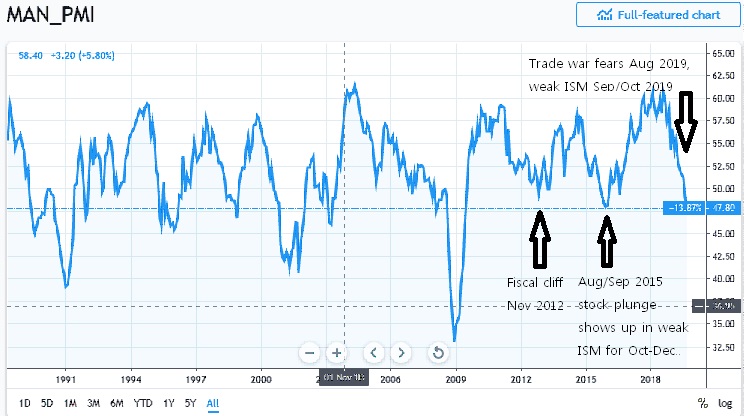
The ISM number coming in at 47.8, below 50 for the 2nd straight month, was enough to fan the flames of recession fears and cause a 40 point drop in SPX yesterday.  The bond  market has a PhD in providing a leading forecast of future economic numbers.  The big drop in yields in August was a clear warning sign that the economic data for the next few months were going to come in weak.  That has happened as the August jobs number and ISM index were well below consensus, along with a bunch of other global PMIs.  That has continued with yesterday's weak ISM number.   Below are historical ISM charts.  We are back to late 2012 and late 2015 levels.


Another factor is the October effect.  The fear of October itself is enough to make investors sell at the slightest bit of bad news.  Especially after last October's brutal selloff, they aren't taking any chances and are playing it safe, selling first, and waiting it out.  It doesn't help that the US China trade talks are happening next week, and most are expecting a disappoint result.  

I am getting flashbacks to late August, when the trade war headlines were so negative, and it felt like a slam dunk to short any rallies, towards SPX 2930.  Once again, we have the negative trade war headlines, and now weak economic data on top of that.  It feels like another obvious time to short.  The trading gut tells me that now at SPX 2925, it is actually more dangerous to be short here than be long.  It doesn't make me want to be long, especially with the stock buyback blackout period lasting for the next few weeks, but it makes me cautious to play the short side.  

Not many are thinking about bullish catalysts, but here a few that I am thinking of:

1.  A truce and a can kick on further China tariffs after next week's US/China trade talks.  Trump seems more desperate to save the stock market, even lying back in late August about having talks with China to boost stocks after they took a dive on more tariffs.

2.  A more dovish Fed that starts QE4 lite to fix the repo market, and probably another 25 bps cut at the October 30th meeting, could ignite sidelined cash into stocks, especially with buyback blackout period ending at that time.  

3.  Germany announcing a fiscal stimulus package as it is becoming quite obvious with the latest Germany PMI that Germany is in a recession.  

Right now, I don't want to go long until I see extreme fear, and we aren't even close, and I don't think it will happen this October.  

Monday, September 30, 2019

Trade War Headlines

There has been a pattern to these trade war headlines that some observant traders will have noticed.  In general, when the market has been rising for a few days, near SPX technical resistance levels, a negative trade war headline usually pops up and brings the market down quickly (last two Fridays).  Then a positive trade war headline shows up during low liquidity hours or over the weekend (last two weekends).  On triple witching expiration day, Friday September 20, the China canceling the Montana farm visit dropped the SPX 25 points in a flash, then the White House denied that China canceled and said it was the US that canceled.   Same with the China investment ban headline.  Also denied over the weekend. 

The White House is treating the US stock market as their personal piggy bank manipulating the markets regularly and profiting through offshore corporate shells that are trading on their behalf.  I don't wear my tin foil hat much, and almost all conspiracy theories are bogus, but the amount of market manipulation based solely on US/China trade headlines is unprecedented.  It puts to shame any kind of trial ballooning that the Fed used to do to test the effect of certain policies. 

If the White House is putting out these trade headlines and profiting from them through trading them through offshore accounts in other people's names, then they have no incentive to make a decision on a trade deal.  The ideal situation for them would be to continue to keep the market on its toes, providing a sliver of hope, and then taking it away, escalating tariffs, and then delaying them.  Politically, making a trade deal with China only benefits Trump if the stock market continues to go higher after the deal.  There is no guarantee that will happen, especially if a trade deal is accompanied by a more hawkish Fed. 

Most people are skeptical of a long lasting US-China trade deal, and rightfully so.  So expectations have been lowered quite a bit.  That means a mere delay of some Chinese tariffs that were recently introduced should be enough to provide a relief rally.  At this point, the best strategy for both sides would be kick the can on tariffs and agree to future talks with nothing concrete happening. 

SPX is stuck in a 2950-3000 range for the past week.  The pullback from the trade war optimism of 2 weeks ago makes it less likely that you will get a sharp drop if the US and China don't agree to do anything.  The trade talks are scheduled from October 10-11, so there will be a lot of fast money traders that will look to get out of their positions before that date.  Since it seems like most of the fast money is short, we could see some short covering a few days before October 10, so it could start late this week/early next week.  If there is another dip down towards 2950 this week, I will consider a small trading long position.

Wednesday, September 25, 2019

Triple Witching Hangover

This week is turning out to be a classic post quarterly options expiration week.  The artificial buying pressure late last week after FOMC has been taken back plus more as the fund managers' puts expired out of the money.  It is going to take a few more days of nervous trading for the investors to get back to their normal level of put protection.

Also, it has been 1 month since the triple bottom around 2825 was hit on August 26, so the tailwind from fund managers getting back to their normal level of equity exposure is gone.  It doesn't mean the uptrend is over, but the probabilities are more even for up or down price movement.  We are in a chop zone and it favors the counter trend traders for the next 2-3 weeks.  After that, we'll probably go back to trending higher if the bond market cooperates and doesn't selloff too much.  Anything under 1.90% 10 year is enough to provide support for equities for the remainder of the year, as the fundamentals aren't bad enough to cause a sustained equities selloff with interest rates this low.   

The impeachment news is a distraction, as everyone realizes that Trump will not get impeached with a Republican majority in the Senate.  The House can call for impeachment, but the Senate will decide not to do it.  The impeachment has no impact on the US China trade deal, the Chinese were never going to give what the White House wanted, and some agriculture and pork/beef purchases won't be enough to get Trump to roll back the tariffs.  Its probably enough to keep tariffs where they are and avoid further escalation.  It seems both sides would rather just kick the can and keep things where they are, instead of giving in to the other side. 

Neither the long side or the short side excites me here.  If I had to put on a trade, I would reluctantly be a buyer of SPX around 2950-2960 support, and be a seller around 3010-3020 resistance.  The positive for the market is the low expectations for a US China trade deal, so there won't be much disappointment if nothing major happens.  The negative for the market is long term weakening earnings growth and overvaluation. 

Thursday, September 19, 2019

Various Thoughts

1. When traders learn a pattern over an important event (FOMC meeting) and prepare for that event as if things will repeat, then the pattern is less likely to work.  The pattern was to sell ahead of the FOMC meeting and buy the dip a few days later after Powell disappoints and Trump ignites trade war angst.  

Ever since Powell has been FOMC chair, the performance of the S&P has been weak, much weaker than an average trading day.  But this time, Powell disappointed with a rate cut and no promise of future eases or repo facilities or whatever else the market dreamed of.  After the initial fakeout dip to draw in the Powell bears, we had a face ripper into the close.

2. One of the most popular hedge fund trades is to bet on an extended rate cut cycle via long Eurodollar futures and call options.  The December 2020 Eurodollars futures contract settled yesterday at 98.45, which is pricing in a LIBOR rate of 1.55% at the end of next year.  LIBOR-OIS spread is usually between 10-40 bps, with occasional spikes higher above 40 bps.  So assuming about a 25 bps spread, that is pricing in a Fed funds rate of 1.30% by the end of 2020.  

With the current rate at 1.88%, that's pricing in about 2.3 rate cuts (58 bps) over the next 15 months.  While I don't disagree with the long Eurodollar futures trade, a better way to make that bet would be to just go long 2 year Treasury notes at 1.74%.  If the Fed cuts 58 bps, the Eurodollar trade breaks even.  However, the 2 year note yield would definitely trade much lower than the current 1.74%.  

3. A lot of traders and investors are reluctant to be long stocks and are long bonds because they fear a recession in 2020.  I don't agree about the recession call for 2020 because of the lack of overcapacity, lack of commodity inflation, and the huge budget deficits providing a lot of fiscal stimulus to the US economy in the background.  But I do agree that being long stocks is a bad risk reward now, not because of recession risk, but because of high valuations, no earnings growth, and political risk.  Political risk is not the trade war, but the risk of Elizabeth Warren becoming the Democrat nominee in 2020, with betting odds favoring her to beat Trump in the next election.  

Tuesday, September 17, 2019

Lower Bar for Powell

Wall Street has a short memory, but the memory tends to last longer when they are associated with big down days and the beginning of a sharp decline.  Almost every trader will remember that the August selloff was kicked off by a less than dovish Powell, and his mid-cycle adjustment comment, and the bear ball went further down the hill with the help of some Trump tariff announcements.  

That August selloff has all been taken back by the stock market.  But with the FOMC meeting closing in, with the accompanying dotplots and the Powell press conference, short term traders will probably be leaning bearish going into the meeting.  That means that expectations from Powell are much lower this time than back on July 31.  Powell has a lower bar to jump over to please the market this time, which makes it a bad risk reward proposition to be short going into the FOMC rate decision.  In fact, I see a higher likelihood of a short term pop rather than a short term drop after the Fed announcement.

There are also opex forces at work this week, with a bullish bias going into the quarterly options expiration.  The Saudi oil news and subsequent pullback probably provided enough fuel for a run higher into the Friday cash open SPX options expiration.  Market makers are usually short options, especially put options.  Although they hedge their exposure, they stand to gain more if markets go higher into the expiration, not lower.  

At current SPX levels of 3000, investors don't seem to be leaning bearish or bullish.  Other than the factors mentioned above, there isn't anything else that really presents an edge here.  The Saudi oil news is relevant for oil, and that's about it.  Oil doesn't really matter to the broader economy anymore because its only a small percentage of consumer spending.  And higher oil prices helps the oil producers just as much as they hurt oil consumers, so it mostly evens out in the stock market.  

Friday, September 13, 2019

Flashback of 2015

Just like 2014, 2019 has provided a huge rally in both the stock and bond market, feeding on the blood spilled by the bond bulls in the prior year (2013 and 2018 respectively).  That sets up a payback period in the following year, usually triggered by a big bond market correction.  In 2015, the correction happened from February to June.  In 2019, it is starting in September.  And it is likely to last a few months, so bond bulls, be prepared.  It will be choppy trading over the next 3 months. 

The top chart shows the SPX and 10 year yield overlapped from March 2014 to March 2015.  The bottom chart is the SPX and 10 year yield over the past 12 months. 


What isn't shown in the chart is what happened over the next 12 months.  And boy were they a rocky 12 months.  From May 2015 to August 2015, the SPX went from 2132 to 1867.  If 2019/2020 were to follow the same script after the bond market rally ended, it gives the market about 5 months before the bottom falls out of the market just like August 2015.   That approximates to February-March 2020. 

Nothing follows a script exactly, but the general concept is that bonds will no longer provide that great hedge against equity selloffs like it has over the past 9 months.  That eliminates a vital hedge which prevented investors from fully panicking out of the stock market during periods of weakness. 

So the stock market is now like a ticking time bomb ready to go off without notice, now that the low interest rate fuel has been used up. 

In fact, the August 2015 selloff was accompanied by a rather meek bond market rally, with the 10 year dropping only about 35 bps during the August 2015 waterfall decline. 

With the overvaluation being much greater now than in 2015, it is easy to imagine a waterfall decline in 2020 to be much steeper than the August 2015 decline.  There are a number of triggers that I can think of right now which will do it, the main one being the Democratic primary winner being either Elizabeth Warren or Bernie Sanders.  Odds of that are about 50% according to betting markets.  And the current polling shows Democrats ahead of Trump in the 2020 presidential election.  That would be a huge game changer as the main reason for the 2017 rally was a the corporate tax cuts, and a Warren or Sanders would likely raise taxes on corporations and the rich, which would be a huge negative catalyst for the stock market. 

We've had another big rally in SPX this week, thanks to positive trade talk.  Remember, the trade war is a distraction to what really matters.  The slowing economy, no earnings growth, and the potential of an anti-corporate welfare Democrat winning the White House in 2020.  There is resistance around the all time highs at 3025, but given the participation of small caps in this rally this week, there should be new all time highs coming up.  Still cautious on long term shorts, but I am getting much more constructive on putting on short term shorts because of the bond market weakness.   However, I will wait till after FOMC meeting and opex next week.