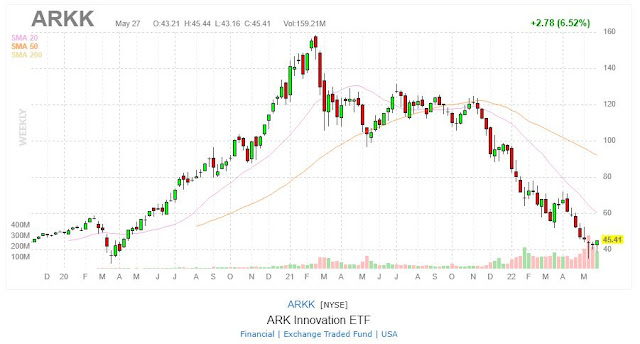
Fads and manias come and go, but in the end, the fundamentals eventually determine price. Its tempting to see stocks down 30-50% and think you are getting a bargain, a half off sale, without looking at the fundamentals. When you had people losing their minds, willing to pay up for flavors of the day, regardless of valuations, you get charts that look like this:
Tuesday, May 31, 2022
Words and Actions Diverge
Friday, May 27, 2022
Micromanagers
The Fed can't get out of their own way. They are worst type of manager. The micromanager. Always having to do something. Always saying too much. Always reacting to the markets. Remember, their forward guidance is worth the amount that you paid for it, nothing. They are the same clowns that predicted zero rates until 2023. Team Transitory throughout 2021.
Apparently, the Fed is starting to feel some heat. Not from the inflation readings. From the weak stock market. That inflation fight isn't so urgent, even with a CPI reading at 8.3%. The stock market selloff has shaken their convictions. All the permabears calling for a recession has infected their psyche, their fear of a hard landing. At less than 1% Fed funds, there is already talk of a pause! While you had the highest CPI in decades. You can't make this stuff up. No wonder the market always believes the Fed is eventually going to come to the rescue. That's been conditioned into investors since 1987.
The Fed clearly doesn't fear high inflation. They probably think its still transitory, and if they just talk about fighting inflation, the inflation will just go away. They believe their own BS about supply chains eventually resolving and lowering prices. I'm sure they'll find a way to blame Putin and the war for the inflation, to absolve themselves of any responsibility for this mess. Powell is about as nonchalant as can be when he makes these rate moves. He does the minimum expected, and is loathe to surprise the market with anything too hawkish. He says he's worried about inflation, but he doesn't act like it. Going for 25 bps in March even as commodity prices were surging higher along with the CPI because of Russia/Ukraine. Taking 75 bps off the table at the May meeting. What's his next dovish stunt? Talking about pausing the rate hikes later in the year to observe how the rate hikes are digested?
Its almost as if he's an ambulance driver on some scenic drive, taking his time getting to the destination, stopping here and there, smelling the roses, taking pictures, while the destination is a disaster area, filled with masses of injured and dying. There is no urgency to hike rates. There is a huge mismatch between action and words.
A hard landing for the stock market is in process. With the valuation excess, its unavoidable, even with Powell having a Bernanke moment, cutting rates to zero while inflation is high and then going to QE again. The Fed cutting rates in 2001 didn't stop the market from going down for another 18 months. The Fed cutting rates in 2007/2008 didn't stop the market from going down for another 17 months.
We're not even at that stage, the Fed is still tightening! That's what's so crazy about this market, its skipped all the steps required for a classical bear market, and gone straight to a bear market as soon as the Fed started hiking rates. That's usually happening in the middle of a bull market, not at the start of a bear market. That's how late Powell has been.
This is unlike any Fed cycle I've ever seen. Its a 1970s type of environment, which most investors have no idea how to trade. In the 1970s, stocks and bonds were poor investments, and commodities were great investments. The macro environment feels like 1973, and the investor asset allocation feels like 2000.
With the Fed so late, by default, they will be late to cut rates, although I do expect them to eventually get to zero and do QE again by 2024. Even with high inflation. But the market will have to stay in a bear market and continue to trend down, like I expect for several more months before the Powell pivot. Will he pivot to try to prevent a hard landing in September? October? My bet is on September. I don't think he'll let the markets keep going down, it makes him nervous. Clearly high inflation doesn't.
A huge rally over the last 2 days, and gapping up in pre market. I sold all of my index longs yesterday, a bit too early. Now waiting for the bulls to get overaggressive on the long side to short NDX. 12600-12800 is my ideal entry point for a NDX short. Expecting the Nasdaq tech names to be lagging the market until the Powell pause.
Wednesday, May 25, 2022
No Credibility
Let's get one thing straight: the Fed has no credibility on inflation. There are many out there who believe that the Fed will keep hiking until they break something but they don't have the balls for that. Or the courage to take the economic pain to lower inflation. Already, you are hearing a Fed governor talk about a pause in September with CPI at 8.2%! These guys are more scared of a hard landing disinflationary environment with tight financial conditions than they are of a slow burn high inflation environment with easy financial conditions.
They are scarecrows. They talk a tough game, but don't play a tough game. And they are so late, that they are early. What that means is that they are so late to tighten, that they've missed their rate hiking window as the bubble economy has peaked out. And that makes their current rate path and balance sheet well suited to a downturn. They now won't have to hike as much as priced into the market because the economy is already weakening. Thus, since they never went to a restrictive policy rate, they don't have to ease right away and look weak on inflation, because they never tightened enough in the first place. Instead of having a 2+% Fed funds rate from early 2021 to early 2023, like they should have, they will instead have a 2+% Fed funds rate from mid 2022 to early 2023, so 18 months less of tight financial conditions, and then they will gleefully cut from 2+% down to zero when facing a growth scare in 2023/2024.
So Powell will have managed to do a lot of talking, with very little action and with only a brief period of rates at a "neutral" rate, before going back to the default easy money policy and zero rates at the first hint of slowing growth, regardless of inflation. The bond market is already starting to sniff this out as the Eurodollars market is getting inverted in 2023, with Jan 2024 Eurodollars priced higher than Jan 2023 eurodollars, basically meaning that STIRs markets are forecasting rate cuts in 2023.
What does this mean for markets for the next 12 months? It means that you won't get the capitulation that everyone is looking for because the Fed will try to steer this plane away from a hard landing, by not getting financial conditions tight enough. In the process, inflation will remain higher, commodities prices will keep going higher, and the dollar will go lower. The yield curve will steepen, as short term rates go down and long term rates less so as the Fed tolerates a higher inflation environment. Stocks will be the trickiest part because stocks love a Fed that doesn't tighten financial conditions, but at the same time, you have a massive overweight in US stocks among both US and foreign investors, high valuations, and corporate margins under pressure from higher labor costs.
The federal government spending will still be quite stimulative in 2023, so if the Fed steps off the gas, you probably have a range bound market with slightly lower highs and lows for the next 12 months. This is assuming what I think Powell will do, which is raise 50 bps at the next 2 meetings, taking Fed funds up to 1.75-2.00%, and maybe doing 1 or 2 hikes of 25 bps in Sep/Oct/Dec, and then saying job is done, congratulating himself for "fighting inflation" and having an appropriate rate for the current economy, which the market will love, and you probably get a 2-3 month rally, and then everyone will look around and see that inflation is still high, and the economy still sucks, and then the markets will have another Wylie Coyote moment as another waterfall decline emerges from the complacency. This will get Powell panicked and looking for ways to placate a market having a temper tantrum because he's not cutting rates and rates are still above 2%. Powell will then go into bazooka/hero ball mode, cutting like hell down to zero.
This market is all Fed all the time, so that's the only thing that matters. Earnings are just a distraction. The meme of this bubble era is the Fed, so they are the drivers of all short to intermediate term moves. Long term moves are driven by valuations, which are still not favorable here.
With a spineless Fed, you will not see capitulation for quite a while, so don't bet on it for 2022. Inflation/commodity prices stay high, although base effects/additional CPI manipulation will help to lower the CPI number which will be a convenient excuse for the Fed to pat themselves on the back and talk about how their measly few rate hikes and tough talk are working, even when they aren't.
Its a choppy market, no V bottoms, lots of time spent lingering near the lows. This is a continuing theme for 2022. Rallies don't last for more than 1 or 2 days. The margin for error is much narrower for bulls, and much wider for bears. This is the mirror image from 2009 to 2021. Trade accordingly.
The high put/call ratios support the case for a short term tradable bounce, but the fund flows data / COT futures positioning data shows investors stubbornly holding on to overweight equity long positions. Maybe a few weeks of sideways trade from 3800 to 4100 and then a steady grind move down towards 3600 in the late summer to force the Fed's hand into pausing at the September FOMC meeting.
Monday, May 23, 2022
US Outperformance is Over
We are seeing a new pattern that investors are not used to. Ever since 2008, coming out of the financial crisis, the US equity market has continuously outperformed other countries and by a large margin. That has drastically changed in the past 6 weeks. Since the start of April, the US has been a huge laggard.
| DAX vs SPX 2022 |
| Nikkei 225 vs SPX 2022 |
| Shanghai Composite vs SPX 2022 |
| MSCI Brazil ETF vs SPX 2022 |
We have finally made the turn, and the market has done its job. It has created the most liquidity and volume for US stocks at the top for US outperformance, which now looks to be 2021. That is a 13 year window of outperformance for US stocks that ended with a blowoff top of epic proportions, as everyone across the globe herded into big cap tech (AAPL, AMZN, MSFT, GOOG, FB, NFLX, TSLA, NVDA, etc.) or into the big 2 US indices: S&P 500 / Nasdaq 100. Those have now become the worst performers, as the underperformance has accelerated over the past 6 weeks.
There are fundamental headwinds for US stocks which weren't present in the last 13 years. We're now in a structurally higher inflation environment with tight commodities markets keeping goods prices high and a massive federal budget deficits which keeps demand artificially high while also keeping money supply growth high. Labor markets are tighter as immigration has trended lower in the US and population has gotten older. This keeps wages higher and gives workers more bargaining power than at anytime in the last 13 years. Higher wages = lower profit margins. Higher inflation = less dovish Fed. I am not a believer that they will try to kill inflation with big rate hikes and very tight policy. They will cave in as soon as the economy slows down enough for people to start complaining about high interest rates and lower stocks. However, they will have a hard time going to QE and rationalizing easy money policies if rents, food, and energy prices keep going higher.
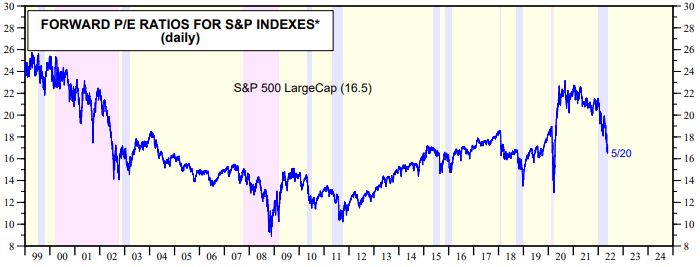
Without QE, I don't see a sustained uptrend in the SPX until all the froth is gone, which would be around the SPX 3000 level. At SPX 3900, the forward P/E is 16.5.
The SPX bottomed at a forward P/E of 14 in 2002, at a forward P/E of under 9 in 2008, under 11 in 2011, and under 14 in 2018. A drop in the forward P/E to 14 would take the SPX to 3300. That is assuming that foward earnings remain the same. But forward earnings estimates seem wildly optimistic, so even a 10% drop in earnings, which seems reasonable considering the slowing economy and falling profit margins, would require the SPX to get down to 3000 to reach a forward P/E of 14. And I haven't even gotten to the worst case scenario of a 2008 or 2011 situation, where forwards P/Es got down to 9 and 11, respectively.
So while many market participants seem to now agree that we are in a bear market, many are still looking for a bounce as the markets look like they are oversold. The trend is down, as the US underperformance and post bubble dynamics reveal. Its hard to make money going long the SPX in that environment. When the market gives you this many changes to go long near the lows, its a sign of weakness. Rarely in the past 13 years did the market offer so many chances to buy the lows as this one has.
Sold the short term long SPX trade for a small gain on Friday, still have a small legacy SPX long left which I will look to sell on a bounce. Still waiting for that elusive and fleeting short opportunity in NDX.
Thursday, May 19, 2022
Recency Bias
The behavior of human beings is easily conditioned, but it takes time. At our core, we are just chimps with slightly bigger brains. The stock market is both a giant casino and a nonstop crowd psychology experiment. Recency bias keeps the crowd more focused on recent data points when markets had a waterfall decline (2020, 2018, 2015/2016, 2011) than older data points (2000-2002, 1973-1974).
In 2020, you had a decline from top to bottom that lasted less than 2 months. The Fed came to the rescue with bazooka QE and the US government did the biggest stimmy spew ever. That was just 2 years ago, so that bias of the Fed coming to the rescue whenever the market plummets is still seared into the heads of investors. 60/40 stock/bond portfolios had a blockbuster performance, as 10 year Treasury yields got down to 0.36%.
In 2018, you had a decline from top to bottom that lasted less than 3 months. The Fed once again came to the rescue, this time, calling off future rate hikes that was priced into the market and making a dovish pivot and signaling future rate cuts in January 2019. The market never looked back and grinded higher for several months after the December 24 2018 bottom. 60/40 did ok during the waterfall decline, and especially well in 2019, as both stocks and Treasuries rallied huge throughout the year.
In 2015/2016, you had an up down up down move that lasted less than 2 months each, each one around 15%, so rather mild, and then followed by a relentless rally that lasted several months. This time too, the Fed turned dovish, calling off rate hikes and pausing after doing a measly 25 bps in December 2015. 60/40 had a huge 6 month performance for the first half of 2016, as 10 yr Treasury yields went to all time lows at the time at 1.32%.
In 2011, you had a decline from top to bottom that lasted less than 5 months, and with Treasuries going through the roof during the European debt crisis, providing a perfect hedge for equity longs. The Fed embarked on Operation Twist, basically QE by lengthening the duration of their holdings, buying long duration Treasuries by selling T-bills. 60/40 portfolios held up very well during the whole downturn.
So the last 4 waterfall declines were all brief, and followed by the Fed caving in to the market and making a dovish pivot. Stocks bottomed and surged higher in the following months. Treasuries rallied huge during all 4 declines and commodity prices went down even more than stocks during all 4. That is the foundation for the psychology of today's investor. They expect the Fed to come to the rescue, and that the market will rally huge for several months afterwards. So they aren't giving up, and also aren't throwing in the towel on bets that Treasuries will go higher.
That recency bias keeps many investors from worrying about a possible extended bear market, which is the more likely scenario based on the exuberance over stocks in the last few years, similar to what you saw in the early 1970s and late 1990s.
Few people remember or consider what happened in 2000-2002, and even fewer what happened in 1973-1974. Extended bear markets, with very few bear market rallies, basically stair step down for months until the final puke phase 2 years after the top. Absolutely brutal markets for buy and hold investors, and just bad overall for permabulls.
The SPX in 2000-2002:
The SPX in 1973-74:
I see 2022 as a combination of 2000 and 1973. You had the dotcom bubble in 2000, and you had the bitcoin/big cap tech/ARKK speculative tech/meme stock bubble in 2021. You had surging oil prices/inflation, as well as the Nifty Fifty in 1973. You have surging oil prices/inflation and FANG/big cap tech in 2021-2022.
Another savage selloff on Wednesday. This market doesn't stop at down 2 or 3%. It goes for blood, and goes down 4+%. Huge chunks taken right back after the bulls got excited about a technical rally after the bottom last Thursday. Even with my bearish tilt, I've been way too bullish on the short term time horizon, and have been waiting for a rally towards 4150 to short SPX and dump everything, including energy. But the market trades like there are a million bagholders looking to sell rallies, which kills them before they can gather steam and lure in more suckers. Just savage.
I will take a shot to put on some SPX longs today into this big gap down, but only for small size, matching my level of confidence on the long side.
Tuesday, May 17, 2022
Powell: Caveman Lawyer
There seems to be a dominant frame developing in the market, one of a sharp growth slowdown and a probable 2023 recession, with inflation peaking soon. I agree about the sharp growth slowdown, but don't agree with the recession or inflation peaking (not the manipulated CPI, but real actual inflation numbers) calls.
When it comes to the economy, with a Fed that's not willing to take the pain necessary with big time rate hikes (up to 5% Fed funds) to kill inflation, only fiscal policy will be able to cause enough of a growth slowdown to result in a recession. And the budget deficit will be over 6% of GDP for 2022, and only glide down to about 5% of GDP for 2023. That's quite expansionary, so the methamphetamine kick will still be there, just not as high as 2021.
Rising energy prices won't do it. A slowdown in corporate profits won't do it. Raising rates from 0 to 2.5% is not going to get the job done. Its like trying to bail water out of a sinking boat with a shot glass. There is still too much liquidity sinking the boat. So a slowdown in capex spending, some corporate layoffs at the margin, and higher mortgage rates enough to cause a recession? If the budget deficit was close to 0, I would agree about the recession calls. But its not. Nowhere even close to a balanced budget.
We underestimate the stimulative effect of big budget deficits. Its free money raining down on the economy. Normally during an economic expansion, like you have in 2021 and 2022, budget deficits are low, as tax receipts go up. But the spending and handouts was so enormous, and the spending is still heavy, for the foreseeable future. Projections of a budget deficit of 5% to 7% for the next 5 years. In the EU, they get all worked about going over 2% deficit to GDP, so the fiscal juice in the US is on a whole another level compared to other developed nations.
American exceptionalism is not high tech, its lots of government pork masking a structually low growth economy with little productivity increases and slowing population growth due to lower immigration levels.
To really kill inflation, the US needs to either raise taxes, reduce government spending, or a combination of both. Social Security and Medicare need to be massively reduced. Same for defense spending. That's just not happening. The US is well on the MMT road and the US dollar will start losing its reserve currency status as the deficits continue to get out of control, and Fed eventually has to monetize all of it in order to save the financial markets.
Mini me monetary tightening by Mr. Caveman Lawyer Powell will not get the results they want. They need to meaningfully curtail demand by decreasing the number of dollars in circulation. Talking tough is just a CYA (cover your ass) exercise to save face. They will continue to make minimal moves that are more bark than bite. Powell is not that guy to put the inflation genie back in the bottle. He will cave under pressure, like he did in early 2019, even as his colleagues talk a hawkish game. Caving is in his DNA. Its in his survival instinct. High inflation or low inflation, when his back is against the wall and financial markets are having a temper tantrum, he will go back to his familiar role of being the market's sugar daddy. He can't take the criticism. Inflation could be totally out of control and he will still cut rates if the stock market crashes. Guaranteed.
I am noticing a sea change in the psychology of market participants over the past few days. The bullishness is going up on a short term time frame, as its become consensus that the market is oversold and due for a bear market rally, and more people are coming around to my view that we are in indeed in a bear market. Based on the huge amount of inflows into stocks in 2020 and 2021, and the high % of household net worth invested in stocks, I only see corporations providing a bid to the market with buybacks, while retail and institutions will be reluctant to add to their holdings in stocks, since they are already at a historically high level. More likely than not, we'll see retail outflows as they pass the denial stage and lurch towards acceptance.
I continue to feel the post dotcom bubble 2000 vibes in this market, so its a dangerous market for buying dips, and even more dangerous for chasing rallies. Bitcoin and crypto currencies are the poster boy for excessive speculation in previously unthinkable investments, which became extremely popular in 2020 and 2021. Expecting a painful slide lower for bitcoin for the next 2 years.
For the overall market, best case scenario, I see a bounce up to SPX 4200 and a resumption of the downtrend after that bounce. Worse case scenario, we top out this week and continue to grind lower towards 3600 for the rest of the summer. This market is tailor made for short sellers, and selling rallies will be profitable until Powell cries uncle and gives up on 50 bp rate hikes, signaling a slowdown in the tightening cycle, probably coming at the September FOMC meeting. So until then, rallies will be brief, IMO.
We have a big gap up today, I have a small "legacy" position in SPX which I will be looking to clear out this week, so may sell it today or tomorrow. Still holding energy, as I am a long term believer in the inflation trade.
Thursday, May 12, 2022
A Savage Market
The selling is relentless. They will let it breathe for a couple of hours and then the sellers come back with a vengeance, gleefully selling bounces to suckers who chase strength. At this rate, chasers who buy up moves who have been getting hammered will go bankrupt in a few weeks as nothing lasts on the upside. Haven't seen this kind of relentless selling since 2008, and before that, the 2000-2002 bear market.
The market trades so heavy, as if there are millions of bagholders looking to sell on any uptick, while the support is weak, as the dip buyers have been getting buried and are running out of dry powder. The marginal seller is much more eager to get his orders through than the marginal buyer. That is showing up in lower highs and lower lows.
At this point, the selling begets selling, as weak hands are shaken out and people are just getting tired of losing money every day and some are just throwing in the towel. I thought we might have a day or two of rallying based on the bounce off of another hot CPI number, but that rally failed like all the other ones for the last 5 weeks.
Amidst the doom and gloom, there is a glimmer of hope from the market going down too fast too quickly, which is setting up a slingshot bounce play once bottom is hit. I thought 3950 would prove to be a strong support area, and it did produce a 90 point bounce yesterday off that number, but it was faded all day. There is a lot of support in the 3850-3900 zone, with 3850 being 20% down from the highs, and 3900 being a heavily traded area in early 2021 before the market went parabolic.
The bounce back up to 4400-4500 looks like a pipe dream now. Its not going to happen. At best, I see a bounce up towards 4150-4200, where I expect sellers to swarm the market like flies to shit. Its a fully entrenched bear market, something investors are just not accustomed to. They are used to bear markets lasting 3-4 months (2011, 2016, 2018, 2020), and are probably expecting similar things this time around. I see very few expecting a long extended bear market like the post dotcom bubble period of 2000-2002, or the financial crisis period from 2007 to 2009.
I am trading under the expectation that we are in a post-bubble 2000 like environment, so position sizing is everything. Buying on dips will be small, and only focused on extreme short term selling points where a probability of a bounce are high (like right now). Shorting into rallies will be big, and concentrated in the most popular sectors during the bubble, in particular, technology stocks. So I am waiting to put on big size only for short positions, and in the NDX, while buying dips in this type of environment will be focused on the strongest sector which have outperformed, and which I expect to continue to outperform, energy. I bought some on the dip yesterday, but for small size, and will look to add if SPX gets towards that 3850-3870 area.
No need to be a hero when buying dips, its not a bull market anymore, so you have to be cautious on longs, and can only be aggressive on shorts.
Tuesday, May 10, 2022
Its Payback Time
There is no free lunch with money printing. The MMT supporters had their time to shine in 2020 while crude went negative amidst the biggest Fed QE + Rona stimmy fest double barrel bazooka ever. They thought all the money spew wouldn't result in inflation. They felt invincible. They were right for a few months. Gradually, and then suddenly, they've been completely wrong. Team Transitory along with their MMT cousins have quietly slinked off in the corner, never mentioning that phrase again, for fear of ridicule.
Inflation is a monetary phenomena. Its not about temporary blips like supply chain problems or war, its about the supply of money chasing a fixed amount of goods and services. I am sure Powell and all the economists would disagree with me, but they are paid whether they are right or wrong, comfy in their ivory towers. When I'm wrong, I feel the pain right away in the form of losses. When they're wrong, they find something convenient to blame (supply chains, Putin, China lockdowns, etc.) or nonchalantly sweep it under the rug.
People tend to overcomplicate things, or just parrot the media, who blame everything on supply chains for the inflation. It all comes down to the money. The US has been the most aggressive nation for both fiscal and monetary stimulus since 2020. They doused everything with a firehose of liquidity and free money, and thought of themselves as heroes. And they've ended up with the highest inflation among all the developed nations. Powell was revered as a great central banker who saved the financial world with his QE bazooka. All he did was kick off the biggest bubble in US financial market history, even worse than Greenspan, and waited 2 years to start undoing what he started. Even the ever late to tighten Greenspan took back the fall 1998 rate cuts with rate hikes 12 months later.
Mr. Transitory, Jerome Powell, has managed to be about as bad as Bazooka Ben Bernanke, the Time Man of the Year, a guy who delayed normalization and rate hikes to the next chairman, so the shit didn't hit the fan on his watch. Doves are celebrated. Hawks are criticized. That's the world that central bankers live in, and they are incentivized to print at the slightest sign of economic weakness. Its the easy way out. And they've abused the printing press resulting in what will be a long period of inflation, that will confound the deflationistas, who are still stuck in the 1980 to 2020 mindset of falling yields, regardless of the fundamentals.
This time, unlike the 1980-2019 time period, the budget deficit is now a significant % of GDP, which is inflationary, especially when the Fed is so willing to provide the funding for all that pork. You need a proportional increase in production to compensate for the increase in money, otherwise, prices will rise. With the dollar as the reserve currency, that exorbitant privilege has kept inflation lower than it would have been otherwise, but there are limits. Eventually, foreign nations will see that the US government is doing its best to debase the dollar, and will be much less willing to finance their debt at low interest rates, leaving the Fed to be the main buyer. That eventually erodes trust in the US dollar, which looks like the king now, but it looked like that in 2000 as well. And by 2008, it looked like the euro had overtaken it as the EURUSD rate went from parity to 1.58.
Right now, there is no concern about the dollar because of its relative strength vs. the euro, yen, and most foreign currencies. But watch what happens when Powell makes his dovish pivot, which is a matter of if, not when. That's when you will see the confidence start to disappear. Its not while they are tightening, because the market over projects the rate hiking path and overrate the Fed's inflation fighting credibility. Powell has no credibility on inflation. He's folded quickly to pressure before. He's been too late to hike. He's all but told you that he won't try to shock the market to get ahead of the inflation curve. And the bond market initially liked, but then thought about it, and didn't like the lack of backbone and inflation fighting that Powell communicated.
The bond market is starting to see the writing on the wall, that inflation will remain sticky, and would prefer the Fed rip off the band-aid, instead of pulling it off slowly and methodically, trying to make it hurt as little as possible. In other words, Powell is a pansy. He will placate the market at the first signs of real stress, and we're much closer to that point than people realize. It would not surprise me if he made a pivot to being data dependent once he gets the Fed funds rate up to 2.0%. Being data dependent = watching the S&P 500. If the SPX stabilizes or goes up, he could sneak in an extra 25 bps, if not, no rate hike. Most likely scenario, after he gets to 2.0%, he will freeze if the stock market follows the post bubble pattern of Nikkei 1990, Shanghai 2007, Nasdaq 2000. Freezing rate hikes at 2.0% with the economy heading south and inflation staying high = guarantee stagflation. And my bet is that Powell will choose a guarantee slow burn stagflation to a fast burning painful deep recession with inflation back towards 2%.
Just a weak weak market. Another brutal selloff on Monday. It looks like it wants to test 3950 to see if there are buyers there before heading north. May do a little dip buying if we see 3950-3970 levels Tuesday, for a short term trade. I see a potential strong bounce this week after the CPI numbers come out and the 10/30 year auctions are behind us, but I don't expect a significant rally until you get to deeper value levels. Ultimately I think we have to get down to the 3600-3700 level before tempting the value buyers and getting a real sustained counter trend move.
I have little confidence in buying the dips in this market. I have all the confidence in the world in shorting the rips. This feels just like a repeat of 2000, with the same levels of heavy equity positioning. That bear market lasted over 2 years. We're only 4 months into this bear market. We've got a long way to go.
Friday, May 6, 2022
Bear Market Action
Yesterday was classic bear market action. Even if this is a short term bottoming process, a messy U bottom that gives you multiple chances to buy the lows is a sign of weakness. A clean V bottom, that only gives you one chance to buy the lows is a sign of strength. We had V bottoms for most of 2009 to 2021. U bottoms were rare. Now the V bottoms are rare, and the U bottoms are back with a vengeance.
What was shocking about yesterday's selloff was the bond market weakness after a less hawkish Powell and a very weak stock market. That is not a good sign for either stocks or bonds. I though 3.00% 10 year yields would provide some resistance to this surge higher in yields, but it was just another speed bump towards higher yields. Scary if you are leveraged long in bonds, like a lot of risk parity funds are, along with a long stock position. A double whammy for risk parity, which are under extreme duress this year, and in particular since beginning of April.
Powell's lack of inflation fighting credibility is hurting the bond market here, the market may have cheered his soft stance on rate hikes in knee jerk fashion, but after thinking about it for several hours, bond investors dumped en masse, even with a vicious stock selloff, realizing that inflation is the enemy, not higher short term rates.
The only strong market that I see on my screen are commodities, which continue to truck higher. Natural gas going to the moon, crude oil steadily rising and recovering from a sharp pullback in March/April, and diesel prices hitting all time highs, higher than 2008 levels when oil went to $147/barrel, speaking to a shortage of refinery capacity and strong demand for oil products. Supply/demand dynamics are extremely bullish for most commodities. Plus the obscene levels of excess liquidity provided by the Fed/Congress/White House in 2020-2021, which is just fuel for the fire.
This is nothing like what we've seen for the last 13 years. Many are offsides here: risk parity funds, investors concentrated in tech, bond funds, passive equity funds, etc. Really the only group that is relatively outperforming this year are the habitual underperformers, the hedge funds. This may one of those periods where hedge funds propensity to be high fee, lower beta versions of SPY will help them, not hurt them.
Dark pool activity/dealer gamma shows levels that usually lead to short term rallies, of course with the disclaimer that the data only goes back to 2011, so basically only covering a bull market. Lots of statistical based strategies, mostly based on mean reversion buy the dip will fail in this bear market.
Still waiting patiently for that ripe shorting opportunity in tech stocks, have a feeling its coming later this month.
Thursday, May 5, 2022
A Post Bubble Face Ripper
Pumping Powell pulled off an AAPL special: under promise, over deliver. This time, he raised expectations for rate hikes so high, that even just promising to do 50 bps at a time in the next 2 meetings was received as dovish. In reality, he's sticking to his original plan back when he was talking hawkish in early April. Its just the Eurodollars/Fed funds rate market that drank the Jim Bullard kool-aid and started pricing in a chance of a 75 bps move, when it wasn't going to happen.
The market is acting according to script, scaring out investors and getting them nervous ahead of a big FOMC meeting, and then breathing a sigh of relief when Powell didn't talk more hawkish than he did a few weeks ago, resulting in a face ripper. Big picture, the situation hasn't changed. Fed is still on automatic pilot for the next couple of meetings, for rate hikes, so you can book 50 bps hike in June and probably 50 bps in July. If the market starts to fall apart going into the July meeting, Powell could just do 25 bps in July to try to foment another short squeeze and rescue the market.
In either case, the Fed funds rate will get up to 175-200 bps by end of July. That would probably be enough for Powell to slow down and only do 25 bps hikes if the stock market is not weak. That's way different than what the Eurodollars market is pricing in, which is penciling in 50 bps in June, 50 bps in July, 40 bps in Sept, 28 bps in Nov, and 23 bps in Dec. That's a total of 191 bps of additional rate hikes in 2022. That's not going to happen. The market will break so hard if the Fed tried to follow the market pricing that Powell will pivot before he could pull it off, guaranteed.
People don't learn from history. How soon do we forget about Mr. Transitory. Powell has no backbone, and he loves to find excuses to be dovish, or less hawkish. How soon we forget about the dovish pivot in January 2019, after the S&P 500 went down 20%, and he kept the dovish pivot even as SPX was ripping to new all time highs in 2019.
This time, It took 8% CPI to get him to finally stop QE and start talking about 25 bp hikes. Only market pricing in 50 bps hikes for several meetings did he finally get the message and the balls to at least try to catch up to the Eurodollars market. The Fed has never been a leader in starting the hawkish wave. It waits for the market to price in rate hikes and then follows suit, usually being way too late.
I know people love to rip on Jim Bullard, especially because his hawkish tone has sparked some selloffs in the past few months, but he's been right more than Powell. Powell is a politician wearing a central banker costume. He does what the politicians and the financial markets want him to do, in that order. He could care less about price stability. He's looking for positional stability, as in staying as Fed chairman for as long as possible. Once again, he will be praised for pumping the markets higher at the FOMC meeting. If it was the opposite reaction, he would have been loudly jeered and criticized. That's the nature of the central bank game. It incentivizes the Fed chairman to be dovish. Don't forget that.
2022 reminds me of 2000, but worse. Inflation is much higher and the budget deficits required to keep this pig afloat is now the highest that its ever been. Once you start handing out money to solve short term economic problems, it becomes an addiction. The Rona stimulus checks were enormously popular. If you do a search on youtube, you'll see so many videos regarding stimulus checks and when they will arrive, whether there will be more, etc. Also, with an aging demographic, Social Security and Medicare spending will keep going much higher, and those are golden gooses that politicians can't touch. All that money that the elderly receive either through Social Security or through healthcare subsidies from Medicare are inflationary. Money for doing nothing. Money for being old and retired.
Even in an inflationary environment, the government knows only one way to solve the problem, either hand out money or reduce taxes. Already student debt is being forgiven, $10,000, and that's just the beginning. Gas taxes will probably be eliminated or drastically reduced if oil prices keep going higher, which is very likely given the supply/demand situation. The Republican party has basically become the Trump party, so like Trump, they will try to pump up the economy with short term band aid solutions like tax cuts and more stimmy. Since Republicans are much more aggressive about tax cuts than Democrats, yet only slightly less aggressive on government spending, they would likely cause bigger budget deficits than big spending Democrats, and thus more stimulative for the economy. Of course, since Republicans are much more politicially savvy than Democrats, they won't provide any of that stimmy under a Democrat president, and instead wait for Trump to retake the throne in 2024 to pour on the stimulus and tax cuts.
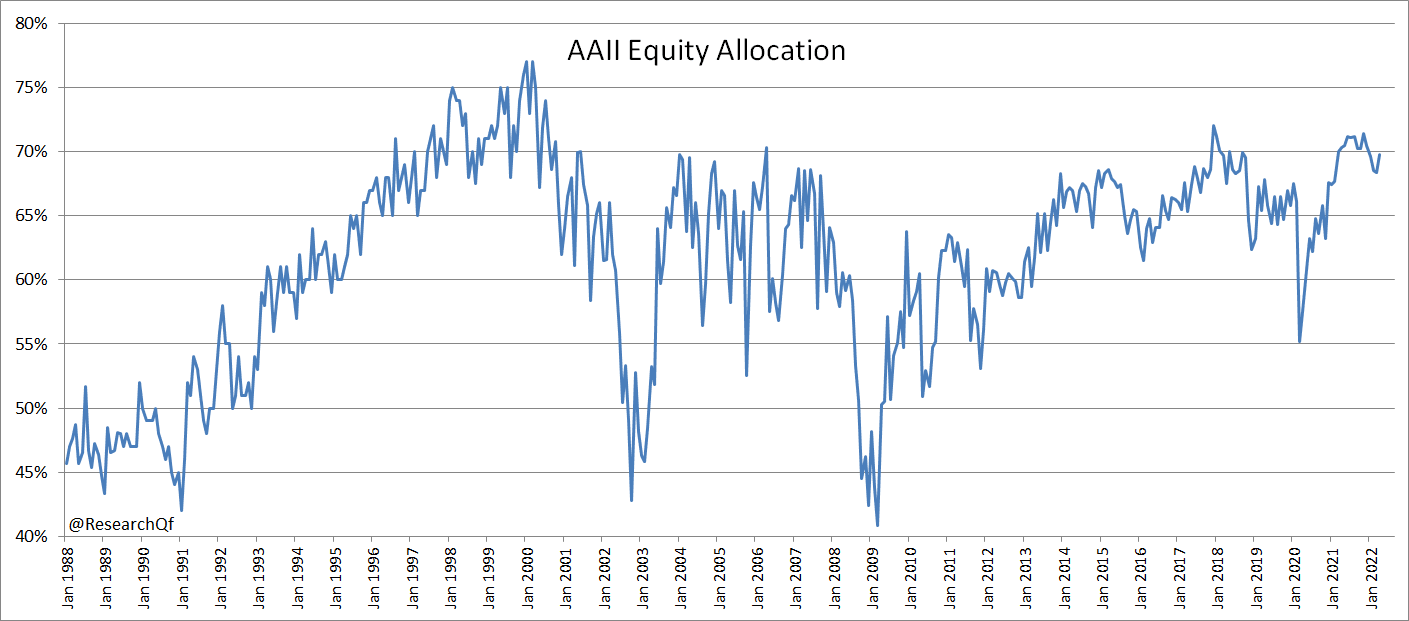
Don't lose sight of the big picture. The SPX and in particular, the NDX has topped out. The price action is terrible. I know a lot of people talk about the bearish AAII and II sentiment surveys, but those are only good contrarian signals in a bull market. In a bear market, not so much. Sure lots of people talk a bearish game, but are they still heavily invested in stocks? Yes.
I am sure most will agree that 2020 and 2021 was a giant speculative bubble (tons of SPAC IPOs, rampant speculation in meme stocks, ridiculous moves in tech stocks, bitcoin, etc.). So in a post bubble environment that we've entered, the closest analog is Nasdaq 2000, especially considering how much retail investors got excited about stocks. Nikkei in the late 1980s, 1990, Shanghai in the mid 2000s, 2007, are also good analogs of a bubble market.
TINA has been engrained in the brains of millennials throughout the last 13 years. Almost like tech stock speculation was engrained in the brains of baby boomers in the late 90s to 2000. The usual aftermath of these speculative boom periods is an extended bear market. Here are a few examples:
![]() |
| Nikkei 1990 |
![]() | |
| Shanghai Composite 2007, Nasdaq 2000 |
| Nasdaq 2021-2022 |
Past bubbles tell you that the first year of the post bubble downtrend is the steepest and most painful. Right now, we are closing in on almost 6 months after the Nasdaq peak in November 2021. So if past is prologue, you have at least another 6 months of a steep downtrend where countertrend rallies will be brief and be great shorting opportunities. The Nasdaq will be the place to put on short bets, as its much weaker than SPX this year, and has much more froth and the worst overvaluations.
Tuesday, May 3, 2022
The Worm has Turned
2022 is turning out to be like 2000. The second half of 2000 that is. Here are the charts for 2000 and the past 12 months.
![]() |
| SPX daily (2000) |
| SPX daily (May 2021 to May 2022) |
The worm has turned. The bears are back. They've been getting destroyed year after year since 2008. Only brief glimmers of success taken back with a vengeance with each V bottom ripping the heart out of the shorts and annoying those holding mostly cash. Its a different story now.
This game is about making adjustments. Like a 7 game series in the playoffs. After seeing what happens in game 1, you have to determine if you just had bad luck or if you actually had a bad strategy and the circumstances have changed. There is a fine line between sticking with your strategy that has been working over the years but recently hasn't, and changing your strategy on the belief that the market regime has changed. If it hasn't, you pay the price by missing out on a big move, or even worse, being faked out and being on the wrong side of one.
The evidence is mounting that the market regime has changed. Here are pieces of evidence:
1. Huge rally off the March 2020 bottom taking the SPX from 2192 to 4818 in less than 24 months.
2. Highest ever price to book, price to revenue ratio for the S&P 500 in 2021.
3. Massive equity inflows and retail participation in speculative garbage/meme stocks from November 2020 until January 2022, most since 2000. Lots of weak hands and public is highly exposed to stocks.
4. High inflation worrying politicians which leads to a hawkish Fed pivot. Results in a weak bond market, 10 year yields up to 3.00%, and Fed funds rate still at 25-50 bps, and Powell seems hell bent on getting Fed funds at least up to 1.75-2.00% before he slows down.
5. Lots of bearish sentiment in the sentiment surveys, but survey on equity allocation still very high (equity fund inflows have only recently turned into outflows). Fully invested bears?
6. Nasdaq tech stock underperformance, financials very weak even with rates projected to go much higher.
7. SPX is no longer giving bulls much time to sell the highs, rallies are sold quickly and the bottoms are messy, lots of U bottoms that lead to only brief rallies vs. V bottoms that lead to relentless rallies from 2009 to 2021.
There are probably more things out there like specific fundamentals for big cap tech which showing slowing earnings momentum despite big time overvaluation, bearish leading indicators, etc.
Yesterday, I could finally see some fear in the market as we broke the 4100 support level and made new lows for the year. Its not a great way to make a bottom, but a lot of pre-FOMC hedging / risk reduction happened over the past several days and it looks similar to the pre March FOMC setup that resulted in a big rally from 4140 to 4620 in 3 weeks. Not expecting anything close to that since we're beyond the point of recognition and its the sellers, not the buyers who are more eager these days. And seasonally, not a good time for investors from May to October.
Very few investors are used to these type of markets, it hasn't happened in over 13 years. The natural instinct of many fund managers is to wait for a big rally to sell, because they ALWAYS happen, right? I tend to agree, but I don't think we'll be getting anything that lasts more than a month from these levels, so I would not be surprised if we go up to 4400-4500 area and then go right back down to 4100. Its a seller's market. Something that investors are not used to. Investors talk bearish, but are they still fully invested? It seems retail investors are, while hedge funds have rightfully turned cautious this year, and for once in a blue moon, are actually outperforming the SPX.
Still low equity exposure, with most of it in energy. Staying away from taking significant SPX positions, unless its on a short setup. Going long SPX is treacherous in this market and to be avoided except for catching brief rallies after big dips.
Friday, April 29, 2022
No Recession But a Weak Stock Market
The stock market is trading like the economy is about to enter a big growth slowdown, and possibly even a recession. I am hearing lots of talk about the Fed breaking something and having a hard landing. This reeks of myopic market focused thinking, with total disregard for the real economy, and the absurd fiscal policy that's still pumping huge amounts of money into the economy in the background.
It was fashionable to talk about the massive Covid fiscal stimulus and QE double bazooka in 2021 as the markets kept going higher. Now its fashionable to talk about a hard landing as the Fed does 50 bp hikes and QT in the coming months. While monetary policy is definitely going to be much tighter, there is still $1.7 trillion of excess liquidity looking for a home that is stuck collecting 25-50 bps in the Fed repo facility designed to sop up all the QE created excess liquidity. There is no shortage of liquidity in these markets. QT will keep bond yields higher than if there was no balance sheet reduction, but I'm betting that Yellen will be financing a big portion of the deficit with T-bills, not coupon bonds. That will have a less negative effect on Treasuries than if coupon bond issuance was expanded.
I still believe we're entering a bear market, but not because the Fed will break something and cause a recession, its just because investors got way too exuberant and overweight equities over the last 18 months. It will be a lot more like 2000 to 2002 than 2007 to 2009. I don't even think that the US economy will get as weak as it did during the post dotcom bubble economy of 2001 and 2002. Back then, there were even budget surpluses, and the budget deficits were a tiny percentage of GDP, around 1-2%. Now its at 6.4% of 2022 GDP, and that after 13% of GDP in 2021. We are in a totally different planet when it comes to the fiscal pumping of the economy. That will keep inflation higher than normal and disappoint those looking for a crash landing and a recession.
Now the economy in Europe and Asia are a different story, but those stock markets are already reflecting a much weaker economy, more so than US stocks are. There is no valuation froth in Europe and Asia, so its not priced for perfection like US stocks were before this recent swoon. So even though I expect the US economy to outperform expectations vs Europe/Asia, the US stock market likely underperforms because of the big overweight investors have in the US.
There will be some wealth effect related weakness in the economy this year, and that will counteract some of the positive growth effects from the government spending, but overall, growth probably goes back to the mediocre 2012-2019 level, which is enough to keep the commodities bull market going and keep the stock market from a total crash scenario, as some are forecasting.
The price action this week seems to confirm the gut feel that market is bottoming and found another bottom at similar levels made in March at 4170-4180 SPX. This should take the market higher over the next 3 weeks as the big earnings reports are now behind us, and FOMC meeting of 50 bps and QT announcement will likely be sell the rumor, buy the fact in my view. Not sure how far we bounce up to in the coming weeks, anywhere from 4500 to 4600. By early June, I expect the market to have either already topped out or be very close to a local top, so a short opportunity will be there. That will be the time to put on short positions to ride lower during the summer.
Don't lose track of the big picture: lots of fiscal pump and small reversal of monetary pump. That is the mirror image of what was happening from 2010 to 2017, before the Trump tax cuts and Covid pork stimmy fest. We know what happens when there is a lack of fiscal stimulus and a lot of monetary stimulus: a strong bond and equity bull market, but a low growth economy. How about when we get a lot of fiscal stimulus and a lack of monetary stimulus, like what we will see over the next several months? Probably a weak bond market and stock market, but a surprisingly strong economy. Basically a great backdrop for commodities.
Wednesday, April 27, 2022
Its a Bear
The bull is dead. Its over. Its a bear market. We haven't seen a bear market since 2008. Investors are not ready for it. I wasn't ready for it to happen so quickly. After 14 years, memories of 2008, and 2000, have faded. After losing money trying to buy the dip a few times since the start of the year, its getting more and more apparent that we aren't turning back. No more multi-month continuous rallies that go to new all time highs. No more V bottoms that don't give you much time to buy the lows. Now you will see messy bottoms that only lead to short term rallies that are a few weeks, not months.
The topping phase and the transition from bull to bear has been shorter than I expected. I see no way this market goes back to SPX 4700 this year, and probably the next rally off this oversold market, will likely only take it up to 4500-4550, at the maximum. The stock market is smarter than back in 2007, and 2000. The markets now realize how important monetary policy is to stocks, unlike back in 2000 or 2007. Its almost gotten to the point where basic macroeconomic fundamentals don't really matter to investors, its just monetary policy.
In order to fuel a stock market that is fundamentally overvalued, new equity inflows have to come in and/or corporate stock buybacks. After the heavy equity inflows since the November 2020 election, you have a heavily invested community that has just started turning tail, and it would not surprise me if these equity outflows turn into bond inflows, which has turned negative. Ever since 2008, these kind of heavy outflows have proven to be near intermediate term peaks in the 10 year yield.
| Equity Fund Flows (Jan. 2020 to Apr. 2022) |
![]() |
| Bond Fund Flows (Dec. 2021 to Apr. 2022) |
At this point, you have a huge investor base, broadened considerably post 2020 with the retail frenzy into speculative names, all underwater and bleeding, with a hawkish Fed and reduced liquidity going into an economy that is slowing. A bad mix would be an understatement.
For this bear market:
The match: Fed liquidity from +$120B and ZIRP to -$95B and 2.00+% Fed funds rate.
The fuel: High valuations.
The only thing that the bulls have going for them is the negative sentiment, but sentiment doesn't change a trend. If investors aren't willing to get bullish, negative sentiment will stay negative, or just get less negative. And given how much the financial markets these days are obsessed with the Fed, I don't see how you get that big bullish turn in sentiment that would drive stock prices higher unless you get Powell throwing in the towel on tightening. I don't see that happening until at least another 125-150 bps of hikes being done. That takes you to possibly at the earliest, the September FOMC meeting where they signal a pause or less hawkish rhetoric.
So from that standpoint, I don't see a bullish catalyst that lasts until you get the Fed throwing in the towel on their inflation "fight", and go back to what they are comfortable doing, pumping more liquidity into the system and backstopping the stock market. But the problem is that I don't see inflation, at least commodity/food inflation coming down. I believe we're in the middle of a strong secular bull market in commodities due to the lack of investment over the years in new oil/gas production and nuclear energy, as well as the rush to invest in low ROI energy sources such as solar and wind. That's causing a shortage of energy, that either needs to be resolved through demand destruction through higher prices or additional production, which will take a few years to come online, because these things don't turn on a dime.
For the first time in 13 years, it will be safer and much more profitable to short rallies than to buy dips. I don't say that lightly, because the buy the dip strategy has been a huge winner over the years.
It looks like the bond market has finally reached a point where buyers are willing to step in and take a stand, which is at 3.00% 10 year yields. There is still time to enter bonds at good levels, so I don't see a need to rush in here. I don't see much upside or downside for bonds as I expect it to be slowly forming a bottom in the next 2 months, before you get that trend change which will spawn a new bull market for bonds. But I don't expect it to be as strong as the bond bull markets from 2008-2009, and 2011-2012, 2014-2016, and 2019-2020. Those bull markets were fed by a steady downtrend in commodity prices, Chinese offshoring led deflation, and less expansionary fiscal policy.
Now we've entered a strong bull market regime for commodities, and the low hanging fruit of Chinese export led deflation is gone. Plus, you're seeing in the US, and even some in Europe, more of a willingness to hand out stimmy checks and deficit spend their way to short term prosperity. That's inflationary, so bonds will not have the same type of crazy moves lower in yields as you've seen in the past 13 years. With that said, I don't expect a secular bear market in bonds, but more of a range bound market for several years that probably trades between 1 to 3% 10 year yields depending on what the Fed is doing at that particular moment in time.
Into the weakness this week, I have stayed away from the temptation to buy SPX and have focused on buying some of the strongest stocks in the strongest sector, energy. I expect energy to be the best hiding place for stocks over the next 2-3 months. And after that, I don't think it will be safe to hold anything, as I expect stock investors to become more and more indiscriminate and urgent in their selling, as it becomes obvious that we're in a bear market.
I am still long a small SPX long position, its small enough where I can
weather the storm and not worry, but I will be selling it on any trip
back towards the 4400-4500 resistance zone. With a much feared FOMC
meeting next week, and with big tech earnings out of the way after this
week, given this oversold nature of the market, I expect a strong
rebound for stocks in May, maybe the last golden exit opportunity for
bagholders like me to dump their stocks and either buy bonds or put on a
short position.
Wednesday, April 20, 2022
A Mess of a Market
The SPX doesn't know where it wants to go. It looks weak, but its still in a rally window after the fear based W bottom in February/March. Unfortunately, I overestimated the strength (maybe timing is just off and it rockets higher this week?), and bought the first major dip off the thrust higher in early April. In a more constructive market, where the Fed governors aren't trying to outdo themselves by trying to be the most hawkish banker, you would see another burst higher after that big bottom in March. But its been chopping downwards, although a big thrust higher the past 2 days.
Looking at the options data and commitment of traders futures positioning, the readings are neutral and provide very little edge. Despite the weakness over the past 2 1/2 weeks, there was not a lot of heavy put buying, which is usually a negative. Investors speak bearishly, but they aren't acting out on their opinions, as equity inflows are still historically high for the past 3 months.
Instead of focusing on the macro markets, I should have been focusing on specific sectors which are in strong bull phases with lots of room to run higher on a fundamental basis, in particular the energy sector. The SPX and NDX are a choppy mess right now and in a phase transition, so probably the best strategy there is just to wait for a bullish extreme, hopefully on "good news", in order to put on a short position. You can be your own worst enemy just focusing on your main market when the market is directionless.
I sold a lot of my underwater SPX long yesterday into the rally, although still holding some just in case we keep going higher. The price action isn't that great so I have reduced. Will be focusing on buying energy stocks, which seems to be the only place where I can see a big rally for the year. Don't see much of an edge in the overall market, and my preference will be to sell remaining longs and go short the SPX or NDX after hopefully a relief rally in May after the FOMC meeting.
Bonds continue to trade horribly, and the 10 year yield nearly touched 3% in overnight trading before BOJ came to the rescue and caused a little short squeeze. Longer term, these are good levels to buy bonds, but short term, its not a great time to buy the dip with just 2 weeks left till the FOMC meeting in May, where you will be getting the double barrel tightening of 50 bps and QT. Its not an event that bonds are likely to rally into, so its probably better to wait till right before the meeting to buy.
This market trades like there is a huge amount of overhead supply, those heavily long US stocks who are looking to reduce their exposure on a rally towards SPX 4600-4700. The crowd has made an 180 degree turn, rightfully so, from bullish to bearish, and realize that with the Fed reducing their balance sheet + hiking aggressively, with the federal government about to enter gridlock after the midterms, its asking for trouble, as the economy slows and you get both fiscal and monetary tightening.
Wednesday, April 13, 2022
Time Arbitrage
There is a lot of noise in short term price moves. Moves that are hard to predict because in the short term, a big institution or group of institutions suddenly deciding to increase or decrease their equity exposure will move the market for the next hour or two, or if they are looking to move very large size, for a day or two. That could be in the direction of the intermediate term move, or against that direction. The longer you go out in time, the less one or two big institutions can influence the direction of the market. Its much easier to forecast what the overall crowd will do, rather than one or two of the big participants.

Some may say that the longer out in time you go, the more exposure you get to news headlines and unpredictable events. That's true, but most of the time, these news events don't affect the market for more than a few minutes or hours. It is not common to get a market event that affects the market for more than a few days/weeks. Covid type of market game changers are rare. Even September 11 2001 doesn't come close. In 2008, which could be considered a slow motion event, wasn't a black swan type of unpredictable market mover. It was building steadily over the previous years. The Russia/Ukraine war this year, which definitely caused the selloff to last longer than it would have otherwise in February/March, is already an afterthought compared to what is always on the minds of most investors: the Fed.
Daytrading is profitable as long as retail investors are heavily involved in the market. If retail is not active, daytrading gets a lot harder. Daytrading against institutional order flow is possible, but much harder than against retail order flow. Institutions are more disciplined, more knowledgeable, less predictable, and make fewer mistakes than retail traders. The only place you will find retail traders making up a significant amount of the volume is in small cap stocks that are in play. That is the only place where consistently large edges exist. That is where beginner traders who are looking for an edge should specialize. The big drawback from focusing on the small cap stocks is having to find shares to short, lack of deep liquidity (not being able to put on large size for more than the day that its active), and long periods of fallow periods with few opportunities when stocks are in a downtrend and/or retail speculation is subdued.
But in order to play with the big boys and be able to scale up, one needs to trade markets where institutions dominate, and retail flows are mostly irrelevant. These are usually macro markets that are covered by futures, such as stock indexes, fixed income, commodities, and currencies, and also large cap stocks. That is where another type of edge appears which is not talked about much. The edge from having longer time frames than institutions that trade frequently, in particular, hedge funds. Hedge funds in particular are judged on a month to month basis, and extended drawdowns are avoided whenever possible. Hedge funds always worry about drawdowns because it looks bad on their record and its frowned upon by their investors. So they often get stopped out of long term positions that are in a long term downtrend. These stop outs are not fundamentally driven decisions, based on investment merit, but based on risk management and fear of big drawdowns. When you have investors that are making trading decisions based on risk management rather than fundamentals, there is an opportunity.
Let's call it time arbitrage. This arbitrage comes from being able to enter positions that are currently out of favor and in extended downtrends, with some liquidations and stop losses exacerbating the trend. These opportunities occur when something is fundamentally undervalued, but currently out of favor on Wall Street. This arbitrage can also happen in the other direction, where a market is in a bubble and extremely popular, and fundamentally overvalued. But usually its more difficult and more dangerous to try to short an overvalued market in a bubble than going long in a undervalued market that is in a bear market.
In the current market, the only market which I see this time arbitrage opportunity is in bonds. I see no long term time arbitrage opportunity in stock indexes or in commodities. For currencies, there is definitely a long term opportunity in the yen, as its selloff is related to Fed policy, so highly correlated to bonds. And buying Treasuries is a better expression of the Fed turning dovish on a weakening economy than going long yen.
Yes, the best long term "time arbitrage" opportunity is in bonds, not because I think inflation will go down a lot more than market expectations. Its because I believe the Fed won't be willing to hike as much as the market is pricing in, based on the global economy weakening, even though I expect inflation to remain sticky, due to continued commodities and housing inflation. We saw in 2007 and 2008, in the face of rising inflation, mainly due to commodities, while the economy was noticeably weaker, the Fed was aggressively easing, and didn't care about inflation in that environment. Now I don't expect a financial crisis or a great recession, but I do see a US/EU recession coming in 2023, like many are predicting. That is another aspect of this opportunity which makes it interesting. Its the fact that so many investors are now expecting much weaker growth or a recession by 2023, but most are not positioned for it, except for crowding into defensive sectors in equities. But the best way to play economic weakness is not in defensive stocks, but in bonds. They are for the most part eschewing fixed income, due to 1) continuous downtrend 2) Fed hawkish rhetoric 3) inflation fears.
The investment flows out of fixed income and towards stocks have been sizeable since the beginning of 2021. Investors were already historically overweight equities vs bonds going into 2021, with the flows since then, its become even a bigger overweight in equities. This makes the weak equities scenario much more harmful for the overall economy, as the most dynamic part of the US economy is US equities. Growth is low, without massive fiscal stimulus, so the wealth effect from equities is a much bigger factor than many are willing to admit. So a few more hikes will cause stock market to go down even more, and thus, a weaker US economy via the reduced wealth effect channel. That's not even factored into the leading indicators which are already rolling over hard.
But the Fed is hawkish now, when the current Fed funds rate is 0.25-0.50%. This isn't a tough time to be hawkish. But the more important issue is this: Will they remain hawkish after 3 rate hikes (50 in May, 50 in June, 25 in July), with the Fed funds rate at 1.5-1.75% and the stock market in a strong downtrend as the economy is clearly weakening (likely August/September scenario)? That's not something many investors are considering at the moment, even though its probably the most likely scenario in 4-5 months time. And no, I don't expect the bond market to be weak until August/September. Unlike 2018, when the bond selloff was extended as the Fed slowly hiked 25 bps every other meeting, this time, they are looking to do 50 bps per meeting, so 4 times faster, plus a much faster QT than in 2018. And leading indicators are more ominous now than in 2018, mainly because the economy didn't get so hot and inventory didn't get so bloated as they have now.
I haven't entered any long term bond positions, but its the best market for those looking to play the long game, and can withstand short to intermediate term drawdowns (unlike hedge funds), with fundamentals that are unfavorable now, but will soon turn favorable. That's an opportunity for those willing to make a long term investment in an asset with a very bad looking chart that is in a slow motion liquidation cycle.
Its brutal price action for the SPX. It usually feels this way at the end of a downswing, unless of course you are in the middle of a protracted downtrend, which I don't believe is the case. I could be wrong, but this looks like a deep dip in a 2-3 month countertrend up cycle that started in mid March. I agree with the majority that the longer term picture looks weak, but disagree about the short term, mainly due to light fund positioning. Still long, looking to hold for a couple of weeks.