Wednesday, September 30, 2020

Delaying Capitulation

 SPX 3360 has been solid resistance in rally attempts the past 2 days.  SPX 3230, break even on the year, has been solid support.  But I don't see that range holding for much longer.  The longer the bulls try to hold off the flush lower towards 3130, the longer the correction will last.  Bulls are reluctant to throw in the towel because every selloff since March 23 has been met with aggressive buying and new highs, but this time is clearly different.  We had a blowoff top on September 2, so it will take time to consolidate those big gains from March to August.  The election uncertainty provides a good excuse for the consolidation. Negative catalysts are still there, in contested election and Covid second wave fears.  So we'll probably need some capitulation before the weak hands are cleared out and strong hands take the market higher. 

The eternal hope for a big fiscal stimulus package before the election has kept the market strong over the past few days, and has delayed the final bottom.  Pelosi and Mnuchin are talking everyday.  A lot of investors are still expecting a fiscal stimulus deal before November 3.  If we do get a deal in the coming days, then you can expect a short term one day pop that would be a monster short opportunity.  If a deal is going to get done, its got to happen by the end of next week because after that, its going to be campaign time and nothing will get done till after the election.

In individual stocks, I am seeing a resurgence in daytrader speculation.  There has been a plethora of pump and dumps over the past few days that was mostly absent for the past 2 months.  It shows that there is still a lot of greed out there and daytraders have not been scared by the correction.  Also, the put/call ratios are back to low levels over the past 2 trading days, after being mostly higher last week.  Investor complacency is still there, and it means we either need to scare them out with a quick plunge or wear them out with every 2-3 day rally being sold hard, until they give up on V bottom hopes.  

COT futures data also is confirming that most of the institutional money (asset managers) did not reduce their net long positions in index futures from September 15 to September 22, a period when the SPX went from 3401 to 3315.  Usually they sell on weakness, but they didn't this time.  So the bulls definitely haven't given up.

We have flat futures after the futures started selling off post Presidential debate, and coming back during European hours.  Most pundits thought it was a "train wreck", whatever that means.  Betting markets have increased the odds of Biden winning from 56% to 59%, after the debate, so overall, a slight negative for the market. 

Missed the short opportunity near SPX 3360, was waiting for a 3380 to short, and never got there.  Looks like 3380 is not going to happen before the next selloff, so if there is a bounce this week from this gap down, give it time to bounce to Thursday, I will definitely put on shorts, looking for much lower into next week. 

Friday, September 25, 2020

Bonds Not Providing the Hedge

Bonds aren't providing the usual risk hedge during stock market selloffs like it used to.  Part of that is because of the already low interest rates and the Fed's reluctance to go below zero interest rates, but it seems like most of this is because of investors' reluctance to buy too many bonds ahead of the election.   

For bond investors, they don't have fond memories of the 2016 Presidential election.  It was probably the biggest bond selloff from an election result that most people have witnessed.  That is naturally in the back of these investors' minds as they decide whether to buy bonds when stocks are selling off.  Usually bonds are the safe haven and a risk-off asset, but since the current market is mainly focused on the election, even bonds are considered too risky here.  

This inability to rally off of a stock market correction doesn't signal bond market weakness.  It just means that the bond market won't have many explosive rallies from current levels of 10 year yields below 0.7%.  To put it another way, the US Treasury market is half way to becoming Japan.  The JGB is a dead market controlled by the BOJ with low trading volume and low volatility.  Japan has killed volatility in their bond market.  The Fed is doing the same.  

This has negative long term implications for stocks because the 60/40 portfolio will no longer be as attractive when 40% of the portfolio in fixed income isn't providing much yield and doesn't provide much of a hedge for equity weakness.  This will in turn mean more portfolio volatility and make it more likely that investors panic sell stocks when they are plunging because bonds aren't providing the negative correlation hedge that sheltered portfolios from the storm.  

You can see the bearishness slowly building up as the put/call ratios are steadily rising but not yet at panicky levels, and the option volume this week is somewhat low compared to the past 2 weeks.  

We are on day 16 of the selloff.  Usually when a selloff goes past 13 trading days, it usually goes on for a full month, so we are likely looking at lower lows until early October.  However, we are short term oversold and near strong support at SPX 3200, so I expect a bounce in the coming days up to perhaps 3300-3320 by month end, and then probably the final flush out in the beginning of October down towards the 3100-3140 zone.  Next week is the first Presidential debate and that will officially kick off the all day every day election coverage which will only make investors even more nervous, as Trump will probably not go out quietly if he loses the election, and poll numbers and lack of undecided voters makes it highly likely that he will lose. 

Tuesday, September 22, 2020

Already Crossed the MMT Bridge

You know a country is on the road to becoming Argentina when politics is the most important factor for determining equity valuations.  Who would have known that Congress and the White House becoming pre-occupied with filling a Supreme Court seat would be the catalyst for a big gap down?  


Since when did Supreme Court seats move the stock market?  Its only because it reduces the chances of a pre-election fiscal stimulus package, which thus reduces the chances of Trump winning the election, which is a negative due to the likely higher corporate tax rates under Biden. 

All this market cares about is fiscal and monetary stimulus.  Company fundamentals don't matter.  Covid doesn't matter anymore.  Vaccines don't matter.  In fact, whatever it takes to get more stimulus (more job losses, virus cases going up, vaccine delays) are a net positive for the stock market. 

Trump is better for the stock market than Biden not because he's going to make America great again, not because he helps the economy, its because he is willing to tolerate even bigger budget deficits than Biden by not raising taxes and/or even trying to lower them further, with the same amount of spending.   The stock market wants bigger budget deficits because they lead to higher GDP, especially when the Fed is monetizing those deficits. 

There is no longer a negative feedback loop between bigger budget deficits leading to higher interest rates leading to lower stock prices.  When the Fed doesn't let interest rates go higher, the bigger the budget deficits, the better.  The weaker the dollar, the better.  The more dollars they print to cover the deficits, the better.  Because when assets are priced in dollars, and there are more dollars floating around for the same number of assets, asset prices go up.  Simple economics. 

Argentina, Zimbabwe, and various banana republics crossed the MMT bridge a long time ago.  The U.S. crossed the MMT bridge in 2017.  There is no going back.  Europe and China are more than halfway across that bridge.  Short term solutions don't solve long term problems.  Trees don't grow to the sky.  Last time I checked, there is a finite amount of resources on Earth.  I guess if Space X can colonize Mars, that will open up room for more growth.  

The sustainability of the current system is based on continuous economic growth, if that becomes impossible, then real interest rates have to be zero to negative to match zero to negative economic growth.  

We got a little flush out on Monday, and it probably marks a short term low that could last a few days.  But I fully expect another wave of selling as we are still on day 13 of the selloff, which has marked the end of a few of the selloffs since 2009, but not all of them.  I have a feeling this one will last around 22 trading days just based on the lack of capitulation and the negative catalysts still ahead (contested election the biggest one).  Considering the selloff started on September 3, 22 trading days would equate to selloff ending around October 5.  But since the election is on November 3, I would not expect a V bottom back up to all time highs.   

SPX is still way above the 200 day moving average which is just above 3100.  History shows that the SPX usually doesn't like to bottom too far away from the 200 day moving average.  I expect a bottom sometime in early October, and closer to 3100 than current levels. 

Friday, September 18, 2020

Still Dip Buying

 A little bit surprised by the big equity inflows for the past week.  You would figure a big shakeout like last week would cause some fund selling, but totally opposite of my expectations.  Biggest equity inflow over the past year, from @themarketear.  


ETF flows for the past week:  

This increases my conviction that SPX 3425 is a hard ceiling and we're likely to go much lower in the coming weeks.  But since we got a pullback yesterday, its right in the middle of the short term range of 3310-3425.  And I don't have confidence in buying dips, even at the low end of the range, because of the negative catalysts (pension rebalance at end of quarter, lack of buybacks, and election uncertainty).  So I will wait for any kind of rally to sell into, anything around 3400 would be good enough to put on shorts, although its looking unlikely to happen. 

Nasdaq has been especially weak during the past couple of days, which is another negative sign.  The small caps and beaten up sectors are too small to be able to move this market higher.  It has to come from tech to be able to move the market big.  

Bonds haven't really been able to go up despite the equity weakness the last 2 days.  It looks like after effects of a market disappointed in Powell.  This whole rally off the March low is based off of big government spending and Fed QE so if neither are beating market expectations, its going to be hard for the market to rally from these lofty levels.  

Trump is starting to get desperate, trying to get re-elected, saying that he wants Republicans to agree to higher numbers for the next stimulus package to get a deal with Pelosi and the Democrats.  But Senate Republicans are wary of giving in to Democrats and looking bad if Trump ends up losing in November.  The closer we get to election day without Trump catching up to Biden in the polls, the more likely Republicans in Congress will distance themselves from Trump.  

The wildcard is if Covid fear keeps a lot of Democrats away from voting on election day, and they don't bother going through the hassle of requesting and then filling out mail in ballots.  It is clear that Republicans are much more likely to vote in person than Democrats so that is a big advantage for them.

Thursday, September 17, 2020

Fed Babies and the Dark Cloud

 It sometimes odd how these short term traders react to the FOMC meetings.  How do you get a big move higher and then a big reversal lower when nothing has changed?  Yesterday, going into the FOMC meeting, most traders seemed to be expecting very little, but did expect Powell to be dovish.  And Powell was dovish but didn't do anything, so pretty much what was expected, but the market was "disappointed".  Not enough "clarity".  These traders have become a bunch of Fed babies. 


The expectations are sky high for Powell.  His duties now include hand-holding short term traders so they don't have a tantrum because they didn't get to hear what they wanted.  The markets have been babied so much since the January 2019 dovish pivot that it is what the market expects.  And if it doesn't get coddled and told what it wants to hear, then the reaction is to sell.  That is what you saw after the June FOMC meeting when the market sold off huge the next day.  It is what you are seeing now after yesterday's FOMC.  

Both stocks and bonds have sold off on the news.  And so has gold.  That is the holy triumvirate these days.  It used to be stocks and bonds only.  But now gold is such a crowded trade that if it starts going down, it starts to affect stocks negatively.  Even when its such a tiny market in comparison to the stock and bond markets. 

The dark cloud hanging around in the background is the election.  Now less than 50 days remain till the big day.  The market hates uncertainty.  Frankly, I don't see what the big uncertainty is because we'll either have Biden or Trump, and they will both be spending lots of money and that is what the market wants.  But the market doesn't move based on how I think about things, it moves based on what the masses think.  They are afraid of a contested election.  The masses are scared of either Biden winning and raising taxes and Trump claiming election fraud and not accepting the results, or Trump winning and Biden claiming election fraud.  

In either case, eventually one or the other will be president and it won't affect the policy outcomes which will be MMT based government spending with the Fed buying up bonds to keep up with it.  I expect the market to eventually come to the same conclusion but probably only right before the election, so this correction should last for several more weeks.

SPX 3425 has been a hard ceiling for all bounce attempts.  I don't see that changing until election day.  Its possible you can get a slight break higher above 3425 but I eventually expect continued selling afterwards.  The bottom end of the range, towards SPX 3300 will be tested in the coming days as we'll have stock buyback blackout period coming up next week along with a big quarterly pension rebalance out of stocks into bonds (estimates around $150-200B).  In this type of environment, a big rebalance could really pressure stocks lower.  I don't see so many willing dip buyers anymore.  The technical damage over the last 2 weeks is substantial.  From past parabolic blowoff tops (e.g. Jan-Feb 2018) , the selloffs usually last longer than the flattening uptrend and then sudden drop type of selloffs (e.g. Aug 2019).   

With the big gap down today, I am just watching but any rally attempts in the next few days should fail quickly.  Wanted to short this Friday hoping for the market to hold up until then but that doesn't seem likely.  I don't see the bottom for this selloff until you get closer to SPX 3130.  The market is still way above the 200 day moving average, and that has acted like a magnet drawing prices closer toward it in selloffs.  Right now, the 200 day MA is around 3100, so still lots of air underneath.  The market has rallied so strongly over the past 6 months that consolidation will likely take longer than your usual corrections.  1.5 - 2 months is around what I am expecting, so we should hit bottom sometime from mid to late October. 

Monday, September 14, 2020

Positioning, Environment, and Zeitgeist

 The short term stock trading game is mainly affected by positioning, the current market environment, and the prevailing zeitgeist.  Let's go into each factor one by one.  

Positioning

The are a few good sources for this, but the main ones that I like to look at is CFTC Commitments of Traders data and put/call volumes and current gamma exposure.  Here is the latest COT data for S&P 500 futures and Nasdaq 100 futures:

 S&P 500


Nasdaq 100

The main group to follow are the asset managers.  Big net long positions for asset managers usually means that institutions are positioned heavily long, and vice versa for small net long or net short positions.  Right now, asset manager longs in SPX futures is moderately long, not yet extreme.  Same goes for Nasdaq 100.  Last week took a big bite out of Nasdaq 100 long positioning.  

Given the price action, positioning is about neutral, so no signal from this.  

Put/call ratios were very low througout August but have risen signficantly since September 3.  Not yet at extreme levels but the CBOE put/call ratio was at 0.83 on Friday, high enough to show signs of caution and give a moderate reversal signal.  

Slight bullish factor.

Current Market Environment

Its a strong uptrend.  Rising 50 day and 200 day moving averages for both SPX and NDX.  Blasted through to a new all time high earlier this month, and despite a big pullback, still too early to say that momentum favors bears.  The pullback cooled down ebullient sentiment towards stocks, and we are closer to strong support levels at 3230 and 3300. 

Bullish factor. 

Zeitgeist

Investors still have a total and complete faith in the Fed to do whatever it takes to keep asset prices high, will keep doing QE and may expand their program if stocks go into a downtrending phase.  Still strong belief that there will be lots more fiscal stimulus regardless of what happens in the upcoming election.  Definitely some complacency and bubble type behavior looking at the phase shift lower in day to day put/call ratios and volumes.  Retail traders are believers in stocks again.  This probably keeps a bid underneath the market until economy strengthens enough to make further  fiscal/monetary stimulus unlikely.  This looks like a growing bubble environment reminiscent of 1999.  

However, a huge event with lots of uncertainty in the November election will keep sentiment subdued and will probably cap the upside.  This will become a bigger and bigger factor as we get closer to the election.  Peak election angst will probably be during October.

Neutral factor now.  Bearish factor in October.

We have the FOMC meeting on Wednesday, which is the big event of the week, and then triple witching expirations on Friday.   Usual pattern is to rally into FOMC meeting, and selloff a bit afterwards, but with futures and options expiration on Friday, that is usually a bullish force on the market.  

Play the range, as market consolidates the big up move over the past 6 months, and with lots of resistance at these lofty levels.  Upside is probably capped at 3450-3470, and downside until end of month is probably capped at 3300-3320. 

Wednesday, September 9, 2020

More Coronavirus = More Fiscal Stimulus = Higher Stock Market

It's time for a reality check when it comes to who moves markets and who doesn't.  Retail traders are not the ones that have caused a Nasdaq bubble.  They are like the dumb money version of high frequency traders, moving markets in the very short term, over a 1 to 5 day time frame, which is about the length with which their call options impact the market, but having no impact on longer term movements.  


Thus, by deductive reasoning, you cannot gain any significant long termpredictive advantage from looking at put/call ratios and options volume.  However, You CAN gain short term predictive advantage from looking at that data.  And considering the post cliff dive 3 day average of prices for the retail favorites such as AAPL, AMZN, MSFT, TSLA, and FB are much higher than current prices, the dealers have taken off most of their hedges by selling stock to match the dropping delta of the outstanding options contracts.  Since most of that is done, there won't be much more selling pressure unless you get institutions panic dumping shares this week.  I would not bet on that because we are very close to strong support at SPX 3300, and NDX 11000. 

The past 3 days was both a combination of parabolic markets hitting a top and crashing lower, and a growing wariness of holding on to overvalued stocks ahead of the election.  Nothing else matters from now till November.  Vaccine news are just distractions.  Covid and vaccine news is yesterday's story.  The driver of the stock indices will be the election and political fallout from it.  Fiscal stimulation is the only fuel that can move this market much higher.  Organic growth is gone for the long term.  

The US is moving towards the Argentina phase of its maturation cycle.  With no natural economic growth, growth will be maintained through massive deficit spending and central bank money printing.  That is why all eyes are focused on the election.

  And whoever wins, a lot of money will be spent in the next 12-18 months.  The US has become the first developed country to become an MMT country.  Japan may have a huge public debt/GDP ratio, but the BOJ has actually been quite conservative when it comes to M2 growth, as Japan easily has the lowest M2 growth of the G20 countries over the last 20 years.  

The US is a different story.  Not only will it end up having the highest public debt/GDP ratio when the dust settles over the next 20 years, it is already embarking on a huge M2 up cycle which is likely to continue considering the obsession with more stimulus funded by Fed QEs and disregard for deficits or funding budgets with increased taxation.  

Anyway, the big move over the next 12 months will be up, so that is always in the back of my mind as the Argentina of the Northern Hemisphere gets rolling and doing helicopter drops, mainly to maintain political power.  Fiscal stimulus is all about politics.  The politicians could give a rat's ass about the plebeians that make up 90% of the country now.  They only care about the stock market, and staying in office.  Pandering to the public will become more blatant as the years go by.  Deflation is impossible.  All roads lead to inflation which will be underreported as usual to give the Fed an excuse to do massive QE to monetize the fiscal deficits.

We had "bad" vaccine news after the close yesterday, and it just reinforced that SPX 3300 is a buy zone.  As I mentioned earlier, Covid is yesterday's news.  It is not going to move the market for more than a couple of hours at most.  Market now sees Covid as a friend, not an enemy.  More Covid cases = more fiscal stimulus =  rising stock market, especially Nasdaq.   

So actually a Covid vaccine would be a negative for the stock market!  It has turned into the most perverse bad news is good news stock market regime.  The more Covid deaths you get, the bigger the fiscal stimulus gets.  That is what the stock market wants.  It could care less about the unemployment rate.  Or the mortality rate.  Half the population could die off as long as you had more and more stimulus the market would go higher!  Economic data is for the birds.  The dodo birds that are extinct in this market.  They have been killed off with the relentless rallies on bad economic news over the past 2 years.  

I am not bullish on a month long time frame, but I do see room for a BTFD bounce starting today or tomorrow, and lasting into the FOMC decision next Wednesday Sept. 16.  

The playbook is to buy SPX 3290-3320, and sell SPX 3450-3480.  The trending market is over.  It is going to be range bound till the election.  The stock market will gradually price in election uncertainty as the days get closer to November.  It is going to be tapebomb central over the next 2 months, with the outcome of the election not to be decided until several days after election day.  The US government is still a technological dinosaur, so don't expect any quick election results with the high number of mail in ballots. 

Thursday, September 3, 2020

It's a War Zone

The stock market is drawing blood.  First it was the bear's blood and now it's the bull's blood.  Heavy casualties out there.  They don't make markets like they used to.  The parabolic rally up to SPX 3580 yesterday and then the big time dump today is uncommon.  In fact, I have never seen it before.  Usually you get a small range consolidation day or two after an all-time high.  Those days are gone.  These markets don't take their time changing trends.  Its straight up and then straight down.  Tough markets. 


Those trading off of historical patterns are going to be caught off guard by this market, because it doesn't trade anything like what I've seen before.  The trading patterns are not something that would result from humans trading, but from algos running wild and having their way, moving prices as far as possible, to the breaking point, to run as many stops as possible.  Its clear that human based trading volume is too small to counter the algo-based forces at work.

Mean reversion trading has gotten decimated in the past 60 days, and its been a bloodbath.  The pain is real, I will not sugarcoat it.  But there's no crying in baseball, these are the markets that we will have to adjust to in the future.  Its not going away.  One thing is clear:  daytrading using mean reversion strategies will get you killed in these type of markets.  Talk about picking up dimes in front of a bulldozer.  And there are a lot of bulldozers running around in these markets.  You had a bulldozer from Tuesday to Wednesday close on the upside, and then a bigger bulldozer from Wednesday close to now on the downside.  Those humans trying to pick up dimes in between are getting run over.  

I have basically just given up on daytrading the SPX, the past patterns don't work well enough and its more suited for trend trading now, unlike before.  Swing trading still works, but you've got to take smaller positions and allow for bigger moves to go against you because these algos will take things to the limit to test the counter trend traders.  To test the humans taking the other side of their trades.  

Still deep in the red on the Nasdaq shorts, and looking for a somewhat graceful exit if the SPX gets close to 3400.   There is an air pocket from the alltime highs at 3580 to 3400, as there was very little time spent on that move up.  That will have to change, as we fill in the air left behind. 

 It is a war zone.  I'll have to regather the troops, take some losses around 3400-3420 zone, in order to put out the shorts again on a bounce, to make some points in the coming chop.  I expect a choppy range to be formed over the coming weeks.  Chop is more favorable for my style so I'm going to have to make up for past losses.  Anyway, looking for one more push lower from current levels of 3460 down towards 3400-3420. 

Monday, August 31, 2020

An Overvalued 2012

 While the narrow tech led rally and tail end of a long bull market remind me of 1999 and 2000, the bond and currency markets acted quite differently back then to now.  In 1999 and 2000, you had a strengthening dollar, especially against the euro, and interest rates were rising, with Fed rate hikes.  

 If you consider the bond and commodity markets, along with stocks, then I see a lot of similarities with 2012, with two big differences:  valuations + long term psychology towards equities.   

In 2012, you still had the 2008 financial crisis in the back of nearly everyone's mind, and the bull market was still only 3 years old.  There was still a deep-seated skepticism towards equities and the trust in long term asset appreciation from stock investing was not there.  

If you throw out the quick crash and V liftoff markets of 2011, 2018, and 2020, which weren't lasting bear markets, but more like 1987 style crashes, then you are looking at a 11+ year bull market right now.  But other than that difference, you see a lot of similarities.  

The setup for the current market is the February-March crash which set up the big fiscal/monetary stimulus that has rocketed the stock market to new all time highs while bond yields remain very low.  The setup for 2012 was the 2011 European sovereign bond market led crash in Aug/Sep 2011 that provided the groundwork for ECB and Fed stimulus.  Gold was also in a strong uptrend by the time the August 2011 crash happened, and it was still trading relatively high in 2012.  And of course, much like now, you had 10 year Treasury yields trading near all time lows, and not going higher even as the stock market kept going up in early 2012.  

The current stage of the rally feels similar to March/April 2012, which saw a breakout above the May 2011 highs at 1370, ultimately topping out at 1422, which was the topping phase after a 6 month rally off the October 2011 bottom.  It is now more than 5 months since the March 23 low, and we got the breakout above the February highs at 3393, and if it plays out similarly to 2012, should be topping out very soon and have a down market for 2 months into a flush out low.  


If you get a similar pullback in SPX as you did in 2012, which was a 10% down move, you are looking at a 350 point downmove, so if the market tops out around SPX 3520, that equates to a correction down to 3170.

Today we have the much awaited splits of AAPL and TSLA.  And the market is gapping up again while the European indices try to follow the move higher only to steadily drip lower from the open.  The US is going up by itself, and the overseas indices have little interest in following it higher. 

Friday, August 28, 2020

Market Regime Change

The VIX is not going down as the market keeps going higher.  In fact, it is going up with the market.  And the VIX is already high at 24.  There are more and more unusual extreme conditions that keep popping up.  The parallels to the dotcom bubble period from 1998 to 2000 keep popping up.  They are the following:

1. VIX staying stubbornly high, above 20, and even going higher as the stock market keeps going higher.  This didn't happen at any time over the past 20 years.  Even in the post crash 2009 rally market, the VIX made lower highs and lower lows as the SPX kept going higher.  The last time we saw the VIX stay so high as the market kept rallying was 2000.  It appears that we've entered a new volatility regime, much like the jump step higher in VIX(12 to 20) from 1996 to 1997, with VIX staying high as the market went higher in 1999 and 2000 (staying mostly above 20).   

2. Equity put/call ratios moving to very low levels and staying there for months.  In June, we saw tremendous call volume and very low put/call ratios.  Since then, the put/call ratio range has shifted to a lower level, to levels that we haven't seen since 2000.  

3. Growing divergence between large cap and small cap performance, especially in Nasdaq names.  Not all Nasdaq stocks are performing well.  Its really only the big names like MSFT, AAPL, AMZN, FB, GOOG, TSLA, etc.  Those doing the worst are companies with market caps under $1 billion, and especially those under $500 million.  Again, a continuation of the large cap vs small cap divergence that we've seen since February 2019.  That persists 18 months later, and is getting even bigger.  Similar thing happened in 1998 and 1999 between SPX and Russell 2000 shown below.


Ironically, the market topped out in March 2000 as the Russell 2000 started to catch up with the SPX.  This was also a time when 10 year yields were in the final phase of the uptrend it started from in late 1999.  

Current divergence between SPX and Russell 2000:


Back to the current market.  It is index short seller hell.  The uptrend has gone parabolic led by just a few tech stocks.  The fall can't come fast enough.  Perhaps the top will be when AAPL and TSLA split their stock on Monday, August 31.  We saw a big move higher in bond yields yesterday, which is a positive for bears, as the market likes to top out after bond yields have gone higher (see October 2018, April 2019, June 2020). 

Wednesday, August 26, 2020

Inflation in the Coming Years?

 Almost every time you get a big round of QE and/or fiscal stimulus, the inflation bugs come out and talk about how inflation is just around the corner.  You saw that from 2009 to 2011, and again in 2018.  

The problem with saying whether there is inflation or not is because of how poorly its measured by the government.  The government distorts prices and uses every methodology in the book to make inflation numbers smaller in the CPI.  Hedonic pricing, substitution, etc.  If you are going to measure inflation based on how the government does it, then its going to take a huge inflationary wave to come up in the numbers.  

I see two main forces for inflation in the coming years: 1. Dollar weakness. 2. Low wage growth.  

 I expect the dollar to be weaker vs other currencies as well as vs gold/commodities.  This will result in cost-push inflation.  A commodity bull market is inevitable when you see how little oil producers have invested in future production, and the huge increase in the money supply this year and probably continuing to a lesser degree with bigger budget deficits financed by QE means more money chasing the same amount of commodities, which will make prices go higher.  

The countervailing force is low wage growth.  If the masses don't have a lot of money to spend, then consumption will be subdued unless you have something like universal basic income.  And as much as modern day Democrats like to spend money, I don't see enough support for universal basic income just yet.  There will have to be prolonged economic weakness that lasts years before you see that happen.  

The last time you saw high inflation (as measured by the CPI) was from the late 1960s to the mid 1980s.  That also happened to be a period when wage growth was over 10% during economic expansions.  Since then, it has gone from 10% to around 5%.  

Unlike a lot of macro "experts", I don't believe that US exports will go down much or that manufacturing will be making a comeback in the US.  The wage gap is just too great between the US and emerging market countries and companies will always use low cost labor whenever possible.   I don't expect big changes in US trade policy with either Democrats or Republicans.  The political powers main focus is the S&P 500, not being tough on China.  And no, Trump is not tough on China.  He raised tariffs a small amount and then stopped.  Its all talk, little action.  And Biden is basically bought and paid for by China so no changes will happen either under him.  

And if not China, companies will just manufacture in Vietnam, India, Mexico, or some other low wage country.  

Also, with so many mergers and acquisitions that happened over the past 40 years, competition has been drastically reduced, which gives companies a lot more bargaining power with workers.  When there are only 2 or 3 companies in a certain field, that means workers have limited choices for work, which means they can't request higher wages because there aren't many companies bidding for their services.  

So where does all that extra money supply end up?  In the financial markets.  The cream rises to the top.  In a crony capitalist society with too big to fail backstops, the big get bigger, and the small stay small, or go bankrupt.  The US business world has basically become a group of oligopolies and quasi monopolies that use their political power to keep competitors from catching up or even coming into existence.  Pricing power comes from having few to no competitors.  And profits come from pricing power.  Those profits are coming from both their workers and their customers.  

I don't expect any anti-trust legislation from Biden.  He will probably do what Obama did which was basically nothing but more regulation which helps big corporations keep competitors away. 

In the markets, inflation only matters in how the Fed reacts to it.  If they act and pretend like inflation is low and under control when it is high, then bond yields will stay low because the Fed will keep buying bonds.  And it seems like Powell at least will not raise rates or quit QE unless you see runaway inflation, which isn't likely under the current US economic system that favors capital over labor.  

So we could have inflation, skyrocketing commodity prices and still have low bond yields.  The US dollar will be taking the heat from the big budget deficits monetized by the Fed.  The Fed has no intention of letting rates rise much, because as soon as they do, the super leveraged financial markets will have a tantrum and then the Fed will be back to either do more QE or even start buying stocks in order to placate the markets like they always do. 

The grind higher continues, at this point its just wait, hold the shorts, and hang on for the ride. 

Monday, August 24, 2020

Pre-election Pullback

The big move higher in the Nasdaq last week was basically the big 5 plus TSLA.  Most of the other stocks in the broader market have shown no interest in following the leaders higher.  In fact, most have been going lower.  I can see it on my watch list of speculative small cap names, most are going down every day, and not by small amounts.  Big chunks have been given up by the Covid pump and dumps and other assorted daytrader plays from the past 2 months.  

This is nothing like the move higher in the indices in June, when you had very broad participation in the speculative wave, and almost everything was going higher.  I suspect that a lot of this is due to both fundamentals not supportive of further moves higher and the lack of a fiscal stimulus deal which is cutting off a lot of the liquidity towards small cap speculation.  

The stock market is now not only a QE addict, but its become a fiscal stimulus addict.  And this isn't something that just started in 2020, it started with the Trump tax cuts in 2018 at the peak of the business cycle.  Like any drug addiction, its much easier to start than to quit.  And since most of the public doesn't care about budget deficits or the national debt, politicians will deliver what the public wants.  Mo money, mo money, mo money.

Bearish for the next 2 months, but things will probably change after the November election.  In general, the market has a tendency to have a pullback ahead of a presidential election (2008, 2012, and 2016).  

 September - November 2016

 September - November 2012

September-November 2008

 Considering the amount of uncertainty coming into the election, with both virus second wave concerns and the election, I expect this pattern to repeat in 2020.  Should see a weak September/October period this year.  

As for the post-election outcomes, I really only see 3 possible scenarios.

A Democratic sweep of Congress and the White House which is the most likely scenario based on polls and betting markets.  This will lead to a big fiscal stimulus package early next year.  Tax increases would probably be delayed till 2022-2023 due to the current economic conditions and political indifference to huge deficits.  It is probably the best case scenario for the stock market.  

The next likeliest scenario is a Democrat win for the White House and House of Representatives, and a Senate win for the Republicans.  That would make a big fiscal stimulus package very hard to pass as most Republicans will have no incentive to fund a bunch of social programs and infrastructure to help out a Democrat president.  Little fiscal stimulus is a disaster for a market that can only run higher on more and more government spending and/or tax cuts.  This is the worst case scenario for the stock market. 

The third most likely scenario is a Republican win for the White House and Senate, with Democrats maintaining control of the House of Representatives.  This would be similar to the Democratic sweep of Congress, but the fiscal stimulus package probably won't be as big under Trump as it would be under Biden.  But you will still likely get a lot of infrastructure spending and as a bonus, there would be no tax increases.  This is also a good scenario for the stock market.  

So overall, you have 2 of the 3 most likely outcomes as a positive for the stock market after the election.  So the short Nasdaq/SPX trade is aimed at capturing the September/October pullback ahead of elections.  After the elections, most likely the market will rally higher.  

There are concerns about a disputed election and complaints of fraud are likely if Trump loses, and like most things that are sensationalist headlines, it probably has no lasting market impact.  

Its time to throw caution to the wind.  It is a time to get bold on the short side, with puts now being undervalued IMO. AAPL and TSLA split their stock on August 31.  So I expect a big hangover after that date, as many speculators delay sales until they get their "extra" stock.  This lines up well with my September/October timeline for a substantial pullback.  I will be adding to shorts in the coming days up to the August 31 split "party". 

Monday, August 17, 2020

Slow Summer Trading

 The volatility has succumbed to the summer doldrums.  The volume has dropped off precipitously since end of July, and when traders don't trade, you get less volatility, and lower volatility induces vol-targeting funds to increase equity exposure, because you know, they like to buy when volatility is low, and sell when volatility is high.  In other words, they like to buy high, and sell low.  

The tremendous momentum has finally run over all the bears, and the fear has all but dissipated, which is why you are not seeing those weekly vicious dips like you did even during the steep uptrend from April to July.  Everyone has looked foolish for selling on those dips, so they have gotten smaller and smaller, to the point where last week, the biggest scare you had was on Tuesday, when the SPX went down 50 points in the afternoon.  That was child's play a couple of months ago, now it scares out the fund managers because they are getting used to lower volatility.  

Based on risk/reward, short is the right side, but I will have to admit that we're probably going to have one more last gasp rally this month, to break all time highs, get bulls excited, and bears nervous, before the September rug pull.  

The sentiment is slowly getting more cautious, which is not necessarily a bullish sign for the market.  Bullish sentiment usually tops out before the stock index, and that's what it looks like is happening here.  I have a hard time imagining bulls getting excited to add more exposure at all time highs with the coming uncertainties this fall.  Market hates uncertainty, and its still far enough out there for them to ignore it for now, but by September, it won't be.  

It seems like Trump has concluded that he has a better chance to win the elections with much reduced mail in voting than with a stronger economy fueled by free money from another big fiscal stimulus deal.   He's probably right.  Democrats are much more likely than Republicans to mail in their ballots, since most Republicans are less fearful of catching Covid and more likely to vote in person.   Democrats are reluctant to give Trump the big fiscal stimulus deal without increased funding for the US Postal Service and to the states for mail in voting, and Trump probably is just waiting them out, expecting them to cave in and give him what he wants, free money for the people to goose the economy without any money for the Postal Service to suppress mail in voting.  And if Dems don't cave in, the Postal Service won't be able to handle all the mail in ballot volume coming in, favoring Trump big time.  

Whatever results we get out of the election, expect there to howls of fraud either way, and its probably going to be an ugly scene.  Market is not even thinking about that right now, with many just chilling out and doing nothing during the summer lull, but when they get back to work in September, the theme will be to reduce risk exposure, and that should pressure stocks lower.  

This low volatility lull won't last for long, probably 1 or 2 weeks more, and then its back to fear and loathing mode. 

Friday, August 14, 2020

1999-2000 Parallels

 Seeing more and more signs that we are repeating a 1999/2000 bubble blowoff top.  It doesn't affect my intermediate term outlook for the next 2 months, but it does affect my longer term outlook following the November election for the next 12 months. 

Market Internals/Divergences

First the obvious sign that this similar to 1999/2000:  Nasdaq outperforming the S&P 500, and the S&P 500 outperforming the Russell 2000.  You see the divergence getting bigger since the March lows.  A small number of stocks are leading the market higher and higher, while the rest of the market struggles to follow along. 

Nasdaq/SPX January 2019 to August 2020
Nasdaq/SPX January 1998 to May 2000
SPX/Russell 2000 January 2019 to August 2020
SPX/Russell 2000 January 1998 to May 2000


Increasing Volume

There has been a big increase in volume since March.  Nasdaq total volume has shattered all time record highs and printed above 6 billion shares daily during the peak in June this year.  Similar big increases in Nasdaq volume occurred in late 1999 to 2000.  Volume is a function of volatility and speculative interest.  There has been a big jump in speculative interest just by looking at Robinhood account activity and the number of new brokerage accounts opened since March among all online brokers.


Put/Call Ratio

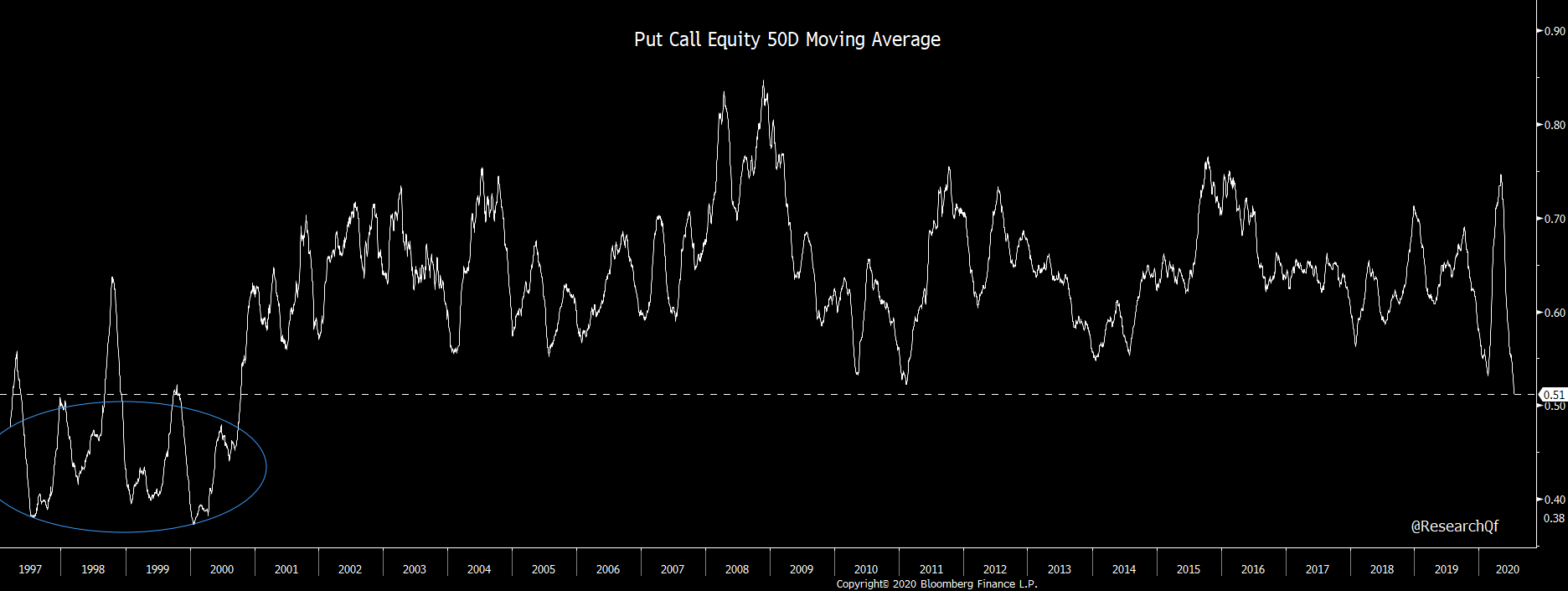
The persistence of low put/call ratios since June is getting hard to ignore.  Here are a few things that point to a potential phase shift for options markets from the 2001-2019 regime to the new 2020 regime.  When an extreme level doesn't provide the same signals as it did in the past, and continue to persist, you have to consider a possible change in market regime.  If these low put/call ratios continue through the rest of the year, you have to adjust the definition of extreme put/call ratios to lower levels. 


 h/t @ResearchQF

One of the possible reasons for this change could be the prevalence of daytraders who speculate on the market not through stocks but through options.  And retail traders now seem to be more heavily involved with calls than puts, especially since the March lows.  Another reason could be the reduced level of put selling following a catastrophic result in March from selling out of the money puts for income. 

SPX is having a hard time cracking through to all time highs.  It is to be expected that there will be stiff resistance here after the amount of rallying this market has done over the past 5 months.  It will be choppy for the next week or two and then I expect a sharp pullback in September. 

Wednesday, August 12, 2020

Nasdaq Lagging

 The momentum trade in the Nasdaq big cap names is starting to unravel.  Nothing huge yet, but the Nasdaq Composite continues to trade heavy compared to the SPX and especially compared to the Russell 2000.  The Russell 2000 is really a side show, its importance is overstated.  Breadth is useful in some cases, but only at truly extreme levels, either good or bad.  The SPX has been able to do fine with weak breadth all year, so its not something that really drives any trading decisions.  

What matters are the big boys, the big 5.  MSFT, AAPL, AMZN, GOOG, FB.  They are the key to the long term direction of the SPX.  Those are the most popular stocks among both hedge funds and retail, so they are a pure read on the sentiment of the market. 

 The weakness over the last 3 days sticks out because if you remember, AMZN, AAPL, and FB had "blockbuster" earnings in late July, all on the same day, and investors were extremely excited about those stocks.  Yesterday, we revisited those post-earnings levels in the NDX, even as the SPX was near all time highs.  

The big cap tech names trade like they are overowned, and totally saturated with buyers.  Those who want to get into those stocks have already gotten in, or won't get in unless they trade much lower.  There definitely doesn't seem like there are too many eager Nasdaq buyers on just a 2-3% correction.  

Since the uptrend has lasted for so long, almost 5 months, there definitely will be some buyers on dips, but eventually, when all those dip buyers have gotten their full allocation of big cap tech, especially, then we can go down in earnest and test some of the important levels below, SPX 3200, 3130, and 3000.  

Another bearish thing that happened over the past 3 days is both gold and bonds finally having steep selloffs, something that was a warning sign in early June, which led to a sharp pullback.  And whenever popular trades like gold and silver suddenly go parabolic and then selloff sharply, its a sign of rampant speculation driving prices too high compared to the fundamentals.  That kind of mindset flows over to the stock market.  

It is without a doubt bubble behavior using the rationale that the Fed is pumping tons of liquidity into the market and lifting all boats.  That belief is so hard wired into investors' heads that its become a self fulfilling prophecy.  The herd can drive a trend to extremes until the forces of supply and demand correct that trend.  This year, you are seeing stock buybacks drastically cut and equity issuance increase at the same time.  If prices stay high while earnings don't grow, corporations will likely try to take advantage by issuing more stock.  

Bottom line, the leaders that have driven the market higher since the March bottom are starting to show signs of buyer saturation, and you are seeing rampant speculative blowoff tops in gold and silver.  Piece by piece, you are getting closer to that exquisite moment where the market tops out and the trend changes violently.  We are almost there, but the bulls won't rollover easily.  They will fight it until the selling forces overwhelm them.  It may take up to 2 weeks before we get that change of trend, but the time bomb is ticking and it can go off any day now.