Thursday, December 8, 2022

Sun Rises in the Bond Market

The positive correlation between stocks and bonds is weakening as the focus shifts from inflation to economic weakness.  The CPI report in November was the game changer.  It gave bond investors the green light to start buying as the fear of an inflationary price spiral and a possible UK like bond vigilante led squeeze higher in yields was put off the table.  As most bond fund managers have been afraid to add duration ahead of this freight train bear market, there was a lot of pent up demand that was building as 10 year yields broke the 2022 highs of 3.50% and squeezed mercilessly higher into late October, only to be saved by a nervous Fed using their loudspeaker, Nick Timiraos of the WSJ to calm down the market.  The day that Timiraos came to the rescue on October 21 was the top in 10 year yields at 4.33%.  

Since the CPI release with the softer than expected inflation print, bond investors have come out of their bunkers and looked at the charred landscape as 10 yr yields have gone from 1.51% at the start of 2022 to the mid 3s.  People forget in times of distress what they are buying and selling.  A 10 year Treasury note is pricing in the average of the Fed funds rate over the next 10 years + term premium.  It is a world where developed world population growth is approximately zero, and productivity is also around zero (maybe negative given the work from home trends, lack of meaningful technological advances, and increasing labor power = lazier workers).  Nominal GDP growth will be driven by inflation, not economic growth.  Expect a return to secular stagnation until the next big stimulus package (2025 story?).  2020-2021 was an anomaly.  You had a convenient excuse for politicians to go full bore populist and spew out tons of fiscal stimulus for individuals, state and local governments, and corporations.  

That is something that will happen again, but the stars have to align to get that kind of scale of coordinated, global fiscal pump priming.  The right mix of Republican and Democrat control of White House and Congress, either total control for one party or a Republican president.  Republicans will obstruct fiscal stimulus if there is a Democrat president in power, but not if its a Republican president.  And Democrats always believe in moar fiscal stimulus, no matter who the president is.  So in most cases, a Republican president leads to more fiscal stimulus than a Democrat president because its not common for Democrats to control both the White House and both Houses.  

Back to the bond market.  Its has been in a 26 month downtrend from August 2020 before it finally bottomed in October.  That is a LONG downtrend.  You have flushed out a lot of weak hands during that process, while offering much more attractive yields for long term investors.  Yields that are high enough where bonds can now provide a risk off hedge to equities once the rate hike cycle is done, which looks to be less than 3 months away.  Due to my pessimistic view on global growth, and even US growth, I lean towards the bullish side on bonds in most situations.  I definitely underestimated the inflationary effects of all that Covid stimulus but its looking like most of that has worked its way through the system.  With prices already having gone up a lot in 2021 and 2022, the base effects for inflation prints will favor disinflationary views over those who think inflation remains sticky in 2023.  The M2 money supply has been dropping steadily in 2022, which is rare to see.  I don't see a wage price spiral happening when the supply of money is no longer increasing and when the demand for workers is dropping as the economy gets weaker.  When the economy weakens, workers have to worry about potentially getting fired, which reduces their wage bargain power, and you have fewer workers switching firms, another source of wage growth.  

Lately, the yield curve has gone into a super inversion.  2-10s are trading -83 bps.  Look at the move in 1-10s, historically extreme:


Take a look at when the 1-10s spread went into negative territory, a sign that the Fed is overtightening and about to push the economy into a recession.  1989, 2000, 2007,2019.  They all resulted in sharp curve steepenings as the Fed aggressively cut rates in all 4 cases.  I expect a similar outcome this time around.  In fact, with the curve that much more inverted now, the curve steepening move will be vicious.  I am still seeing most fixed income analysts call for the Fed to keep rates high and not cut in 2023.  So betting on aggressive Fed rate cuts for the 2nd half of 2023 is both an out of consensus view, and also not priced into the SOFR futures curve as Dec 2023 is trading at 4.38%, which is only 52 bps lower than the 4.90% terminal rate pricing in Mar/June 2023.  The risk reward is quite good in the short end of the curve at current levels, although timing it will be important.  The roll up in yields is extreme at the short end of the curve, so the negative carry for being long 2s and short 10s is almost 40 bps/year.  That is a big chunk to pay out for a curve bet, but it should pay off big when the Fed enters a rate cutting cycle.

From the daily headlines, CNBC, and Bloomberg, slowly more are becoming aligned to the recession view, and that's part of the reason you are seeing the big rout in crude oil even as US inventories keep going lower and China loosens it Covid policies.  There has been heavy liquidation of long positions in Brent and WTI futures over the past couple of weeks.  With the curve going from backwardation to slight contango, systematic commodity traders are reducing longs and adding shorts. 

In trading, sometimes the market just induces you to take a position which you never thought about taking so soon.  The big drop in crude oil this week is piquing my interest.  Even with the short term cyclical headwinds and demand weakness that is sure to come down the pike, at a certain price, the risk reward turns positive for buyers.  We are probably already at that point, but I will wait for an even better level.  This is a seasonally weak time of year for crude oil, and there are still residual bagholders who still cling on to hopes of $100, $150, $200 oil.  There are plenty of barrel counters who are besides themselves trying to figure out why crude keeps going lower as crude inventory levels go lower, amidst China reopening hopes.  That has kept me away from the long side.  But I'm noticing that some of the permabulls are softening their bullish rhetoric.  Oil stocks have massively outperformed the commodity in 2022, so if I play for a long, it would be in oil itself, not oil stocks.  Something that is on the radar.  

Closed out part of the NDX short yesterday in the premarket, and will look to close out the rest today.  Finally got that big spike in put/call ratio to 1.17 yesterday, and noticed that the fear was building up watching CNBC.  After today, probably will not play the short side in NDX or SPX until after Christmas, as I see little edge shorting during a seasonally strong period of the year, and ahead of CPI and FOMC, which probably will result in a relief rally.  Even though I think SPX will go up next week after the big events are behind us, I will not play the long side.  The levels just aren't attractive and there is rug pull risk in the unlikely case that Powell puts back on his hawk costume or you get a hot CPI.  I will let others fight those battles.  Its still a swing trader's market in SPX.  If we get a big rally after the CPI and FOMC, then we can talk about taking longer term short positions later in the month.  Especially in tech.  Until then, letting the market come to my buy or sell levels to put on positions.  They need to induce me to take a position by getting to an extreme, because there is nothing that's really attractive at current levels.

Monday, December 5, 2022

Retail Getting Bagged

The post bubble environment is playing out and the winners and losers are becoming clear.  The winners:  energy, pharma, healthcare, utilities.  The losers: mega cap tech (GOOG, AMZN, META, TSLA) software, semiconductors, speculative tech (EVs, ARKK favorites).  The worse performing names:  AMZN, GOOG, TSLA, NVDA, ARKK, etc. are heavily owned by retail investors.  The best performing names are not:  XOM, OXY, MRK, LLY, XLV, etc.  

The stock market has managed to do what it always does:  punish the uninformed who come late to the party and crowd into the most popular and overvalued names.  Let's take a look at 2 of retail favorite ETFs:  TQQQ (3x leveraged Nasdaq 100) and ARKK, vs 2 of the best performing ETFs: XLE and XOP.  

Inflows into QQQ, TQQQ, and ARKK, and outflows from XLE and XOP.  Yet, the performance is the complete opposite of the investor flows.


While you've seen a big rally off the October lows for the SPX, you haven't much of a bounce in ARKK or even in TQQQ.  

The most overowned stock among retail, TSLA, is acting the weakest among the megacap tech names.  It still hasn't even been able to get back above the October lows, when the overall market bottomed.  Its quite clear that there is a drastic reduction in demand for concept stocks that are massively overvalued with weakening earnings outlooks.  About the worst combination you can get for a stock.  Would not be surprised to see TSLA perform even worse in 2023 than in 2022.  Look at the low institutional ownership, which means that retail ownership is huge, uncommon for a stock with a market cap so big. 


 The heavy participation of retail investors, who are still heavily invested (they got diamond hands!) is a classic symptom of a market that is saturated and likely heading lower.  From 2008 to mid 2020, retail investors stayed away from the stock market, as equity fund outflows were the norm.  Only in the past 2 years has that changed.  The millenials, probably the dumbest generation of investors, finally had enough of sitting on the sidelines and finally piled into the bubble stocks (FANG, EVs, ARKK, meme garbage) en masse in 2021 to catch up.  Not only that, they also piled into cryptos, looking to get rich quick.  The end result is a bubble that's now popped, with retail bagholders littering the landscape.  The wealth effect is real for these millenials.  They are the ones with the most propensity to consume yet have been hit with the biggest losses.  This is not going to help with household formation in the coming years.  Add to the much higher mortgage rates and house prices that still haven't come down much and you have a shit sandwich for the millenials.  

Last Wednesday, Powell dropped his hawk act and showed his true colors.  Its not easy putting on act all the time, especially when the incoming econ. data doesn't support it.  Powell either had to lie through his teeth to try to forward guide a much higher terminal rate to keep the stock market down, or just be honest and admit that looking at lagged data to keep hiking rates is asking for trouble.  Powell seems to be over the  hawk phase of his act, and finally telling people what he really thinks.  He's afraid of overtightening, and is still going for that soft landing.  Although its highly unlikely that there is a soft landing, he'll probably soften his tone for none other than political reasons.  

He is already feeling some heat from the Dems for being too hawkish, and he's a guy who tries to please politicians.  He's the farthest thing from Volcker, no matter how much he wants to be revered like him.  The sooner he drops his infatuation with being the next Volcker, the less pain the economy will feel in 2023 and 2024.  But its probably already too late.  This is nothing like the late 70s, early 80s.  The secular stagnation and debt dynamics are total opposites of that time period.  The yield curve inversion and the leading indicators have already baked in a mild recession.  I can't picture Powell getting ahead of the curve, and he'll probably just be reactionary as always and be late as a result, panic cutting in big chunks in the summer/fall of 2023 to try to stave off a huge rise in unemployment and a big economic slowdown.  

I put on a small short NDX position on Thursday, and am looking to add to the position on Monday.  The market seems to be struggling here as we approach that much talked about SPX 4100 level, which seems to be the target for a lot of short term bulls.  With CPI and FOMC, along with a bunch of central bank meetings next week, it would fit the pattern of a pullback ahead of the events, and then probably a rally after the events are behind us.  So looking for a pullback later this week.  Not sure about levels, but probably the best time to cover will be Thursday/Friday. 

Tuesday, November 29, 2022

Zooming Out

The markets have slowed down considerably since the big CPI rally.  There is a short term equilibrium in the market, and volatility has compressed.  Its during days like this where its good to take a look at the long term picture of various markets and stocks.  It only confirms that there was a big change that took place in 2022, that we had a big bubble pop, and given how big the previous trends have been, its a very significant change in the markets.  

Despite all the talk about investors, in particular hedge funds being very bearish, its good to take a look at the % of net worth in equities and bonds for US households.  

Households are very underweight bonds from a historical perspective, at the lowest levels in the past 40 years.  Contrast that with equities, which is near historical high levels.  The overweight in equities and underweight in bonds points to a high probability that equities will be underperforming bonds for the next several years. 

The SPX has appreciated a lot over the past 5 years, and even with the bear market in 2022, its still at elevated levels.  Earnings have improved, but a lot of that was the massive Covid stimulus in 2020 and 2021 pumping up the bottom line.  Without a continuous stream of stimulus, these earnings levels are unsustainable.  With a recognition that inflation is no longer something that is always transitory in nature, valuations have to reflect a Fed that will be more cautious going to ZIRP and QE.  They will go back to that well when things get really bad, but I don't expect Bernanke type policies which used QE frequently and freely even when the economy was stable and growing.  That should automatically lower the fair level P/E levels for the SPX, especially when we are basically in a zero real organic growth environment

Take a look at TSLA and AAPL, the faces of the everything bubble.  Still very extended technically from a long term view, and overvalued from a fundamental view.  Estimate of fair value in this new environment is $30 for TSLA and $80 for AAPL. 


Let's take a look at the bond market.  The 2 year yield is at the highest level since 2007, and holds long term value at these levels.  If you assume that the real growth rate (with neutral fiscal policy) for the US is close to 0, and inflation will be determined by fiscal policy (unlikely to have big stimulus for next 2 years), then long term fair value is probably close to 2%.  Of course, 2 year yields are priced off the forward curve of Fed funds rates for the next 2 years, but from a longer term view, these high rates are unsustainable when nominal GDP growth goes back towards 2%, which I expect in the coming years.  You can't hand out 4.5% risk free for very long when the nominal growth rate is 2%.  Secular stagnation never went away.  It was just papered over by massive fiscal and monetary stimulus in a big overreaction to a pandemic. 


I am sensing a shift in the market view on bonds since the CPI report came in lower than expectations.  The pentup demand for duration has been building up as investor outflows and Fed jumbo hikes scared fixed income investors.  Now that they see light at the end of the hiking cycle tunnel, that demand is slowly being unleashed.  Investors are now more willing to go out on the yield curve to lock in decent yields for the next few years.  Fundamentally, if you are expecting a recession, there is no better way to express that view than to be long bonds, especially the belly of the curve, which is the most sensitive to economic conditions.  The leading economic indicators are showing a drastic slowing in the economy for 2023:


This is looking very similar to early 2001, another post tech bubble environment, but I expect a worse outcome.  The LEI levels are similar, but Greenspan was aggressively cutting in 50 bps chunks during that time.  This time, Powell is aggressively hiking while the LEIs are in the same spot. What's even worse, is that the natural growth rate of the economy was much stronger in 2001 than it is now.  It was a younger demographic with stronger population growth and a strong increase in productivity due to rapidly increasing computing power and the growth of the internet.  So it should be a much worse recession than in 2001.  My base case is that the Fed has to cut rates down to 1% or below over the next 2 years to have any meaningful stimulative effect on the economy. 

The bull case that I am hearing is year end seasonality (very soft edge), strong consumer balance sheets (its getting weaker and weaker), and strong labor market (will get much weaker as recession hits).  Those are 3 temporary factors that will quickly dissipate in 2023.  So its hard to embrace the bull case, especially when there is still a big overweight in equities over bonds for US households, with much more inflows into equity funds than bond funds in 2022.  

Looks like I missed shorting the top of the rally last week, being too patient.  At SPX 3975, I see no short term edge shorting, so I will abstain.  If the market rallies back from here towards SPX 4040-4060 zone, I will put on NDX shorts looking for a 400-500 point pullback in the NDX.  Not going big game hunting yet, as I expect a narrow range over the next several weeks.  

On China: its a tempest in a teapot.  Human nature never changes, and the overreaction to social unrest will always be present.  Whether it be Zero Covid protests, BLM protests, French yellow vest protests, Greece austerity protests, etc., they don't affect the market.  They are an entertaining sideshow for news junkies that can't ignore the latest headlines and always have to put in there 5 minute expert take on the subject.  

What is exciting doesn't affect the financial markets for long (geopolitics, social unrest, etc.).  What is boring does (fiscal and monetary policy). 

Friday, November 25, 2022

Profit Margins

The big driver for corporate earnings for the next 10 years will be profit margins.  Revenue growth will be hugging zero + inflation, as demographics is destiny, and there are no new technological innovations that will boost productivity.  If there is something new that is a game changer that appears in the next 10 years, it will take another 5-10 years for that to really affect the GDP numbers.  The lack of energy supply growth is also a limiting factor for future global growth, as energy is the building block for all economies.  

So what are the main drivers of profit margins?  Its mainly 3 things:  pricing power, labor costs, and interest rates/taxes, in that order.  Obviously if you don't have pricing power, that really kills your profit margins as you can't collect as much for the same product.  In the U.S. in particular, the lack of antitrust enforcement has allowed a huge amount of concentration in various industries.  This has allowed for corporate profit margins to keep rising even as economic growth keeps shrinking.  Corporate welfare is the default stance for politicians as the corporations play a huge part in financing the campaigns of politicians on both sides.  Corporate lobbyists have huge influence and are the reason corporate tax rates are the lowest in the past 50 years.  They also ensure that corporate tax loopholes remain open and unchanged.  Corporate profits as a percent of GDP is at the highest levels in the past 75 years. 


Pricing power is one facet of profit margins that is the most bulletproof, as the politicians are bought and paid for by corporate America, so its unlikely that antitrust legislation will gain any traction unless there is a revolution from the masses.  The average person is uninformed about the tax code, or the laws that are not being enforced by the government to prevent monopolies and collusion.  So the cause of their lower living standards and higher costs for goods and services is shrouded in a veil that few are sophisticated enough to dig into.  Its just easier to blame the other party for inflation and a lower standard of living. 

Next comes labor costs.  Labor is the biggest expense for most corporations, so it has a notable effect on corporate profits.  Corporations want to pay the least they can get away with while still retaining workers.  The lack of competition is a key factor in keeping wages down, as there just aren't many different places to find similar work for a lot of workers.  Also outsourcing to cheaper labor countries like China keep wages lower as corporations are very willing to go overseas to keep labor costs down.  But the balance of power which has been heavily skewed towards corporations is slowly shifting.  The lack of labor force growth in the G7 and China is giving workers a bit more bargaining power as labor supply is unable to keep up with labor demand.  

Quiet quitting and work from home wouldn't even be a thing unless workers had confidence in getting another job if they got fired.  The aging population ensures that the labor force will continue to shrink even if the population remains stable, as more people drop out of the labor force due to retirement.  

This shrinking labor pool hurts corporate profit margins in 2 ways:  companies have to pay more for the same job, and they are getting less productive workers because they are working from home/quiet quitting/less qualified.  

The last factor is interest rates/taxes.  Corporations as a whole are net borrowers.  So higher interest rates on corporate bonds hurts the bottom line.  If we are to assume that the structural energy shortage and profligate fiscal policy due to populism are secular trends, then you are likely to have higher interest rates in the future than you did from 2008 to 2021.  That increases interest expense, which hurts profit margins.  And corporate tax rates are at 21%, the lowest in 50 years.  Its very unlikely they will be cut further.  Its much more likely that they are increased in the future as the budget deficits keep getting bigger.  That would reduce profit margins for almost all corporations.  

Inflation has mostly come from an increase in corporate profits rather than an increase in labor and nonlabor input costs, as most assume.  This shows you how much pricing power corporations have in the U.S.

So pricing power likely remains a constant, labor costs are likely rising, and interest rates/taxes are likely rising compared to the past several years.  These are things that long term stock investors need to take into account when trying to estimate the forward returns on equities over the next 10 years.  It just makes me more of a bear on stocks from a fundamental perspective, which are already unfavorable due to historically high valuations.  

It looks like we are getting more bulls on board the year end rally bus.  It feels like its getting a little bit crowded.  I am still not short yet, but its getting quite tempting to put on a starter position.   The post holiday doldrums could hit this complacent market next week.  I have noticed that the Nasdaq has been lagging badly for the past 2 weeks.  It appears that the money flows are now going out of tech and into anything else but tech.  I expect that trend to continue for the next 12 months.  Its the dotcom bust all over again. 

Monday, November 21, 2022

No Organic Growth

One of the habits of financial markets is extrapolating short term trends well into the future.  Remember 2021, when the Fed was assumed to be stuck at zero until 2024 and financial repression would continue for years and years?  Now in late 2022, almost everyone assumes that the Fed will be higher for longer, keeping rates at a restrictive level for all of 2023 and well into 2024.  Its a bizzaro world out there.  Rear view mirror forecasting while ignoring the prior misses using that same forecasting method. 

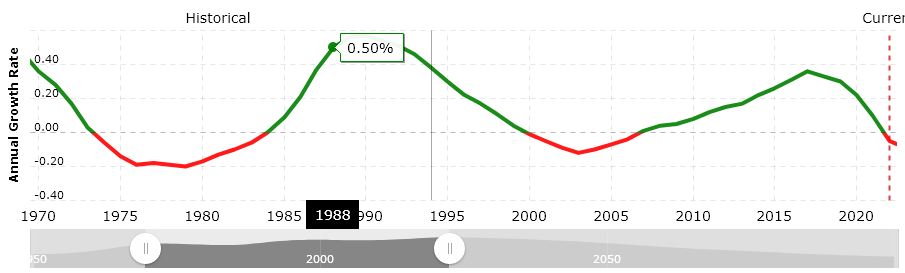
In order to maintain restrictive rates for a long time, there needs to be growth. Where will the growth come from?  The fertility rate is steadily dropping in the G7 nations and China.  The main source of world population growth, Africa, is basically an economic non-entity.  Here is the population growth rate for the US, the big 3 in the Eurozone (Germany, France, Italy), and China since 1970.  

United States population growth rate

Germany population growth rate

France population growth rate

Italy population growth rate

China population growth rate

Notice the steady downtrend for the past 5 years for all of the countries above.  The U.S. population growth rate is now around 0.3%/year.  Immigration has dropped dramatically in the U.S.  In Germany, France, and Italy combined, there is negative population growth.  China has steadily declined and is now at 0, and falling the fastest of them all.  In all the above populations, the demographic is getting older, reducing the current labor force and potential labor force in the coming decade.  Its a recipe for very low growth.

The GDP equation is as follows:  


The 3 key inputs for GDP growth are productivity, capital, and labor.  With work from home and an aging population, with no new breakthrough technologies since the internet, productivity is flat to down.  Capital is no longer cheap or readily available with the Fed jacking up interest rates and reducing the money supply.  And with an aging population and near zero population growth in the biggest economies in the world, there is no growth in the labor force.  Basically, you have zero GDP growth without a surge of cheap capital in the form of fiscal and monetary stimulus.  Without stimmy, no growth.  Its that simple.  

Secular stagnation is the baseline, and whatever artificial means are used to shake the patient from its stupor are the exceptions, not the rule.  The 2020-2022 economy running high on stimmy is over.  Sure, there will be stimmy coming back, because populism is here to stay, but its not coming back in the US anytime soon.  With gridlock until the end of 2024, the Republican base will not help Biden/a Democrat get re-elected by pumping the economy.   So odds are very low for any new stimulus in the next 2 years.  That's 2 years of being drug-free for this stimmy addict of an economy.  The withdrawal pains are being vastly underestimated.  The patient will be screaming for another dose to get rid of the hangover as he's crashing down from his biggest rush ever.  

I am sympathetic to the secular inflation case because odds are high that the politicians will keep going back to that money well when things get hairy, and that will ensure future inflationary waves.  But since inflation is a rate of change statistic, it will not stay at a high level for long if the governments and central banks aren't continuously printing.  And the coming downward cyclical forces are so strong that it will overwhelm the structural energy supply shortage. 

Without the buffer of a naturally growing economy from population growth and/or productivity growth, the economy will not be able to handle a Fed funds rate at 4-5% for long.  Its already showing signs of weakening and Fed funds isn't even at 4% yet.  Powell who is smarter than he sounds, is just following the safest path politically, which is to act like an inflation fighting hawk when inflation rates are high.  He needs an excuse to change his rhetoric, either in one of 3 ways:  1) a big drop in stocks/blow out in credit spreads 2) a much lower CPI 3) much weaker nonfarm payrolls numbers.  

I thought a big drop in stocks or a much weaker credit market would be the first thing to break, but they have held up well, as investor psychology is still very much in a buy the dip mentality.  So it may have to be much weaker nonfarm payrolls numbers that gets the Fed to relent from its hawkishness.  The CPI works with an even bigger lag than the NFP, so its going to be the last thing to show that the economy is in a recession.  Considering how important housing is to the economy, the higher yields will have a much bigger effect in 2023 than currently, as the downstream effects of a housing freeze will flow through to construction and durable goods demand.  This will have a notable effect on the jobs numbers in the coming months.  

I hear many five minute stock market experts calling for a year end rally, talking about how underperforming fund managers will be chasing for performance, talking about positive seasonality, etc.  Valuations are still too high considering the high level of yields.  The fundamentals are horrible.  Shorting overvalued tech stocks around SPX 4000 feels like shooting fish in a barrel.  Looking to reload on tech shorts at higher levels as the Thanksgiving holiday cheer tends to get investors bullish. 

Thursday, November 17, 2022

Collision Course

The dead horse is coming back to life.  The bond market is no longer getting bullied by hawkish Fed rhetoric.  In fact, its starting to flat out ignore any of the hawks who insist on using forward guidance to price in higher rates further out on the curve.  2-5s are inverted by 50 bps.  2-10s inverted by 65 bps.  This is not a long term sustainable situation.  It is amazing to see this level of curve inversion when you still have multiple hikes priced in the next few months.  Especially as you have been getting steady outflows from bond funds as well as the draining of liquidity from QT.  And the bond market is defiantly replying "balderdash" to Fed hawkishness by pricing in several rate cuts starting in the 2nd half of 2023 and even more in 2024. 

Its a battle now.  Fixed income traders vs the Fed.  They are on a collision course, with one side saying the Fed will cut in 2023 and the Fed denying it and talking of a higher for longer plateau.  I am siding with the fixed income guys.  They aren't perfect, but they have a much better track record of forecasting future rate moves than the Fed.  And the economic leading indicators are flashing red.  

Just doing basic macro 101 analysis will tell you that a steep inversion in the yield curve, especially towards the front end, is a warning sign of a coming recession.  Add to all the demand that was used up to buy "stuff" in 2020 and 2021 and you have a consumer that is no longer in a rush to buy goods.  As for services, that post Covid pentup demand was released in 2022, and will go back to normal levels in 2023 and beyond.  

The excess savings are steadily being used up, as inflation and the negative wealth effect take their toll on the consumer.  With gridlock guaranteed after the Republicans taking the majority in the House, there will be no big stimulus packages coming down the pike.  Without fiscal stimmy, the secular stagnation theme will come back with a vengeance.  After all the talk about free spending governments, with gridlock the next 2 years, you are likely going back to monetary policy being the only game in town.  

And when the Fed has to try to make up for weak growth with loose monetary policy, they usually overdo it, because they can't help themselves.  Sure, they say they won't backstop financial markets, but its one thing to say it now, before the economy turns sour.  But when things get ugly, they've always come to the rescue.  Its in their mandate.  Its what they do.  

The more the Fed tries to fight the bond market with hawkishness, and more rate hikes, the more quickly they bring on the pain point for the economy, forcing a quick turnaround from hikes to cuts.  The rate hike path will be more like the Matterhorn than a big plateau.  

We have been pulling back after that euphoric pop on a weaker PPI number on Tuesday, as nervous shorts and underweight longs were afraid of another CPI like day. I took advantage of the strength to put on NDX shorts.  If we get a further pullback this week, I will cover to re-deploy shorts on the next rally.  The strength in the bond market and dollar weakness should prevent any big rug pulls for the time being, so I won't get greedy looking for a big down move.  After a couple more weeks of bulls coming on board, by early December, that should be the time to put on a bigger short and with lower price targets.  Staying nimble for now, no need to dig in the trenches for a long war.  Just quick strikes on the short side until I see more of a saturation of bulls. 

Tuesday, November 15, 2022

Dotcom Bust 2.0

To figure out the future, you have to study the past.  Things never play out the same way, but there are general tendencies in the financial market.  The main template for the current time period is not the 1970s inflationary period, or the 2007-2009 financial crisis period, but the late 1990s/2000 dotcom bubble.  The 2 main ingredients that you saw only in that bubble and in this bubble was the extreme greed in chasing the riskiest investments (2000: internet stocks.  2021: bitcoin, meme stocks, EV/speculative tech stocks), with widespread popularity in stock investing and daytrading.  You never saw that in the 1970s or in 2007.  The sheer amount of assets that poured into the stock market not only through equity funds but through direct investments by retail, is eerily similar to 1999/2000.  

The extreme bubble valuations in this everything bubble is only rivaled by the peak valuations during the 2000 bubble.  Valuations are not a great timing tool, but they are a great measure of the amount of expected return for playing the long or short side.  The higher the equity valuations, the lower the long term expected returns, and vice versa.  Its all common sense, but the big picture is often forgotten as we focus on short term price movements, earnings, the latest Fed speak, economic data, etc.  

So going by the dotcom bubble template, the Nasdaq topped out in March 2000, and made the final bottom in October 2002.  That is 30 months from top to bottom.  If you look at this Nasdaq bubble, it topped out in November 2021 and if it were to follow the same time frame as the dotcom bubble, the market would make a final bottom in May 2024.  Now I don't think it will take that long to go down to the final bottom, but its a possibility.  It gives you an idea of how long the bear market can last if it just follows the normal post bubble course of action.  My best guess would be a bear market that lasts until late 2023/early 2024, so about 2 years in length.

Let's take a look at the waves up and down in the Nasdaq 2000-2002 bear market.  

Nasdaq Jan. 2000 - Dec. 2002


If I were to guess where we are in the bear market relative to 2000, it would be around November of 2001, after a sharp rally off the 911 lows in September.  That rally and subsequent sideways chop lasted for 4-5 months before it gave way to an absolute bull killer of a downtrend that lasted 6 months from the bear market rally high in January 2002.  

With the dollar dropping sharply in the past week, it looks like the US dollar uptrend is in for a long period of consolidation, which likely means we are in a long period of consolidation for the equity market before the final down wave which is always the most brutal.  I could see that starting in the first quarter of 2023 and lasting till the summer.  This post CPI move should not go much higher, as I don't expect a Mt. Fuji formation of straight up and straight down.  It will likely be more of a Alps mountain range of gradual tops and bottoms for a few months before the bottom falls out and we enter a long downtrend that will eventually lead to a capitulation by the bulls.  We could be trading in a narrow range from 3800-4050 for the next 3 months. 

I expect the bond market to be strong in 2023 as inflation slows down and the recession becomes more clear in the economic data.  That should be supportive for equities initially, but when the economy really starts to slow down in the spring/summer, entering a deep recession (don't believe the shallow recession predictions), you will see bonds and stocks going in opposite directions.  I agree with the long term secular inflation theme due to the populist wave of politicians that love to deficit spend to buy votes.  But the disinflationary forces of a deep recession will make people forget about inflation for the next 12 months. 

Bottom line, there is still a long ways to go for this bear market, and it appears the first phase is done, and before you transition to the next phase, usually you will see a long consolidation of the downtrend to build up potential energy for the final big down move which usually leads to the bulls throwing in the towel in despair.  

Still not short yet, don't have a lot of confidence that we'll get a sharp move lower anytime soon.  At the same time, don't think we'll get a continual squeeze higher, although a minor overshoot above 4000 towards 4050 is definitely possible.  After studying the charts and looking at the 2000-2002 bear market, I will only be shorting NDX and tech stocks.  Expecting continued underperformance for tech stocks for several months.  Am long some Treasuries to play for a sharper economic slowdown than most expect.  Will look to start a small short in NDX and tech into any strength this week. 

Friday, November 11, 2022

Greed is Still High

That was a savage face ripper.  Not only did it rip the face off the shorts, it also poured acid right afterwards.  In no way am I buying into the post CPI rally, you don't change your mind based on one day.  All the research and analysis remains the same.  They say all the work is done leading up to game day.  During the game, its just running through everything that you prepared for.  Yes, inflation has peaked, and will go down more rapidly than the general consensus.  That is bullish for bonds.  But not necessarily bullish for stocks.  Especially if the Fed doesn't respond to the lower inflation with rate cuts.  Based on how entrenched Powell has put himself into the hawk corner, he's not going to cut rates before CPI hits 2% until stocks go down meaningfully (SPX under 3300) or the recession really hits the jobs numbers and/or credit markets.  It looks like barring a huge drop in the stock market or a crash in jobs numbers/CPI, 50 bps is a lock for December.  That takes Fed funds effective rate to 4.35%.  If NFP and CPI and stocks don't go crazy to the upside, he could raise one last time in February to 4.60% and pause there.  But the stock market will not be satisfied with that outcome, especially with QT running in the background, sucking out liquidity. 

So how can it be bullish for bonds and not for stocks if Powell remains intransigent and refuses to cut rates from the terminal rate as CPI inflation steadily heads towards the 2% target?  Its because the economy will get weaker than many expect and that will result in much lower earnings and a sharp cutback in stock buybacks.  The financial markets appear to be on the cusp of a reversion to the negative correlation of stocks with bonds.  That is what has happened during all the major bear markets in the last 40 years during a recession.  Even if Powell tries to fight the bond market by refusing to cut rates in 2023, the bond market will have all the data that it needs to build its case for Powell to eventually cave in to its demands.  And it will not be shaken by a hawkish Powell, instead, it will just bide its time waiting for the lag effects of higher rates, less money supply, and negative wealth effects to work its way through the system, day by day.  Housing construction will be a in deep freeze in 2023, lopping off a huge chunk of demand.  

The one big takeaway from yesterday's reaction to the lower CPI is that investors are still quite greedy despite all the so-called bearish sentiment.  The SPX going up 208 points in day when it wasn't even that oversold tells you how eager investors are about catching the rally.  It is days like yesterday which keep me cautious about being short ahead of much feared economic data releases.  Yes, it works out well to short some of the time, but usually its better to be safe than sorry.  Especially when the last 2 reports led to immediate huge drops in stocks.  The market has a habit of catching investors off guard when things have been going one way for so long.  

A word on crypto with the FTX debacle.  Jon Corzine was not an outlier.  There have been rogues who can't resist the temptation to dip into customer funds/bank capital to make huge bets.  SBF just could get away with it for longer because he was in the wild wild West of finance.  Cryptocurrency trading is just a giant casino with few rules and shady owners with a few big sharks roaming the waters and tons of little fish coming in, which continually feed the sharks.  It was marketed as a way to invest in the Fintech Defi revolution, but its really just a way to gamble online on the most volatile asset class out there.  In the end, really the only ones that make money in the enterprise are a few savvy sharks, the exchange operators who are trading against their own customers, using old fashioned bucket shop stop runs to wipe out overleveraged accounts and collect their cash, while collecting on commissions at the same time.  And if they feel like they can get away with it, they'll just steal customer money.  After all, there are no repercussions except the cries from the fleeced fish, who no one cares about anyway.  

Eventually bitcoin and all the other cryptocurrencies will be relegated in the history books as a symbol of the immense greed of these times, where speculators would believe almost anything in order to get rich quick.  Based on everything that I see out there, there is no way that you are going to get a sustained rally higher under these conditions of irrational greed despite a year long downtrend.  If I were to use an analog, it would be the dotcom bubble period from 2000 to 2002.  We are in the November 2001 period, after a big post 911 rally, facing another horrible 12 months to come for the stock market.  But this time, unlike in 2001, the Fed is still hiking and taking out liquidity.  It can be argued that this bear market could get even uglier than the dotcom bust, but the central banks cannot stomach that kind of pain.  Finance is too politicized and populism is too rampant for the free market to operate unencumbered.  There is an uncle point that they will reach, when even a few rate cuts aren't enough, and the stock market will be begging for more rate cuts in order to stop going down.  And they will have to deliver them.  The stock market will hold the central banks hostage by threatening to suicide bomb the whole financial system in order to get more rate cuts.  That's when things bottom, not when investors think stocks will rocket higher when the Fed pauses hikes.  

Cautiously waiting to see what happens going into monthly opex, it is tempting to start a short here, nearly at 4000, after such a huge move higher.  But remembering what happened 3 months ago in the last opex week when the market was ripping towards 4300, you often get tops at those gamma squeeze moments occurring due to monthly opex.  That would be the ideal setup for a low risk short.  Almost there, but I'll probably wait until early next week to start the short campaign just to be on the safe side.  And it will probably be with a mix of short SPX, NDX, and long the belly of the curve in Treasuries. 

Tuesday, November 8, 2022

Money Supply is Shrinking

And no one cares.  Market forecasters and economists are great at extrapolating the past into the future.  They are great at taking short term trends and make them seem like long term trends.  The church of what's happening now is always the busiest, and has the most members.  People could care less about what happens 2-3 years from now, they want to know what will happen today, this week, this month, etc. 

The money supply is doing something that is very uncommon, and its not getting much attention.  Its going down, and very rapidly in the past month.  The U turn that governments and central banks have taken in 2022 in both fiscal and monetary policy is having a big impact in the very foundation of the money game.  The supply of money.  M1 money supply is barely up year over year in the US, and has been falling since January.  

U.S. M1 Money Supply

Look at that big drop in September, that's not conducive to continual high inflation.  Yet, many are extrapolating the sticky core inflation into 2023, forgetting that levels don't matter.  Remember, inflation is a rate of change statistic, if you go from 10 to 100 and go down to 90, that's considered deflation.  The same thing happened with the money supply.  You had a huge burst higher in the money supply in 2020 and 2021, and that's completely stopped and even gone a bit into reverse in 2022.  2023 will surprise people in how fast the inflation rate goes down because of year over year base effects and shrinking supply of narrow money, one of the best predictors of future economic growth and inflation, of course with about a 12-15 month lag.  

I know people love to talk about supply chains, Russia Ukraine war, food and energy prices, wage growth, etc.  It makes for a nice story, but they don't control inflation.  Inflation is controlled by the supply of money and the amount of goods and services available.  The rate of change of the supply of money is usually much more dynamic and variable than the rate of change in the total amount of goods and services.  Thus, money supply is ultimately the main factor in deciding the rate of inflation.  The reason Japan has had much lower rates of inflation than the rest of the world is because its had the lowest rate of money supply growth by a mile.  


Japan's M2 money supply has gone up ~ 100% over the past 25 years, while the US M2 money supply has gone up over 350% over that time period.  That is why the US has had a higher rate of inflation than Japan, not demographics or any other "smart" explanations economists and market "experts" come up with.  Just look up the M2 money supply in Argentina and you will see where the inflation is coming from there.

Milton Friedman was right, inflation is a monetary phenomena.  A wage-price spiral has the order incorrect.  Its a money supply - price - wage spiral.  An increase in the supply of money fuels higher prices which results in workers demanding and receiving higher wages.   

The CPI data comes out Thursday, and it is the big market mover these days, like what the NFP used to be back in the day.  I have no idea what the CPI will do in the near term, but investors are overestimating the stickiness of core CPI, as leading indicators, including the M1 money supply, are forecasting a sharp deceleration in 2023.  

No one really cares about money supply these days because it works with such a huge lag, and its like the iceberg that's slowly moving, yet people think its sitting still.  Given time, huge effects are seen from the increase or decrease in the money supply.  But we are living in a world of instant information, instant gratification, just a torrent of information overload that gets most people focused on the news/economic data for the day.  Its encourages excessive trading and very short time frames. 

Counterintuitively, the reduction of commissions to near zero and the ease with which trades are placed is the most value destructive evolution in retail investing.  This evolution has helped line the pockets of the payment for order flow market makers like Citadel, Susquehanna, Wolverine, etc. as well as the front running HFTs which are the bane of the existence for active fund managers.  

Profitable daytrading can be done, but its trying to make money the hard way when there are so many other ways to do it that are higher probability, have less slippage, and less prone to execution error.  I guess some people are just so averse to taking overnight risk or can't sleep at night if they have a position on that they stick with daytrading.  With the amount of 0DTE options being traded these days, the intraday patterns have changed, and I'm sure there are some tradable patterns, but its not really my style looking for quick move.  I would rather lean on levels and price exhaustion to find opportunities.  

We are getting a grind higher into the midterm elections.  I am sensing a growing level of optimism about the market despite the tech wreck that I see almost everyday in the market.  Its irrational, but investors have been mesmerized by stocks over the years, and BTFD and TINA mindset are still there among the community.  But tech stocks are the leaders.  No matter how well other sectors are trading, tech is still the guiding light for this market, and without tech leadership and strength, it will be difficult for the market to keep going higher.  And looking at how earnings are turning for the worse among the tech names, and how crowded they still are among retail, I expect a replay of what you saw in the dotcom bubble where tech stocks underperformed in a bear market for 2 years.  We just completed year 1 of the underperformance.  I think there is at least another year left.  

We are still seeing fairly steady inflows into equity funds despite the poor performance this year.  Let's not forget that from 2010 to 2020, there was almost always a constant inflow into bonds and out of equity funds except for very brief periods in 2013 and 2018.  It has been the opposite in 2022.  Gut feel that investors are doing the wrong thing again this time around, selling bonds and buying stocks.

Been laying low for the past few days, not seeing a high probability trade.  With the midterm elections and CPI this week, it would not surprise me to see stocks and bonds both higher on a relief rally after the events have passed.  That could set up a top for opex next week when you have the big monthly Friday expiration.  SPX 3900-3950 would be a good spot to short. 

Thursday, November 3, 2022

Powell's Hawk Costume

You have to give Powell credit for keeping up the hawkish act, he should win an Oscar with his performance since Jackson Hole.  He could have been honest and eased off the brake a bit to match the somewhat dovish statement but apparently he didn't like the way stocks rallied after that leak to the WSJ before the quiet period.  The huge 250 point SPX rally was just too much bull for Jay.  He didn't want to redo that fiasco in July/August when he loosened financial conditions even as inflation and nonfarm payrolls were coming in hot.  This time, he wasn't going to be mealy mouth and noncommittal, he would lie if he had to.  Forward guidance is a way for the Fed to tighten financial conditions without having to do any rate hikes.  He tried to get the market to expect a higher terminal Fed funds rate but at the same time, admitting that he would likely step down in upcoming meetings. 

Whenever the Fed guides beyond the next meeting, you can basically throw that forward guidance into the trash can.  The Fed usually tries to go through with what they hinted at for the following meeting, but beyond that, it comes down to financial conditions and the data.  If you get lower than expected inflation numbers and weaker nonfarm payrolls in the coming months, Powell will slow down to 25 bps in February, and if its weak enough, pause right there.  Whatever he said at this meeting will be long forgotten in early 2023.  It looks like its going to be 50 bps in December, and then a big question market for February 2023. 

Rates are getting to a point where the stock market has to compete for fund flows with money markets and T-bills, as a risk free 4+% is quite attractive compared to stocks that are still historically overvalued with earnings declining.  When cash becomes a more attractive asset, it tends to suck money out of riskier assets, which should feed through to credit spreads widening and stocks weakening.  Nothing happens in a straight line, but that's the gravitational force the stock market is fighting at the moment.  

The volatility continues to be off the scale, its underappreciated because its been like this all year.  This kind of volatility assures that vol target funds and systematic strategies will not be coming in to support the market anytime soon.  

Its not a good long term sign for the stock market when you see the big cap tech stocks get destroyed.  These are the sentinels of the market, the drivers of the animal spirits.  When the retail favorite tech names get crushed like this, it makes retail less willing to invest in the market.  If these tech stocks continue to be out of favor, watch for retail outflows.  There was so much money pumped into stocks in 2021, and early 2022.  There is a lot of money stuck in stocks and equity ETFs, when investors start to give up on the stock market, you could see a deluge of outflows which could take the SPX to that 3000-3200 level that it traded at pre Covid.  

Got that big selloff after the Powell press conference.  The market was just a bit too hopeful for a less tough Powell, and he disappointed again.  This is not the norm, and traders should not get used to a tough talking Powell.  But the data was just not weak enough for any dovish talk.  Lots of events coming up in the next few days: nonfarm payrolls, midterm elections, and then CPI.  The fast money bulls are selling ahead of those events, for fear of a repeat of what happened in September and October ahead of the data.  Still think the bulls will try to rally the troops one more time after the events are behind us, but that's probably going to be the last decent rally before a continuation of the downtrend.  Those looking for SPX 4100-4200 are still clinging to hopes of a repeat of that bear market rally from June to August.  With yields unrelenting, along with a tough Fed, doubt you see above 4000 this year.  I am waiting for a bear market rally to put on shorts again, anything above 3900 would be a good risk/reward short. 

Monday, October 31, 2022

Kid Gloves

We will find out in 2 days whether Powell continues his Volcker Jr. act or he screws up the acting and let's his guard down, revealing his inner dove, which is much closer to what he really thinks.  Psychoanalysis is not my specialty, so I will not dig into that rabbit hole.  But you got a glimpse of how this Fed feels through the writings of WSJ Nick Timiraos, who is undoubtedly in regular contact with the Fed.  Timiraos is the loudspeaker for the micro-managing Fed, who feels like the market is a baby that needs regular coddling and supervision.  After all the resilience this market has shown towards the rate hikes, the Fed still uses kid gloves.  They are afraid that something might break, but at the same time, trying to control inflation expectations with as much forward guidance BS as possible.  

The past 6 months have been an anomaly.  It is not normal, and will be uncommon.  Don't ever forget the default stance of the Fed.  It is to pump up the financial markets.  It is to baby the markets, and err on the dovish side.  High inflation is something that just got in the way of their normal pumping operations.  In no way will they keep fighting inflation if the economy breaks bad.  And so far, the leading indicators have only just begun to creep into corporate earnings and the more coincident indicators.  With a labor shortage, the nonfarm payrolls numbers have been resilient, so it will take time for the employment data to get really bad.  It eventually will get bad, because without heavy fiscal and monetary pumping, you don't have any growth.  But the lagged effect of monetary policy can be stretched out a bit when stocks refuse to go down and stay down.  These counter trend bear market rallies aren't helping with pulling forward weak demand. 

On Sunday, after a furious 1 week rally, Timiraos was on the beat again, talking about how the economy was still strong, with consumer excess savings still high.  That could have been written when 10 year yields were at 4.30%, nothing has changed, but it looks like the Fed gave him a hint to ratchet down the expectations for the upcoming FOMC meeting, as the expectations were starting to get quite dovish and the big rally in stocks isn't what the Fed was looking for.  If they could help it, they would just like to see Treasury bonds go up without stocks going up along with it, but that's not something they can control.  

So the question going into Wednesday is will they try to save the bond market and allow stocks to go wild to the upside along with an easing of financial conditions and inflation expectations?  The RBA, Bank of Canada, and ECB have all responded with less hawkish rhetoric and below expectations rate hikes and/or guidance.  But those regions are either more sensitive to interest rates due to variable rate mortgages or have weaker economies.  Don't forget the US poured the most fiscal and monetary stimulus in 2020 and 2021, and has the one of the stickiest inflation situations among the major economies, so they have more work to do, but are they going to chicken out early?  

Its a tough call, I never like to bet on a Fed being hawkish because their history has shown that they almost always surprise on the dovish side.  If they have a hawkish surprise, its usually well telegraphed.  But I can't imagine Powell liking the reaction in the stock market when he sent whispers to the WSJ to try to save the long bond as it was getting crushed, only resulting in a much bigger rally in stocks rather than the bonds themselves.  With expectations raised for a less hawkish Fed and with a big rally post earnings, it is very possible stocks will be disappointed with what comes out of the FOMC meeting.  But I am cautious about putting on a bigger short position due to the seasonality effects of post-earnings buyback wave + the potential for inflows post FOMC, midterm election, and CPI.  Would have preferred to get out when I had the chance post AMZN earnings bomb, but was a bit too lax on the short position management going into Friday, due to the small position size.  

At the moment, neutral on the bond market, and slightly bearish short term on stocks.  There are no easy opportunities at the moment, hence the light positioning.  The big picture remains as bearish as ever, and the fact that the talking heads on CNBC/Bloomberg are more bullish makes me more confident in my long term view that this bear market has a lot more to go. 

Thursday, October 27, 2022

Unsustainable

It can't continue like this.  Yields trending higher and stocks trying to rally.  It is puzzling to see the eagerness with which stock investors are looking for a bear market rally, going from pessimism to optimism in a matter of days.  Its that recency bias kicking in.  The 13 years of mental conditioning.  And all it took was a hint of a Fed step down (hinting at a 50 bp hike in December) via WSJ's Nick Timiraos before the Fed quiet period started.  The Fed showed their true colors again.  They got nervous that the bond market would go haywire while they were in their quiet period, afraid that the long end of the yield curve would get unhinged, like the UK gilts market a few weeks ago.  The Fed, along with Yellen, came to the rescue (not a true rescue, but a sneak peek), trying to calm the bond market to prevent any further liquidations.  

For a moment there, I thought the Fed were united in brainwashing the market to believe that they would pull a reverse Draghi and do whatever it takes to crash the economy to bring down inflation.  Apparently, it was all an act, as I suspected.  Powell has long lasting dovish credentials, and its not going to fade away after 2 months of talking tough on inflation.  

It doesn't make me bullish on stocks, I suspect stocks will change its focus in the coming months to falling corporate earnings away from rate hikes and bond yields.  I eventually expect a massive bull steepening in the Treasury market as the market starts pricing in the turn, and gets more aggressive with second half 2023/first half 2024 rate cuts.  A bull steepening based on a weakening economy is what happened from late 2000 to mid 2003, late 2007 to mid 2009, and from late 2018 to mid 2020.  It was a very bearish time period for stocks in 2 of those 3 instances.  The last one, the economy just didn't get weak enough to hurt corporate earnings, very different than the current situation.  

The stock market will be competing for capital with a liquidity starved Treasury market that cannot function under the current lopsided supply/demand situation.  The last few weeks are a glimpse of what the Treasury market will be with no QE.  Actually, its negative QE, or QT. There aren't enough natural buyers of long end Treasuries at these levels when the Fed is so determined to take short rates higher.  The supply demand doesn't match when you have trillion dollar deficits needing funding + nearly $100B/month in Treasury/MBS balance sheet runoff.  Especially when the biggest recipient of dollars from the US (China) goes on a Treasury buyer's strike, as buying US bonds doesn't align with their political interests.  Also, it doesn't help that the US is ratcheting up the pressure on China by banning certain chip exports, and froze Russia's overseas dollar assets.  China would rather own commodities or US real estate, than Treasuries, and I don't blame them.  

So if you no longer have China buying Treasuries, then the US has to make up for it with mostly domestic demand, which requires higher yields to bring in buyers.  And if the long end yield gets too high, that puts an even bigger squeeze on housing, which got priced based on much lower mortgage rates, pre 2022.  

Its just unsustainable.  The Fed is pushing the bond market closer to the systemic edge, with its hawkish talk and 75 bps raises, as well as the silent killer, QT that is running in the background, slowly taking liquidity out of the system.  Its causing a supply demand mismatch, something this liquidity addicted market can't handle in the long run.  What is unsustainable in the long run eventually stops.  But the market is very short term focused, because hedge funds are short term focused, and because retail money is even shorter term focused (dopamine addicts who are pouring huge sums into 0DTE options).  So you don't have too many looking out beyond the next few days or weeks.  That's why you see so many who are long term bearish, but are short term bullish looking for a bear market rally.  By the way, when most of the fast money tell you that they are short term bullish and long term bearish, it means they are positioned long and looking to get out quickly, which is NOT a bullish scenario. 

The irony of this market is that the more that investors hold on to Fed pivot hopes and not sell, keeping stocks afloat, the longer it will take for the Fed to pivot as they see no need to rush to the rescue to save the market.  These rate hikes work with a lag in the real economy, so the economic data hasn't gotten weak enough for the Fed to pivot without blowback.  If they pivot at the upcoming Fed meeting, there will be a lot of observers who will criticize the Fed for being so soft on inflation with unemployment so low.  So barring a big slowdown in employment or a big drop in inflation, the only out for a Fed pivot is a very weak stock/credit market.  And the stock market dip buyers are not throwing in the towel to provide a pretext for the Fed to offer the market a get out of jail free card.  

Yes, the inflation and jobs numbers will slow down in the coming months, but the stress is more in the financial economy than the real economy.  The real economy eventually gets infected by the weakness in the financial economy, but it will take a few more months.

Not only are there a lot of bottom pickers in stocks, I am also seeing some bottom pickers in the bond market.  This is not a great sign for those looking for a real durable bottom where they can aggressively play for a trend change.  A recent JP Morgan Treasury client survey showed the biggest net long responses since 2020.  And the COT data for Euro FX showed speculators as being quite long, something that is unusual considering how weak the euro has been versus the dollar.  All this tells me that the most likely scenario over the next 3 months is further dollar strength, stock market weakness, and a bond market that will probably be range bound at best.  Over the next 2-3 weeks, the fast money and underinvested hedge funds can chase this market a little bit higher, but that just sets up another huge bull trap, like mid August to end of September.  

A quick word on earnings.  Once again, this earnings season proves that being short in the middle of earnings season is a bad trade.  Even with weak MSFT, GOOGL, and TXN earnings where each of them dropped after their reports, the SPX brushed it off like it was nothing and actually managed to squeeze all the way up to 3880 yesterday.  Proving once again that the SPX doesn't trade based on its individual components, even the big dogs.  It trades based on short term investor flows and the macro picture.  

I am short, but small size, and only looking to play for a shorter term swing.  If they try to push it towards 3900 this week, I will be adding to shorts.